Honeysuckle Flower
- Chinese
- 双花
- Pinyin
- Shuang Hua
- Latin
- Flos Lonicerae
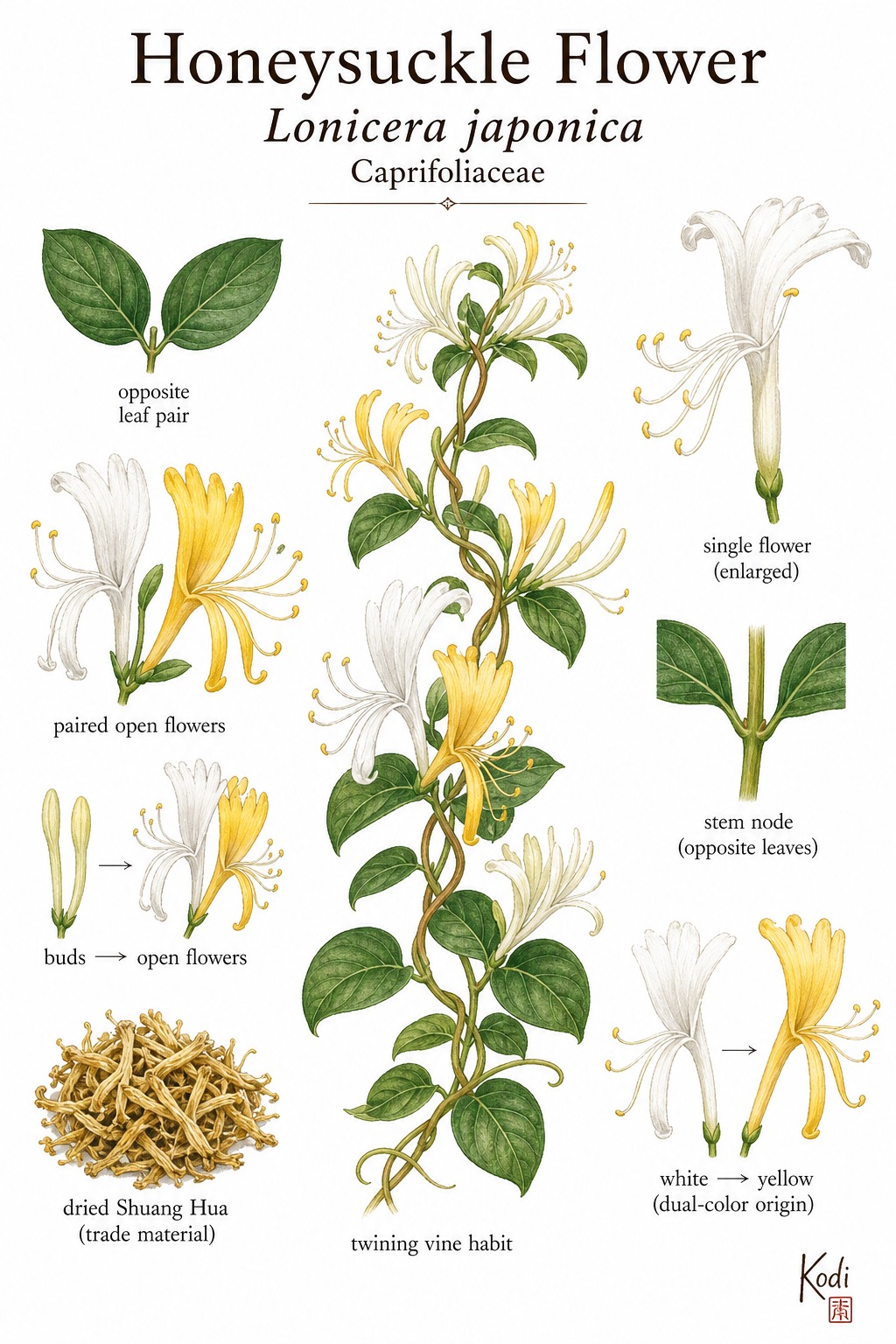
Known in TCM as Shuang Hua (双花), this sweet, cold herb enters the Lung, Heart, and Stomach. Traditionally, it clears heat and resolves toxicity - Shuang Hua carries the same core medicinal work as Jin Yin Hua for hot sores, throat swelling, furuncles, and febrile toxic patterns, most often applied for pharyngitis, upper respiratory infection, and furunculosis. Modern research has identified Chlorogenic among its active constituents.
Part used: Flower
Also Known As
Latin: Flos Lonicerae | Pinyin: Shuang Hua | Chinese: 双花
TCM Properties
- Taste
- sweet
- Temperature
- cold
- Channels
- Lung, Heart, Stomach
Traditional Use
Primary Actions
- Clears heat and resolves toxicity - Shuang Hua carries the same core medicinal work as Jin Yin Hua for hot sores, throat swelling, furuncles, and febrile toxic patterns.
- Disperses wind-heat - it is used in early exterior heat disorders with fever, sore throat, and thirst when the pathogen has not yet sunk deeply.
- Cools heat from the qi and blood levels - traditional use extends to toxic rashes, hot dysenteric presentations, and more intense internal heat patterns when paired appropriately.
Secondary Actions
- Shuang Hua is a very common synonym and trade name for Jin Yin Hua, referring to the white-and-yellow dual coloring of the flower rather than to a different basic crude drug.
- This sibling record preserves the synonym layer so the standard Jin Yin Hua page can remain the canonical textbook entry without flattening all market names into one label.
Classic Formulas
- Yin Qiao San - classic wind-heat formula where Shuang Hua functions exactly as the standard Jin Yin Hua medicament.
- Wu Wei Xiao Du Yin - toxin-clearing abscess formula emphasizing its strong heat-toxin role.
- New summer-heat or throat-swelling formulas often label the herb as Shuang Hua in dispensary or patent-medicine contexts even when the formula logic is the same.
Classical References
- Traditional and modern Chinese references treat Shuang Hua as a synonym of Jin Yin Hua, named for the bud's progression from white to yellow.
- Its medicinal identity remains the same sweet cold honeysuckle flower used to clear heat, resolve toxin, and vent wind-heat.
Modern Research
Active Compounds
- Chlorogenic acids - major quality-marker compounds tied to anti-inflammatory and antioxidant research
- Flavonoids such as luteoloside and lonicerin - important constituents in the flower's pharmacology profile
- Iridoids and secoiridoids - characteristic honeysuckle compounds tracked in quality-control work
- Polysaccharides - increasingly studied immune and functional fractions
Studied Effects
- A 2023 review summarized the structural characteristics and health-related applications of Lonicera japonica polysaccharides, reflecting the modern research depth behind the Shuang Hua / Jin Yin Hua medicinal track (PMID 37375383).
- A 2023 in vitro study reported antibacterial effects of Lonicera japonica against Bacillus cereus, providing preclinical support for the flower's long anti-infective reputation (PMID 37223411).
- A 2012 wound model study found Lonicera japonica extract promoted wound repair and reduced inflammation, aligning with classical toxin-clearing and sore-resolving use (PMID 23173654).
PubMed References
- Extraction, Purification, Structural Characteristics, Health Benefits, and Application of the Polysaccharides from Lonicera japonica Thunb.: A Review (2023)
- Lonicera japonica Thunb. as a promising antibacterial agent for Bacillus cereus ATCC14579 based on network pharmacology, metabolomics, and in vitro experiments (2023)
- Wound repair and anti-inflammatory potential of Lonicera japonica in excision wound-induced rats (2012)
Safety & Interactions
Contraindications
- Spleen-Stomach deficiency-cold with chronic loose stools
Cautions
- Although mild, Shuang Hua is still a cold herb and can weaken digestion if overused in patients without clear heat.
- The synonym name should not mislead users into treating all honeysuckle products as interchangeable in quality or dosage.
Conditions
- Pharyngitis Traditional ★★★★☆ JSON
- Upper Respiratory Infection Traditional ★★★★☆ JSON
- Furunculosis Traditional ★★★☆☆ JSON
- Breast Abscess Traditional ★★☆☆☆ JSON
Frequently Asked Questions
What is Honeysuckle Flower used for?
Honeysuckle Flower is traditionally used to Clears heat and resolves toxicity - Shuang Hua carries the same core medicinal work as Jin Yin Hua for hot sores, throat swelling, furuncles, and febrile toxic patterns., Disperses wind-heat - it is used in early exterior heat disorders with fever, sore throat, and thirst when the pathogen has not yet sunk deeply., Cools heat from the qi and blood levels - traditional use extends to toxic rashes, hot dysenteric presentations, and more intense internal heat patterns when paired appropriately.. Research has investigated its effects on: A 2023 review summarized the structural characteristics and health-related applications of Lonicera japonica polysaccharides, reflecting the modern research depth behind the Shuang Hua / Jin Yin Hua medicinal track (PMID 37375383).; A 2023 in vitro study reported antibacterial effects of Lonicera japonica against Bacillus cereus, providing preclinical support for the flower's long anti-infective reputation (PMID 37223411)..
What are other names for Honeysuckle Flower?
Honeysuckle Flower is also known as Lonicera, Jin Yin Hua, Double Flower Honeysuckle. In TCM: 双花 (Shuang Hua); Flos Lonicerae.
Is Honeysuckle Flower safe during pregnancy?
The safety of Honeysuckle Flower during pregnancy has not been established. Consult a qualified healthcare provider before use.
What are the contraindications for Honeysuckle Flower?
Honeysuckle Flower should not be used in: Spleen-Stomach deficiency-cold with chronic loose stools. Consult a qualified practitioner before use.