Honeysuckle Stem
- Chinese
- 忍冬藤
- Pinyin
- Ren Dong Teng
- Latin
- Caulis Lonicerae
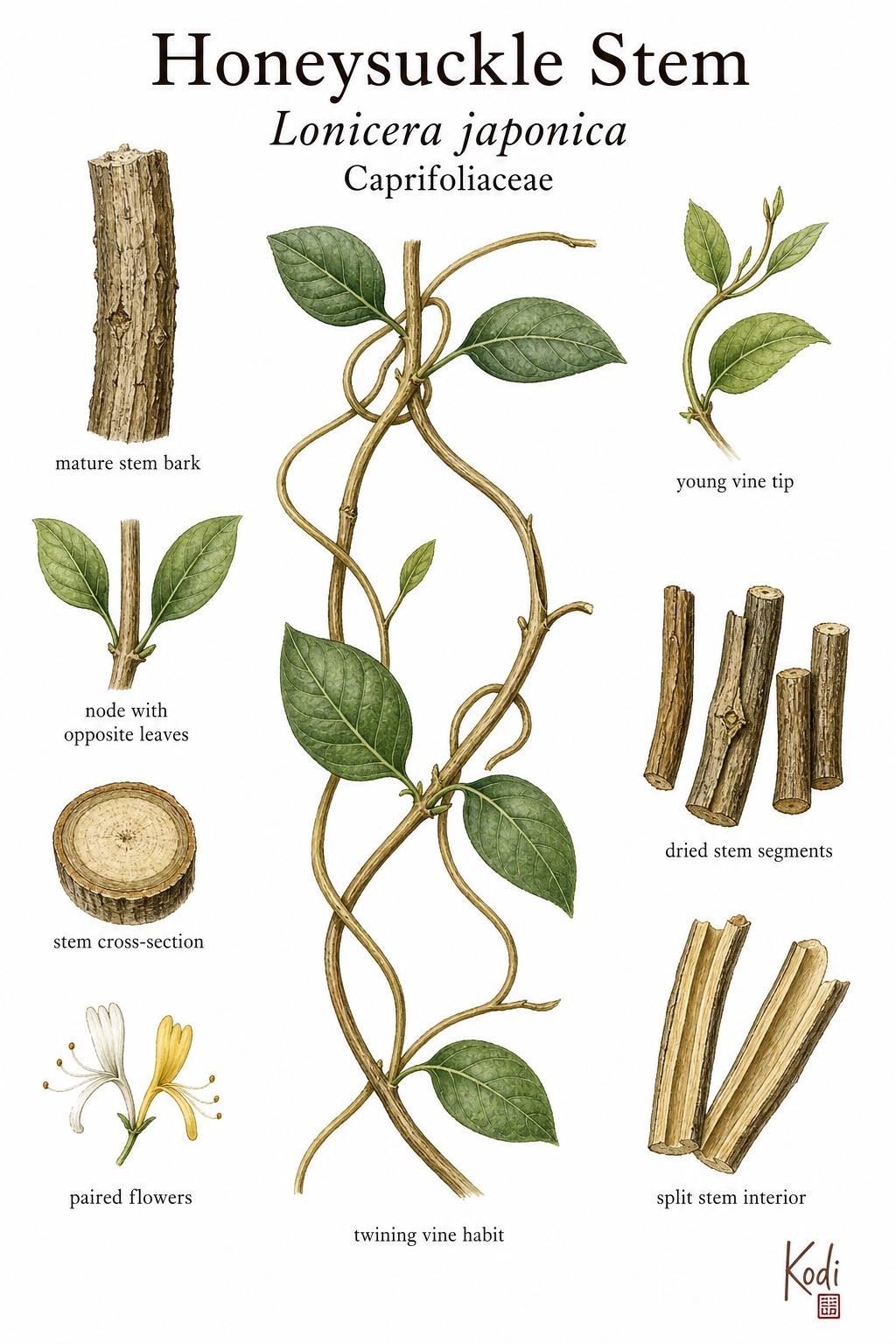
Known in TCM as Ren Dong Teng (忍冬藤), this sweet, cold herb enters the Heart and Lung. Traditionally, it clears heat and resolves toxicity - Ren Dong Teng is used for febrile disease, sore throat, heat-toxic dysentery, abscesses, and inflamed swellings, most often applied for joint pain, rheumatoid arthritis, and pharyngitis. Modern research has identified Chlorogenic among its active constituents.
Part used: Stem
Also Known As
Latin: Caulis Lonicerae | Pinyin: Ren Dong Teng | Chinese: 忍冬藤
TCM Properties
- Taste
- sweet
- Temperature
- cold
- Channels
- Heart, Lung
Traditional Use
Primary Actions
- Clears heat and resolves toxicity - Ren Dong Teng is used for febrile disease, sore throat, heat-toxic dysentery, abscesses, and inflamed swellings.
- Unblocks the channels and relieves wind-damp-heat pain - traditional use includes hot painful joints, red swollen obstruction, and aching limbs where heat and dampness are both present.
- Relieves restlessness from lingering heat - it may be used when heat disturbs the Heart with irritability or vexation, especially in warm-disease contexts.
Secondary Actions
- Compared with the flower, Ren Dong Teng is more channel-opening and less purely exterior-releasing, which is why it appears more often in hot painful obstruction and heat-in-the-collaterals settings.
- It preserves the toxin-clearing identity of the Lonicera plant while shifting the clinical center of gravity from the flower bud to the vine-and-stem medicament.
Classic Formulas
- Ren Dong Teng with Qin Jiao or Sang Zhi - traditional strategy for wind-damp-heat painful obstruction with red swollen joints.
- Heat-toxin formulas with Jin Yin Hua and Lian Qiao - used when sore throat, fever, or swelling require both flower and stem aspects of Lonicera.
- Dysenteric or abscess formulas in later clinical practice - applying the stem's cold toxin-clearing action where inflammation and heat predominate.
Classical References
- Official Chinese references describe Ren Dong Teng as sweet and cold, entering the Heart and Lung to clear heat, resolve toxicity, and unblock the channels.
- Traditional materia medica also note its use in wind-damp-heat painful obstruction and hot dysenteric conditions, showing a broader application than the flower alone.
Modern Research
Active Compounds
- Chlorogenic acid and isochlorogenic acids - major phenolic constituents relevant to anti-inflammatory action
- Biflavonoids such as ochnaflavone-related compounds - key functional substances highlighted in Caulis Lonicerae research
- Flavonoid glycosides - important anti-inflammatory and antioxidant constituents
- Iridoid-related fractions - supportive constituents in broader phytochemical profiling
Studied Effects
- A 2021 study found glycosides of Caulis Lonicerae inhibited IL-1beta-mediated inflammatory proliferation of synovial cells, supporting the traditional use of Ren Dong Teng in hot painful obstruction and joint inflammation (PMID 33484196).
- A 2020 paper on Lonicerae Japonicae Caulis identified anti-inflammatory activity and functional substances including biflavonoids and isochlorogenic acid, giving direct part-specific modern support to the stem record (PMID 33189843).
- Mechanistic work on chlorogenic acid, a primary constituent linked to Caulis Lonicerae, found apoptosis-inducing and anti-inflammatory effects in IL-6-induced synoviocytes, reinforcing the species' rheumatic-inflammatory relevance (PMID 27168850).
PubMed References
- Glycosides of Caulis Lonicerae inhibits the inflammatory proliferation of IL-1β-mediated fibroblast-like synovial cells cocultured with lymphocytes (2021)
- Anti-inflammatory property and functional substances of Lonicerae Japonicae Caulis (2020)
- Chlorogenic acid induces apoptosis to inhibit inflammatory proliferation of IL-6-induced fibroblast-like synoviocytes through modulating the activation of JAK/STAT and NF-κB signaling pathways (2016)
Safety & Interactions
Contraindications
- Marked deficiency-cold without a heat component
Cautions
- Ren Dong Teng is generally mild, but its cold nature can aggravate weak digestion if used inappropriately.
- Most modern evidence remains preclinical and part-specific rather than based on large clinical trials of the crude stem.
Conditions
- Joint Pain Traditional ★★★☆☆ JSON
- Rheumatoid Arthritis Research ★★☆☆☆ JSON
- Pharyngitis Traditional ★★☆☆☆ JSON
- Dysentery Traditional ★★☆☆☆ JSON
Frequently Asked Questions
What is Honeysuckle Stem used for?
Honeysuckle Stem is traditionally used to Clears heat and resolves toxicity - Ren Dong Teng is used for febrile disease, sore throat, heat-toxic dysentery, abscesses, and inflamed swellings., Unblocks the channels and relieves wind-damp-heat pain - traditional use includes hot painful joints, red swollen obstruction, and aching limbs where heat and dampness are both present., Relieves restlessness from lingering heat - it may be used when heat disturbs the Heart with irritability or vexation, especially in warm-disease contexts.. Research has investigated its effects on: A 2021 study found glycosides of Caulis Lonicerae inhibited IL-1beta-mediated inflammatory proliferation of synovial cells, supporting the traditional use of Ren Dong Teng in hot painful obstruction and joint inflammation (PMID 33484196).; A 2020 paper on Lonicerae Japonicae Caulis identified anti-inflammatory activity and functional substances including biflavonoids and isochlorogenic acid, giving direct part-specific modern support to the stem record (PMID 33189843)..
What are other names for Honeysuckle Stem?
Honeysuckle Stem is also known as Lonicera, Honeysuckle Vine. In TCM: 忍冬藤 (Ren Dong Teng); Caulis Lonicerae.
Is Honeysuckle Stem safe during pregnancy?
The safety of Honeysuckle Stem during pregnancy has not been established. Consult a qualified healthcare provider before use.
What are the contraindications for Honeysuckle Stem?
Honeysuckle Stem should not be used in: Marked deficiency-cold without a heat component. Consult a qualified practitioner before use.