Human Placenta
- Chinese
- 紫河车
- Pinyin
- Zi He Che
- Latin
- Placenta Hominis
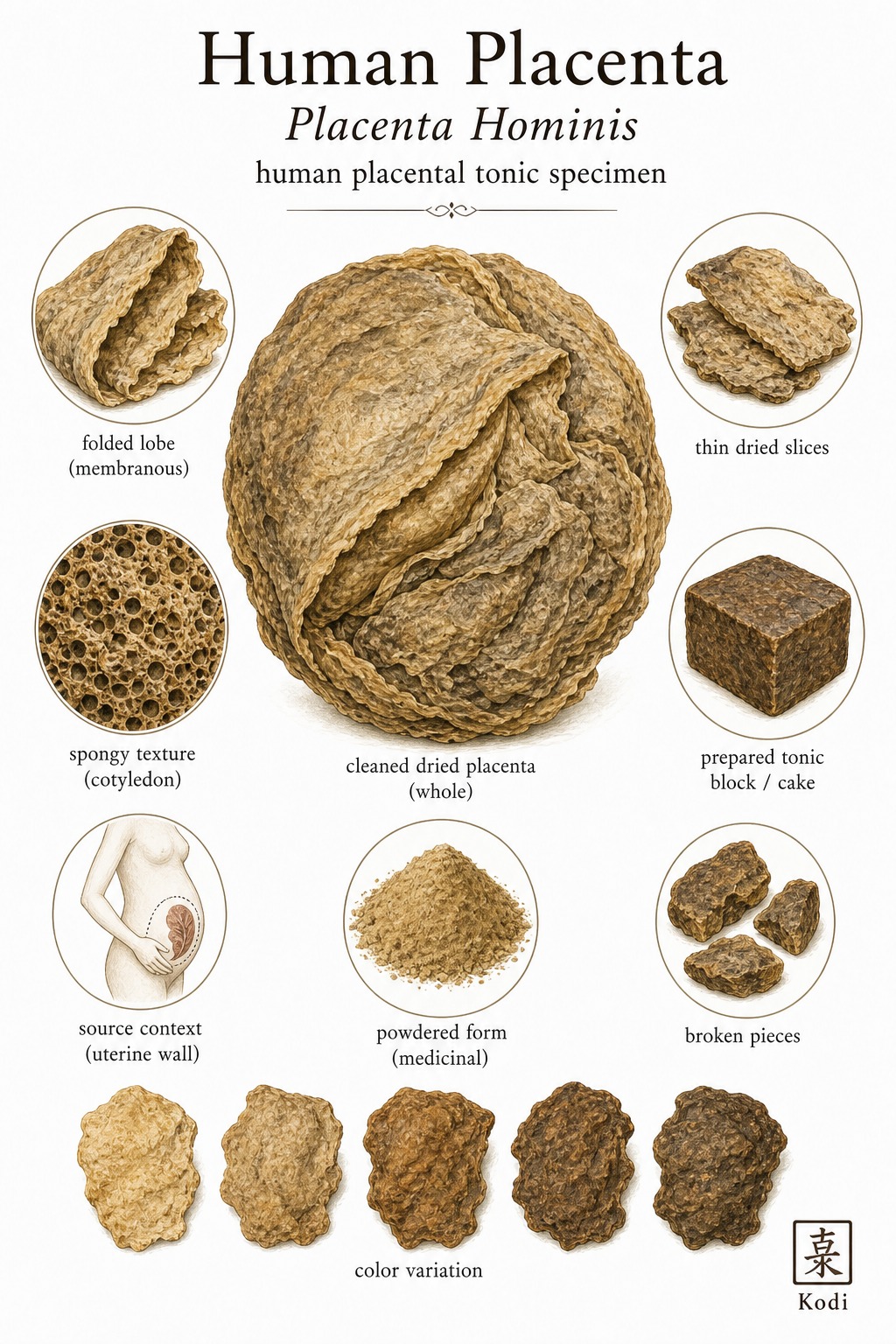
Known in TCM as Zi He Che (紫河车), this sweet and salty, warm herb enters the Lung, Liver, and Kidney. Traditionally, it tonifies Kidney essence and supports deep deficiency states - Zi He Che is a classic blood-and-flesh tonic for profound depletion with infertility, impotence, weak constitution, or wasting, most often applied for fatigue, infertility, and asthma. Modern research has identified Peptides among its active constituents.
Part used: Placenta
Also Known As
Latin: Placenta Hominis | Pinyin: Zi He Che | Chinese: 紫河车
TCM Properties
- Taste
- sweet, salty
- Temperature
- warm
- Channels
- Lung, Liver, Kidney
Traditional Use
Primary Actions
- Tonifies Kidney essence and supports deep deficiency states - Zi He Che is a classic blood-and-flesh tonic for profound depletion with infertility, impotence, weak constitution, or wasting.
- Augments qi and nourishes blood - older use includes chronic exhaustion, poor complexion, shortness of breath, and failure to recover after long illness or constitutional weakness.
- Tonifies Lung and Kidney to help grasp qi - traditional indications include chronic deficiency cough, wheezing, or consumptive weakness rather than acute excess heat lung disease.
Secondary Actions
- This is one of the clearest examples of a historical tonic whose modern ethical, legal, and infectious-risk profile sharply limits any casual continuation of old crude-drug practice.
- The 2015 edition of the Chinese Pharmacopoeia removed Zi He Che, and modern discussion should foreground provenance and safety rather than romanticize it as an ordinary deficiency tonic.
Classic Formulas
- He Che Da Zao Wan - a classic placenta-centered deficiency tonic strategy used historically for severe wasting and constitutional depletion.
- Zi He Che Wan - generic historical naming pattern for placenta-based deep-tonification formulas.
- Pairing with Ren Shen, Lu Rong, or Dong Chong Xia Cao - traditional logic for severe Lung-Kidney depletion, infertility, or chronic deficiency wheezing.
Classical References
- Modern official Chinese references still describe Zi He Che as sweet, salty, and warm, entering the Lung, Liver, and Kidney to warm the Kidney, supplement essence, augment qi, and nourish blood.
- These same sources now also note the legal and ethical limits around placenta trade and the major safety concerns that led to its removal from the 2015 Chinese Pharmacopoeia.
- Historically powerful reputation does not erase modern sourcing, consent, and pathogen-control concerns.
Modern Research
Active Compounds
- Peptides and protein hydrolysate fractions - major marketed biologic components of processed placenta extracts
- Amino acids, nucleotides, and small bioactive metabolites - commonly cited supportive constituents
- Growth-factor-like and cytokine-modulating fractions - part of the rationale for regenerative and anti-inflammatory research
- Lipids, minerals, and other variable biologic material - highly dependent on screening and processing standards
Studied Effects
- A randomized placebo-controlled trial reported that subcutaneous human placental extract improved some chronic fatigue syndrome outcomes, but this reflects standardized injectable extract rather than routine crude Zi He Che dispensing (PMID 26911970).
- A 2024 mouse study found that human placenta hydrolysate reduced inflammatory pain markers and allodynia in a CFA-induced model, which is mechanistically interesting but still preclinical (PMID 39338341).
- A 2024 atopic-dermatitis model study reported anti-inflammatory effects from human placenta extract in HaCaT cells and DNCB-treated mice, again pointing to processed extract research rather than validating unsupervised crude medicinal use (PMID 39252632).
PubMed References
- Human Placental Extract as a Subcutaneous Injection Is Effective in Chronic Fatigue Syndrome: A Multi-Center, Double-Blind, Randomized, Placebo-Controlled Study. (2016)
- Analgesic Effect of Human Placenta Hydrolysate on CFA-Induced Inflammatory Pain in Mice. (2024)
- Human Placenta Extract (HPH) Suppresses Inflammatory Responses in TNF-alpha/IFN-gamma-Stimulated HaCaT Cells and a DNCB Atopic Dermatitis (AD)-Like Mouse Model. (2024)
Safety & Interactions
Contraindications
- Unverified human-tissue sources
- Heat, fire, or damp-heat excess patterns rather than deep deficiency
- Pregnancy, fertility treatment, or postpartum use without specialist supervision
- Any setting in which infection-control, consent, or legal provenance cannot be confirmed
Cautions
- Placenta-derived material raises unusually serious ethical, legal, infectious, and contamination concerns.
- Chinese official references note that private trade in placenta is illegal and that Zi He Che was removed from the 2015 Chinese Pharmacopoeia because of safety concerns.
- Modern extract research does not justify self-sourcing or unsupervised use of crude human placenta.
Conditions
Frequently Asked Questions
What is Human Placenta used for?
Human Placenta is traditionally used to Tonifies Kidney essence and supports deep deficiency states - Zi He Che is a classic blood-and-flesh tonic for profound depletion with infertility, impotence, weak constitution, or wasting., Augments qi and nourishes blood - older use includes chronic exhaustion, poor complexion, shortness of breath, and failure to recover after long illness or constitutional weakness., Tonifies Lung and Kidney to help grasp qi - traditional indications include chronic deficiency cough, wheezing, or consumptive weakness rather than acute excess heat lung disease.. Research has investigated its effects on: A randomized placebo-controlled trial reported that subcutaneous human placental extract improved some chronic fatigue syndrome outcomes, but this reflects standardized injectable extract rather than routine crude Zi He Che dispensing (PMID 26911970).; A 2024 mouse study found that human placenta hydrolysate reduced inflammatory pain markers and allodynia in a CFA-induced model, which is mechanistically interesting but still preclinical (PMID 39338341)..
What are other names for Human Placenta?
Human Placenta is also known as Placenta Hominis, Human Placental Material. In TCM: 紫河车 (Zi He Che); Placenta Hominis.
Is Human Placenta safe during pregnancy?
The safety of Human Placenta during pregnancy has not been established. Consult a qualified healthcare provider before use.
What are the contraindications for Human Placenta?
Human Placenta should not be used in: Unverified human-tissue sources; Heat, fire, or damp-heat excess patterns rather than deep deficiency; Pregnancy, fertility treatment, or postpartum use without specialist supervision; Any setting in which infection-control, consent, or legal provenance cannot be confirmed. Consult a qualified practitioner before use.