Hypoglaucous Collett Yam Rhizome
- Chinese
- 粉萆薢
- Pinyin
- Fen Bi Xie
- Latin
- Rhizoma Dioscoreae Hypoglaucae
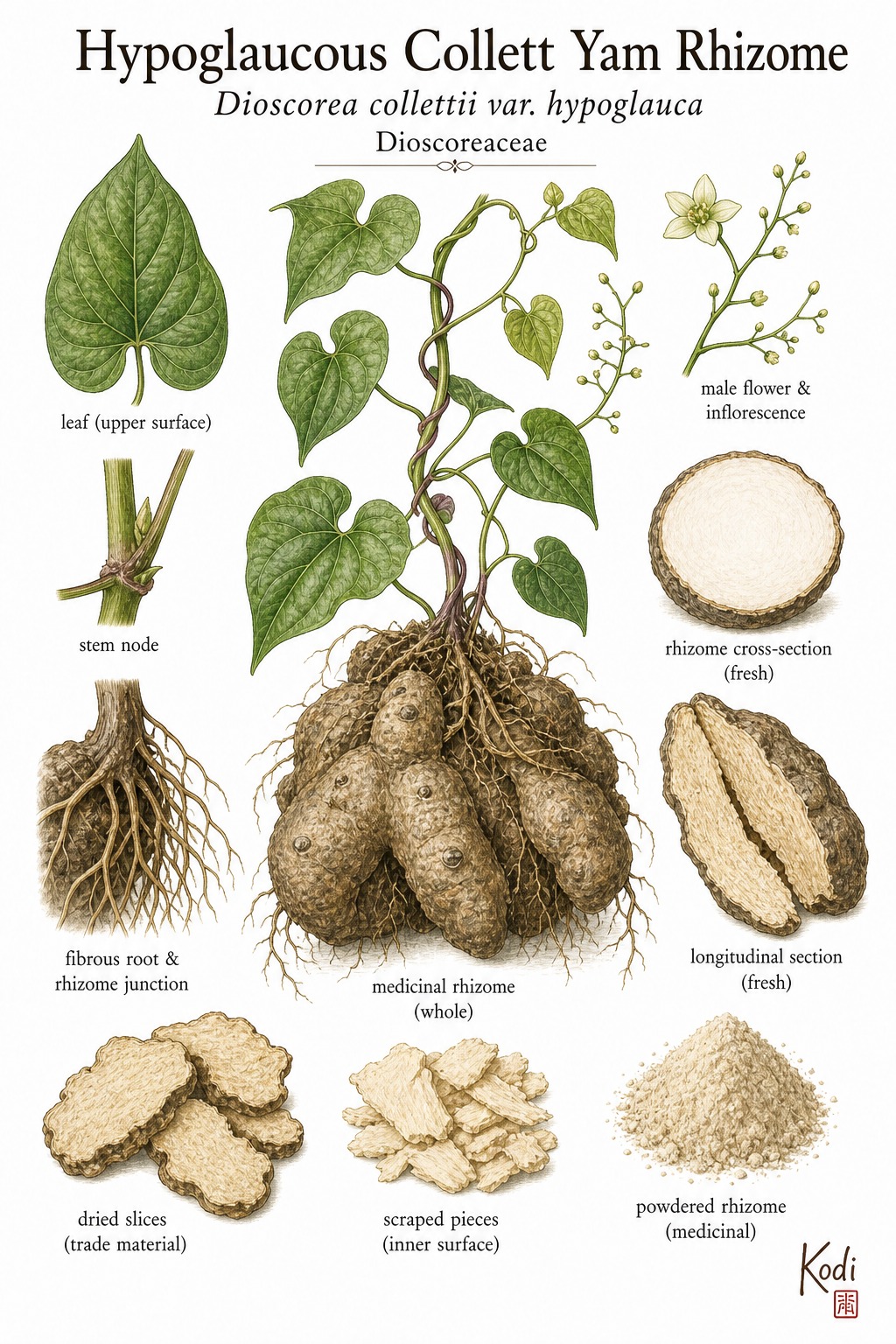
Known in TCM as Fen Bi Xie (粉萆薢), this bitter, neutral herb enters the Kidney and Stomach. Traditionally, it separates the clear from the turbid and drains dampness - Fen Bi Xie is used for cloudy urine, white turbidity, persistent damp leukorrhea, and other lower-burner damp conditions, most often applied for leukorrhea, frequent urination, and rheumatism. Modern research has identified Steroidal among its active constituents.
Part used: Rhizome
Also Known As
Latin: Rhizoma Dioscoreae Hypoglaucae | Pinyin: Fen Bi Xie | Chinese: 粉萆薢
TCM Properties
- Taste
- bitter
- Temperature
- neutral
- Channels
- Kidney, Stomach
Traditional Use
Primary Actions
- Separates the clear from the turbid and drains dampness - Fen Bi Xie is used for cloudy urine, white turbidity, persistent damp leukorrhea, and other lower-burner damp conditions.
- Dispels wind-damp and relieves painful obstruction - textbook usage extends to heavy, fixed, or swollen joint pain, especially when dampness is prominent.
- Helps resolve damp-toxic skin patterns - older and modern teaching both include damp sores, eczema, and moist toxic lesions in its range.
Secondary Actions
- This page is intentionally anchored to the specific powder-form identity from Dioscorea hypoglauca rather than collapsing all Bi Xie trade names into one record.
- It should be read alongside, not instead of, later sibling entries such as the broader Bi Xie and Mian Bi Xie pages.
Classic Formulas
- Bi Xie Fen Qing Yin - classic formula context for cloudy urine and lower-burner turbidity in which Bi Xie is the signature herb.
- Fen Bi Xie with Yi Zhi Ren and Shi Chang Pu - pairing logic for frequent cloudy urination with deficiency and damp obstruction.
- Fen Bi Xie with Huang Bai, Ren Dong Teng, or Fang Ji - damp-heat or painful-obstruction strategy when urinary turbidity overlaps with swollen painful joints.
Classical References
- Official Chinese references state that both Mian Bi Xie and Fen Bi Xie are bitter and neutral, entering the Kidney and Stomach to dispel damp turbidity and relieve painful obstruction.
- Traditional discussion repeatedly emphasizes white turbidity, leukorrhea, and damp-heavy joint pain rather than simple dry urinary irritation.
- Because several species circulate under the name Bi Xie, identity control matters.
Modern Research
Active Compounds
- Steroidal saponins including dioscin and related sapogenins - the best-known modern candidates in Bi Xie pharmacology
- Diosgenin-forming saponin fractions - frequently discussed in anti-inflammatory and uric-acid research
- Tannins and starch - supportive traditional crude-drug constituents
- Proteins and minor phenolic constituents - less emphasized than the saponin fraction
Studied Effects
- A 2021 study found that total saponins of Dioscorea collettii attenuated monosodium urate crystal-induced inflammation through suppression of TLR4/NF-kappaB signaling, supporting the gout and damp-bi research bridge around Bi Xie materials (PMID 34721647).
- An earlier experimental paper reported that total saponins of Dioscorea improved hyperuricemia-related parameters in animal models, reinforcing the species group's modern uric-acid interest (PMID 16437741).
- A 2016 rat study showed that total saponins from Dioscorea septemloba lowered serum uric acid through transporter regulation, which is useful comparative evidence but still not the same as direct clinical proof for Fen Bi Xie (PMID 27072969).
PubMed References
- Total Saponin of Dioscorea collettii Attenuates MSU Crystal-Induced Inflammation by Inhibiting the Activation of the TLR4/NF-kappaB Signaling Pathway. (2021)
- Effect and mechanism of total saponin of Dioscorea on animal experimental hyperuricemia. (2005)
- Total saponins from dioscorea septemloba thunb reduce serum uric acid levels in rats with hyperuricemia through OATP1A1 up-regulation. (2016)
Safety & Interactions
Contraindications
- Marked yin deficiency with dryness and depletion rather than damp turbidity
Cautions
- Fen Bi Xie is drying enough that long-term use can be a poor fit for people with pronounced fluid deficiency.
- Several different species circulate under the Bi Xie name, so substitution and identity confusion are real concerns.
- Most of the gout and hyperuricemia literature remains preclinical or species-group based rather than direct human evidence for this exact crude drug.
Conditions
- Leukorrhea Traditional ★★★★☆ JSON
- Frequent Urination Traditional ★★☆☆☆ JSON
- Rheumatism Traditional ★★★☆☆ JSON
- Eczema Traditional ★★☆☆☆ JSON
Frequently Asked Questions
What is Hypoglaucous Collett Yam Rhizome used for?
Hypoglaucous Collett Yam Rhizome is traditionally used to Separates the clear from the turbid and drains dampness - Fen Bi Xie is used for cloudy urine, white turbidity, persistent damp leukorrhea, and other lower-burner damp conditions., Dispels wind-damp and relieves painful obstruction - textbook usage extends to heavy, fixed, or swollen joint pain, especially when dampness is prominent., Helps resolve damp-toxic skin patterns - older and modern teaching both include damp sores, eczema, and moist toxic lesions in its range.. Research has investigated its effects on: A 2021 study found that total saponins of Dioscorea collettii attenuated monosodium urate crystal-induced inflammation through suppression of TLR4/NF-kappaB signaling, supporting the gout and damp-bi research bridge around Bi Xie materials (PMID 34721647).; An earlier experimental paper reported that total saponins of Dioscorea improved hyperuricemia-related parameters in animal models, reinforcing the species group's modern uric-acid interest (PMID 16437741)..
What are other names for Hypoglaucous Collett Yam Rhizome?
Hypoglaucous Collett Yam Rhizome is also known as Powder Bixie, Dioscorea Hypoglauca Rhizome. In TCM: 粉萆薢 (Fen Bi Xie); Rhizoma Dioscoreae Hypoglaucae.
Is Hypoglaucous Collett Yam Rhizome safe during pregnancy?
The safety of Hypoglaucous Collett Yam Rhizome during pregnancy has not been established. Consult a qualified healthcare provider before use.
What are the contraindications for Hypoglaucous Collett Yam Rhizome?
Hypoglaucous Collett Yam Rhizome should not be used in: Marked yin deficiency with dryness and depletion rather than damp turbidity. Consult a qualified practitioner before use.