Ilex Rotunda Bark
- Chinese
- 救必应
- Pinyin
- Jiu Bi Ying
- Latin
- Ilicis Rotundae Cortex
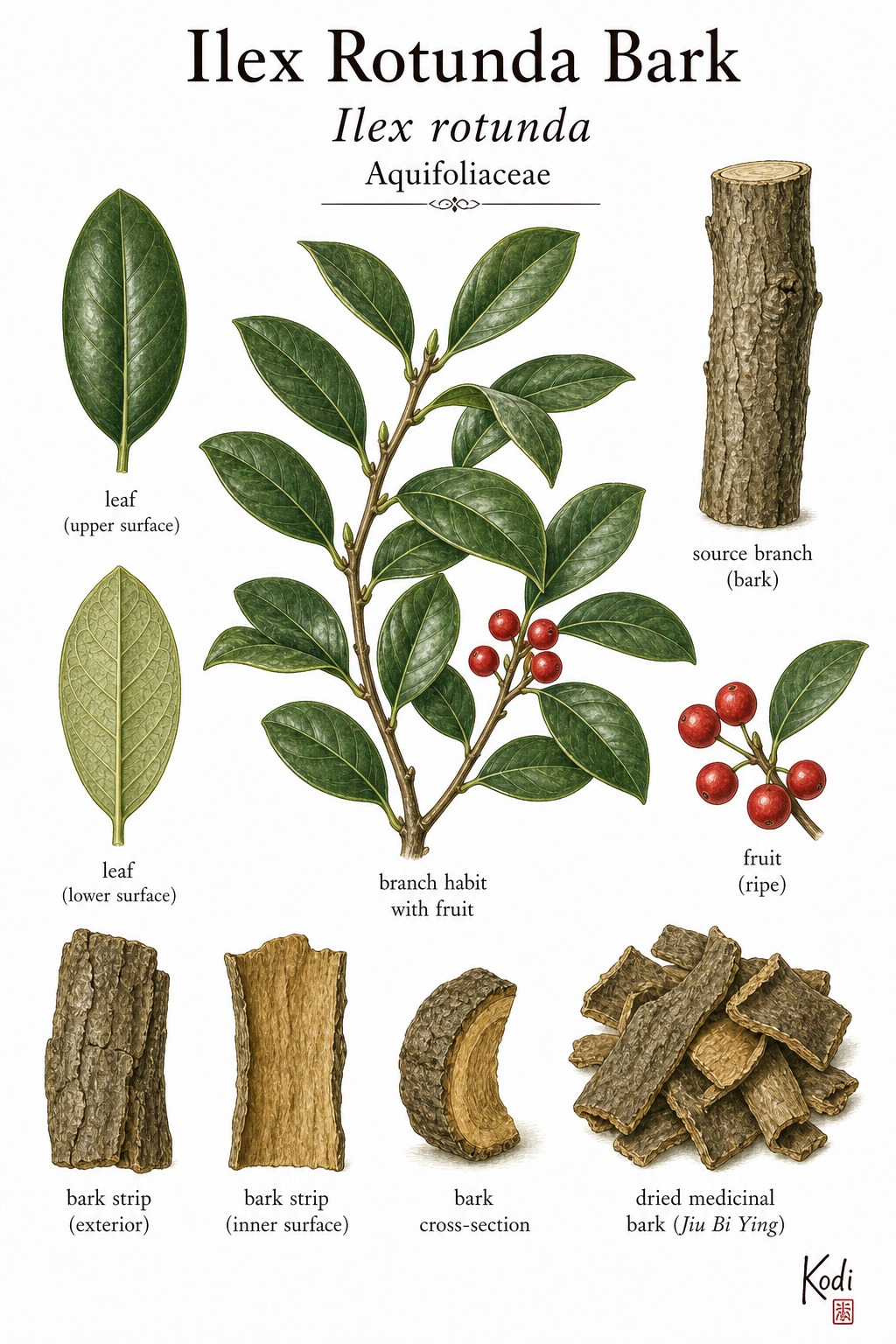
Known in TCM as Jiu Bi Ying (救必应), this bitter, cold herb enters the Lung, Stomach, Large Intestine, and Liver. Traditionally, it clears heat and resolves toxin - Jiu Bi Ying is used for sore throat, hot dysentery, damp-heat skin eruptions, and swollen painful toxic lesions, most often applied for pharyngitis, dysentery, and eczema. Modern research has identified Triterpenes among its active constituents.
Also Known As
Latin: Ilicis Rotundae Cortex | Pinyin: Jiu Bi Ying | Chinese: 救必应
TCM Properties
- Taste
- bitter
- Temperature
- cold
- Channels
- Lung, Stomach, Large Intestine, Liver
Traditional Use
Primary Actions
- Clears heat and resolves toxin - Jiu Bi Ying is used for sore throat, hot dysentery, damp-heat skin eruptions, and swollen painful toxic lesions.
- Drains dampness and relieves pain - the bark is also used for damp-heat abdominal pain, joint pain, traumatic swelling, and painful obstruction with redness or inflammation.
- Cools the blood and reduces swelling - regional usage includes decoctions, washes, or poultices for boils, eczema, and bruised or inflamed tissue.
Secondary Actions
- This is an Ilex bark medicine, not a culinary illicium spice. The stub's English label was misleading and has been corrected so it does not collapse into star-anise style material.
- Jiu Bi Ying is much more regionally familiar in South China than in everyday export-dispensary TCM, so modern indexed evidence is still thinner than its local reputation might suggest.
Classic Formulas
- Jiu Bi Ying with Mu Xiang or Bai Tou Weng - regional dysentery strategy when damp-heat and toxic heat produce abdominal pain, tenesmus, or bloody stool.
- Jiu Bi Ying with Man Jing Zi or Ban Lan Gen - throat-swelling and wind-heat pairing logic for red painful throat with toxic heat.
- Topical washes or poultices with Ku Shen or Huang Bai - damp-heat skin strategy for eczema, sores, and moist inflamed lesions.
Classical References
- Official Chinese references describe Jiu Bi Ying as bitter and cold, entering the Lung, Stomach, Large Intestine, and Liver to clear heat, detoxify, dispel dampness, and relieve pain.
- The standard traditional indications include pharyngitis, dysentery, eczema, painful joints, and traumatic injury with swelling.
- Its strongest identity is as a heat-toxic and damp-heat bark rather than as a general tonic or harmonizing herb.
Modern Research
Active Compounds
- Triterpenes such as rotundic-acid-related constituents - major anti-inflammatory candidates discussed in Ilex rotunda bark research
- Phenolic acids and flavonoids - supportive antioxidant and anti-inflammatory constituents
- Saponins and glycosides - repeatedly profiled in bark chemistry work
- Tannins - part of the bark's traditional astringent and anti-inflammatory interpretation
Studied Effects
- A 2022 analysis of Ilex rotunda bark constituents reported anti-inflammatory activity from isolated compounds, supporting the herb's traditional toxic-heat and swollen-pain indications while remaining preclinical (PMID 35616360).
- A 2023 pharmacology study suggested that Ilex rotunda Thunb may protect against ulcerative colitis through anti-inflammatory and barrier-supportive mechanisms, which is relevant to the dysentery and intestinal-heat tradition but still experimental (PMID 37541404).
- A 2020 metabolomics-based rat study found lipid-lowering and anti-obesity effects from Ilex rotunda extract, broadening the species research map even though that is not the classical core use of Jiu Bi Ying bark (PMID 32222573).
PubMed References
- Anti-inflammatory Constituents from the Barks of Ilex rotunda. (2022)
- Ilex rotunda Thunb protects against ulcerative colitis by modulating inflammatory cytokines and intestinal barrier function. (2023)
- Lipid-lowering effect of Ilex rotunda extract in high-fat diet-induced obese rats through metabolomics. (2020)
Safety & Interactions
Contraindications
- Stomach yin deficiency or pronounced cold-deficiency digestive weakness
Cautions
- Its cold bitter profile can be a poor fit for chronic loose stool or abdominal cold without damp-heat or toxic heat.
- Most modern evidence remains preclinical and should not be over-read as proof for serious infectious or inflammatory disease treatment.
- Regional bark medicines are especially vulnerable to source substitution, so authenticated material matters.
Conditions
- Pharyngitis Traditional ★★★☆☆ JSON
- Dysentery Traditional ★★★☆☆ JSON
- Eczema Traditional ★★☆☆☆ JSON
- Joint Pain Traditional ★★☆☆☆ JSON
- Traumatic Injury Traditional ★★☆☆☆ JSON
Frequently Asked Questions
What is Ilex Rotunda Bark used for?
Ilex Rotunda Bark is traditionally used to Clears heat and resolves toxin - Jiu Bi Ying is used for sore throat, hot dysentery, damp-heat skin eruptions, and swollen painful toxic lesions., Drains dampness and relieves pain - the bark is also used for damp-heat abdominal pain, joint pain, traumatic swelling, and painful obstruction with redness or inflammation., Cools the blood and reduces swelling - regional usage includes decoctions, washes, or poultices for boils, eczema, and bruised or inflamed tissue.. Research has investigated its effects on: A 2022 analysis of Ilex rotunda bark constituents reported anti-inflammatory activity from isolated compounds, supporting the herb's traditional toxic-heat and swollen-pain indications while remaining preclinical (PMID 35616360).; A 2023 pharmacology study suggested that Ilex rotunda Thunb may protect against ulcerative colitis through anti-inflammatory and barrier-supportive mechanisms, which is relevant to the dysentery and intestinal-heat tradition but still experimental (PMID 37541404)..
What are other names for Ilex Rotunda Bark?
Ilex Rotunda Bark is also known as Rotunda Holly Bark, Jiubiying. In TCM: 救必应 (Jiu Bi Ying); Ilicis Rotundae Cortex.
Is Ilex Rotunda Bark safe during pregnancy?
The safety of Ilex Rotunda Bark during pregnancy has not been established. Consult a qualified healthcare provider before use.
What are the contraindications for Ilex Rotunda Bark?
Ilex Rotunda Bark should not be used in: Stomach yin deficiency or pronounced cold-deficiency digestive weakness. Consult a qualified practitioner before use.