Immature Bitter Orange Fruit
- Chinese
- 枳实
- Pinyin
- Zhi Shi
- Latin
- Fructus Aurantii Immaturus
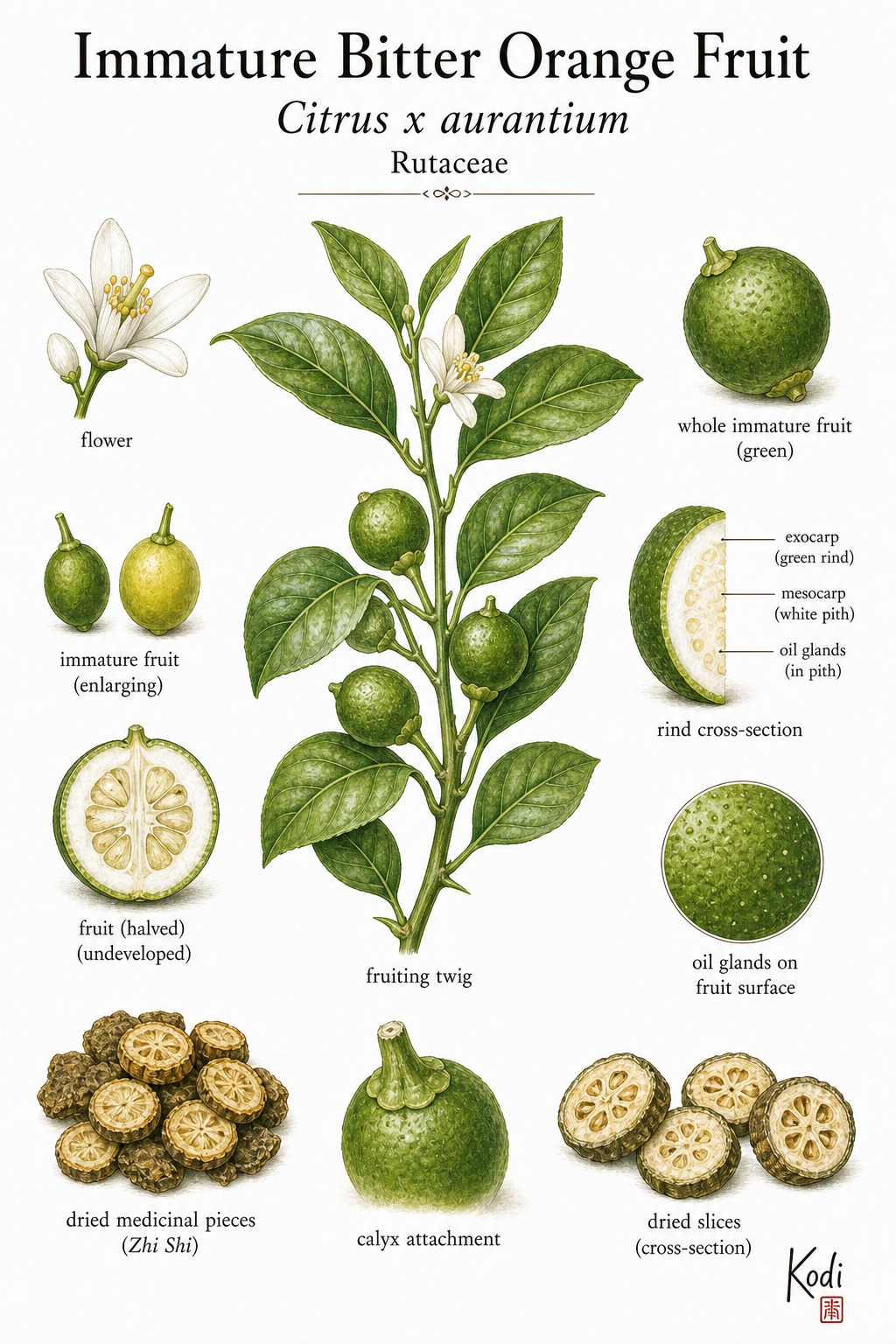
Known in TCM as Zhi Shi (枳实), this bitter and pungent and sour, slightly cold herb enters the Spleen and Stomach. Traditionally, it breaks up stagnant qi and reduces accumulation - Zhi Shi is a strong descending citrus used when fullness, focal distention, food retention, or hard obstructive digestive stagnation is pronounced, most often applied for dyspepsia, abdominal distension, and constipation. Modern research has identified p-Synephrine among its active constituents.
Part used: Fruit
Also Known As
Latin: Fructus Aurantii Immaturus | Pinyin: Zhi Shi | Chinese: 枳实
TCM Properties
- Taste
- bitter, pungent, sour
- Temperature
- slightly cold
- Channels
- Spleen, Stomach
Traditional Use
Primary Actions
- Breaks up stagnant qi and reduces accumulation - Zhi Shi is a strong descending citrus used when fullness, focal distention, food retention, or hard obstructive digestive stagnation is pronounced.
- Transforms phlegm and disperses focal obstruction - it is classically used for chest bind, phlegm-qi congestion, and pressure or pain under the diaphragm and in the chest.
- Directs qi downward and assists bowel opening - formulas use it when constipation, post-meal fullness, or even organ prolapse reflect impaired descent with excess stagnation.
Secondary Actions
- Zhi Shi is the stronger, more breaking immature-fruit sibling to Zhi Qiao. That distinction matters clinically: Zhi Qiao regulates, Zhi Shi forcefully descends.
- Concentrated bitter-orange supplements sold for energy or weight loss should not be treated as equivalent to ordinary Zhi Shi decoction pieces.
Classic Formulas
- Zhi Zhu Wan - classic pairing with Bai Zhu for focal distention, reduced appetite, and middle-burner blockage.
- Zhi Shi Xiao Pi Wan - later formula tradition for pi fullness and severe epigastric obstruction with weak digestive transformation.
- Zhi Shi Xie Bai Gui Zhi Tang or Hou Pu San Wu Tang - chest-obstruction and abdominal-fullness formula contexts where Zhi Shi's strongly descending action is central.
Classical References
- Official Chinese references describe Zhi Shi as bitter, pungent, sour, and slightly cold, entering the Spleen and Stomach to break qi, eliminate accumulation, transform phlegm, and dissipate focal distention.
- Traditional materia medica consistently contrasts it with mature Zhi Qiao, emphasizing that Zhi Shi is harsher, more forceful, and more strongly descending.
- Its classical indications include food stagnation, constipation, chest bind, and prolapse formulas where excess obstruction is prominent.
Modern Research
Active Compounds
- p-Synephrine - the protoalkaloid most discussed in cardiovascular and metabolic bitter-orange literature
- Naringin and neohesperidin - major flavonoid glycosides in immature Citrus aurantium fruit
- Volatile oils including limonene-rich fractions - aromatic compounds relevant to digestive and antimicrobial research
- Other citrus flavonoids and alkaloid-like amines - supportive constituents in motility and metabolism studies
Studied Effects
- A 2024 multicenter randomized study reported that aurantii fructus immaturus granules improved functional dyspepsia symptoms and appeared non-inferior to domperidone over four weeks, offering unusual clinical support for a classical Zhi Shi digestive indication (PMID 39745035).
- A 2024 study found that total flavonoids from Aurantii Fructus Immaturus improved constipation in mice through microbiota and barrier-function pathways, which fits the herb's traditional descending-qi use while remaining preclinical (PMID 40979483).
- A 2017 pharmacokinetic study found that Aurantii Fructus Immaturus modulated intestinal P-glycoprotein and CYP3A4 expression, reinforcing the need to take drug-interaction potential seriously with concentrated extracts (PMID 28270768).
PubMed References
- Evaluating the Efficacy of Aurantii Fructus Immaturus Granules in Functional Dyspepsia Treatment: A Multicenter, Randomized, Double-Blind, Double-Simulated, Domperidone-Controlled Non-Inferiority Study. (2024)
- Total flavonoids of Aurantii Fructus Immaturus improve constipation through modulating gut microbiota, intestinal barrier function and inflammation. (2024)
- Effect of Aurantii Fructus Immaturus Flavonoid on the Intestinal Absorption of Coadministrated Drugs and Expression of Efflux Transporters and CYP3A4 in Rats. (2017)
Safety & Interactions
Contraindications
- Pregnancy without qualified supervision
- Marked qi deficiency, prolapse, or digestive weakness without true stagnation
Cautions
- Because Zhi Shi is strongly descending and moving, it is easier to overuse than gentler citrus regulators such as Zhi Qiao or Chen Pi.
- Weight-loss or stimulant bitter-orange extracts can deliver far higher p-synephrine exposure than traditional decoction use.
- Medication review matters when concentrated bitter-orange products are used because transport and metabolism effects have been reported.
Drug Interactions
- CYP3A4 or P-gp substrate drugs - concentrated bitter-orange extracts may alter intestinal handling and drug exposure
- Stimulants or caffeine-containing products - combined use may increase palpitations, blood pressure, or sympathetic stimulation
Conditions
- Dyspepsia Clinical ★★★☆☆ JSON
- Abdominal Distension Traditional ★★★★☆ JSON
- Constipation Research ★★★☆☆ JSON
- Chest Pain Traditional ★★★☆☆ JSON
Frequently Asked Questions
What is Immature Bitter Orange Fruit used for?
Immature Bitter Orange Fruit is traditionally used to Breaks up stagnant qi and reduces accumulation - Zhi Shi is a strong descending citrus used when fullness, focal distention, food retention, or hard obstructive digestive stagnation is pronounced., Transforms phlegm and disperses focal obstruction - it is classically used for chest bind, phlegm-qi congestion, and pressure or pain under the diaphragm and in the chest., Directs qi downward and assists bowel opening - formulas use it when constipation, post-meal fullness, or even organ prolapse reflect impaired descent with excess stagnation.. Research has investigated its effects on: A 2024 multicenter randomized study reported that aurantii fructus immaturus granules improved functional dyspepsia symptoms and appeared non-inferior to domperidone over four weeks, offering unusual clinical support for a classical Zhi Shi digestive indication (PMID 39745035).; A 2024 study found that total flavonoids from Aurantii Fructus Immaturus improved constipation in mice through microbiota and barrier-function pathways, which fits the herb's traditional descending-qi use while remaining preclinical (PMID 40979483)..
What are other names for Immature Bitter Orange Fruit?
Immature Bitter Orange Fruit is also known as Aurantii Fructus Immaturus, Zhishi. In TCM: 枳实 (Zhi Shi); Fructus Aurantii Immaturus.
Is Immature Bitter Orange Fruit safe during pregnancy?
The safety of Immature Bitter Orange Fruit during pregnancy has not been established. Consult a qualified healthcare provider before use.
What are the contraindications for Immature Bitter Orange Fruit?
Immature Bitter Orange Fruit should not be used in: Pregnancy without qualified supervision; Marked qi deficiency, prolapse, or digestive weakness without true stagnation. Consult a qualified practitioner before use.
Does Immature Bitter Orange Fruit interact with any medications?
Immature Bitter Orange Fruit may interact with: CYP3A4 or P-gp substrate drugs - concentrated bitter-orange extracts may alter intestinal handling and drug exposure; Stimulants or caffeine-containing products - combined use may increase palpitations, blood pressure, or sympathetic stimulation. Always inform your healthcare provider of any herbal supplements you are taking.