Poria
- Chinese
- 茯苓
- Pinyin
- Fu Ling
- Latin
- Poria
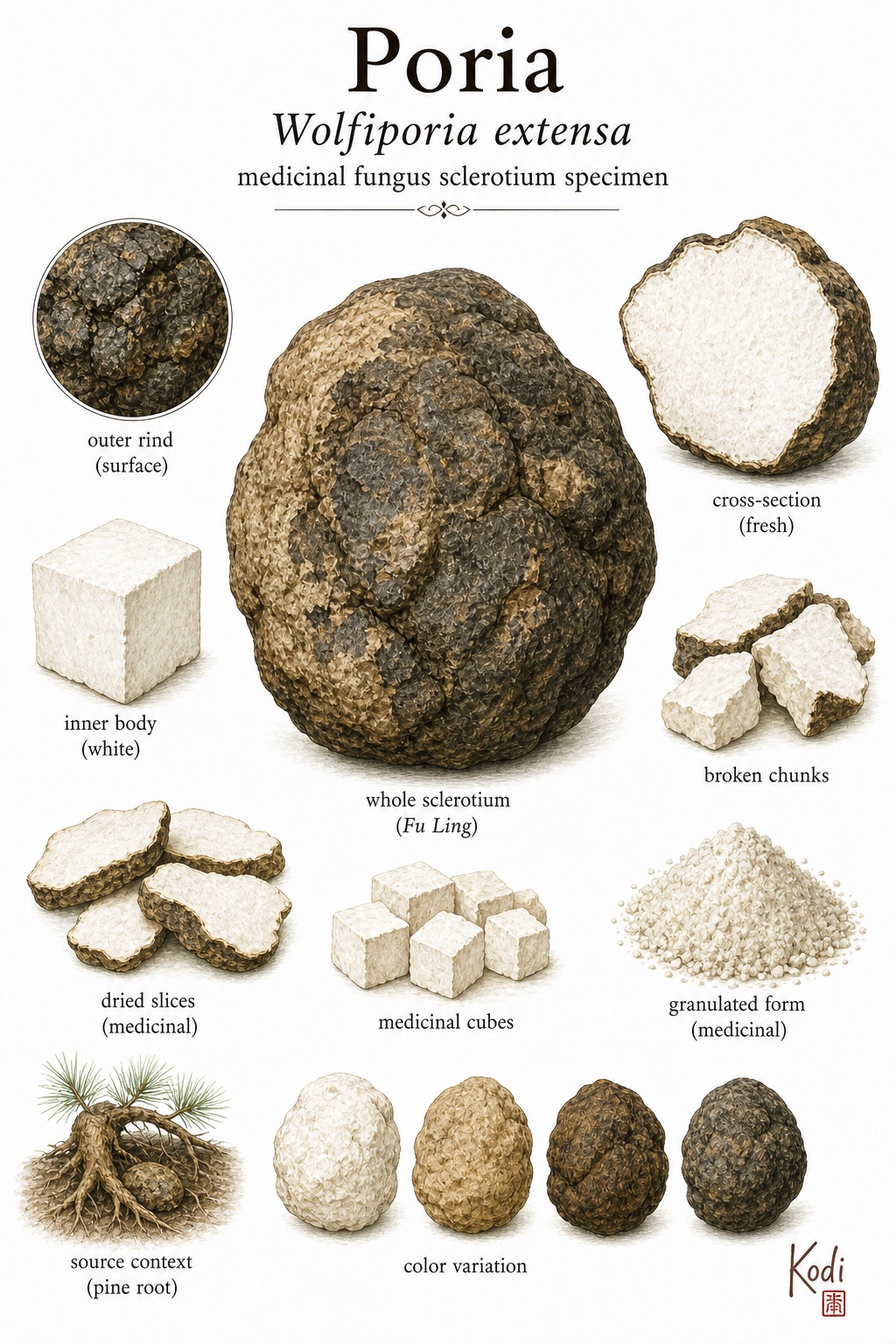
Known in TCM as Fu Ling (茯苓), this sweet and bland, neutral herb enters the Heart, Lung, Spleen, and Kidney. Traditionally, it promotes urination and leaches out dampness - Fu Ling is a foundational gentle damp-draining fungus for edema, urinary difficulty, dizziness from retained fluids, and water accumulation without harsh injury to the qi, most often applied for edema, diarrhea, and insomnia. Modern research has identified Poria among its active constituents.
Part used: Sclerotium (fungus)
Also Known As
Latin: Poria | Pinyin: Fu Ling | Chinese: 茯苓
TCM Properties
- Taste
- sweet, bland
- Temperature
- neutral
- Channels
- Heart, Lung, Spleen, Kidney
Traditional Use
Primary Actions
- Promotes urination and leaches out dampness - Fu Ling is a foundational gentle damp-draining fungus for edema, urinary difficulty, dizziness from retained fluids, and water accumulation without harsh injury to the qi.
- Strengthens the Spleen and supports transformation - it is used for loose stool, poor appetite, digestive weakness, and lingering damp obstruction that reflects weak transport rather than only excess heat.
- Calms the Heart and quiets the spirit - textbook usage includes palpitations, insomnia, and restlessness when deficiency and phlegm-damp disturb the Shen.
Secondary Actions
- Fu Ling is the canonical whole sclerotium page in this family. It should not be collapsed into the regional synonym `Yun Ling`, the edema-focused peel `Fu Ling Pi`, or the spirit-calming pine-root portion `Fu Shen`.
- Its great value in formulas is gentleness: it drains, supports digestion, and calms without being either strongly bitter-cold or heavily cloying.
Classic Formulas
- Wu Ling San - classic water-metabolism formula where Fu Ling helps move dampness and support urination.
- Shen Ling Bai Zhu San - foundational Spleen-deficiency and damp-diarrhea formula in which Fu Ling both supports digestion and drains excess damp.
- Ling Gui Zhu Gan Tang or Gui Pi Tang - formula contexts that highlight its roles in dizziness from retained fluids and spirit disturbance from deficiency.
Classical References
- Official Chinese references describe Fu Ling as sweet, bland, and neutral, entering the Heart, Lung, Spleen, and Kidney to promote urination, strengthen the Spleen, and calm the mind.
- Traditional teaching treats Fu Ling as one of the most versatile ways to remove dampness without overcooling or exhausting the patient.
- Part-specific entries such as Fu Ling Pi and Fu Shen are understood as specialization within the same medicinal material family rather than as different plants.
Modern Research
Active Compounds
- Poria polysaccharides - the best-known immunomodulatory and gut-focused research fraction
- Triterpenoids such as pachymic acid and poricoic acids - signature lipophilic constituents in broad Poria pharmacology
- Ergosterol and sterol derivatives - supportive fungal constituents with anti-inflammatory interest
- Adenosine and related small metabolites - minor compounds relevant to sedative and metabolic discussion
Studied Effects
- A 2011 review summarized the pharmacological activities of Poria cocos, including diuretic, sedative, anti-inflammatory, immunomodulatory, and antitumor research themes, helping explain why Fu Ling remains such a broad modern-interest medicinal fungus (PMID 21347995).
- A 2022 review focused on pachymic acid and described anti-inflammatory, antitumor, neuroprotective, and sedative-hypnotic potential, although much of that work still remains preclinical (PMID 35978941).
- A 2023 review of water-soluble and alkaline-soluble polysaccharides highlighted continuing interest in Fu Ling's immune, gut, metabolic, and supportive health effects while also underscoring major differences between fractions and preparations (PMID 36871682).
PubMed References
- Pharmacological activities of Wolfiporia extensa (Poria cocos): a review. (2011)
- Progress in Pharmacology, Toxicology, and Pharmaceutical Developments of Pachymic Acid: A Review. (2022)
- A review of chemical structures and health effects of water-soluble and alkaline-soluble polysaccharides from Poria cocos. (2023)
Safety & Interactions
Contraindications
- Profound fluid depletion or yin dryness without damp retention
- Clear qi sinking or prolapse without dampness or phlegm
Cautions
- Fu Ling is generally gentle, but long-term heavy use may be a poor fit for people who are already very dry and depleted.
- Modern Poria extracts and supplements can be far more concentrated or fraction-specific than ordinary decoction pieces.
- Because the research literature often studies isolated polysaccharides or triterpenes, results do not always map cleanly onto crude-herb dosing.
Conditions
Frequently Asked Questions
What is Poria used for?
Poria is traditionally used to Promotes urination and leaches out dampness - Fu Ling is a foundational gentle damp-draining fungus for edema, urinary difficulty, dizziness from retained fluids, and water accumulation without harsh injury to the qi., Strengthens the Spleen and supports transformation - it is used for loose stool, poor appetite, digestive weakness, and lingering damp obstruction that reflects weak transport rather than only excess heat., Calms the Heart and quiets the spirit - textbook usage includes palpitations, insomnia, and restlessness when deficiency and phlegm-damp disturb the Shen.. Research has investigated its effects on: A 2011 review summarized the pharmacological activities of Poria cocos, including diuretic, sedative, anti-inflammatory, immunomodulatory, and antitumor research themes, helping explain why Fu Ling remains such a broad modern-interest medicinal fungus (PMID 21347995).; A 2022 review focused on pachymic acid and described anti-inflammatory, antitumor, neuroprotective, and sedative-hypnotic potential, although much of that work still remains preclinical (PMID 35978941)..
What are other names for Poria?
Poria is also known as Poria Cocos, Hoelen. In TCM: 茯苓 (Fu Ling); Poria.
Is Poria safe during pregnancy?
The safety of Poria during pregnancy has not been established. Consult a qualified healthcare provider before use.
What are the contraindications for Poria?
Poria should not be used in: Profound fluid depletion or yin dryness without damp retention; Clear qi sinking or prolapse without dampness or phlegm. Consult a qualified practitioner before use.