Yunnan Poria
- Chinese
- 云苓
- Pinyin
- Yun Ling
- Latin
- Sclerotium Poriae Cocos
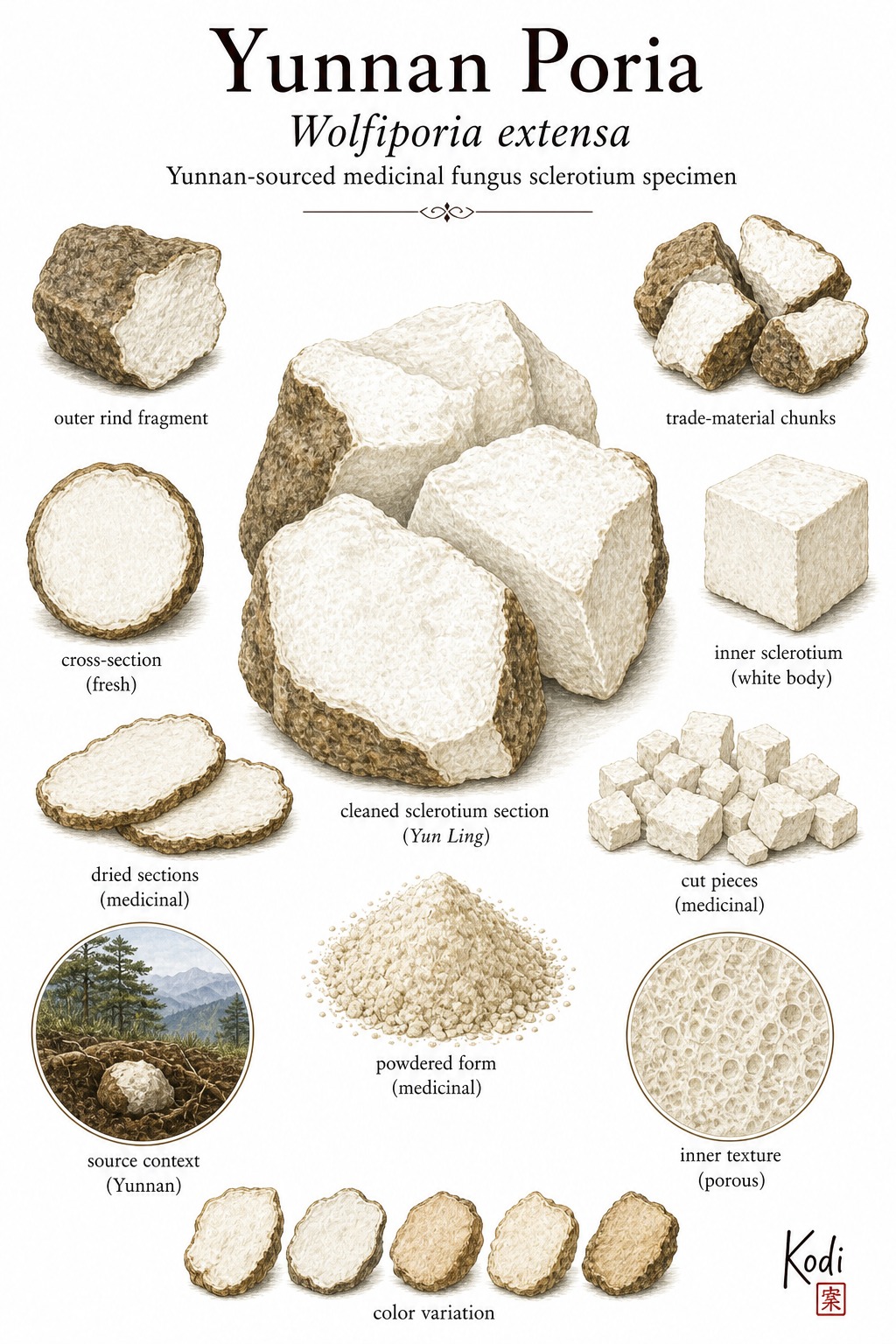
Known in TCM as Yun Ling (云苓), this sweet and bland, neutral herb enters the Heart, Lung, Spleen, and Kidney. Traditionally, it promotes urination and drains dampness - Yun Ling is used the same way as standard Fu Ling for edema, water retention, dizziness from dampness, and urinary sluggishness, most often applied for edema, diarrhea, and insomnia. Modern research has identified Poria among its active constituents.
Part used: Sclerotium
Also Known As
Latin: Sclerotium Poriae Cocos | Pinyin: Yun Ling | Chinese: 云苓
TCM Properties
- Taste
- sweet, bland
- Temperature
- neutral
- Channels
- Heart, Lung, Spleen, Kidney
Traditional Use
Primary Actions
- Promotes urination and drains dampness - Yun Ling is used the same way as standard Fu Ling for edema, water retention, dizziness from dampness, and urinary sluggishness.
- Strengthens the Spleen and helps stop diarrhea - it supports weak digestion with loose stool, poor appetite, and lingering dampness.
- Calms the mind gently - like Fu Ling, it appears in formulas for palpitations, disturbed sleep, and deficiency-pattern restlessness when dampness or phlegm also play a role.
Secondary Actions
- Yun Ling is best understood as a regional or trade-style name for Fu Ling, especially Yunnan-sourced material, rather than as a fundamentally different medicinal fungus.
- This page preserves the naming layer already present in the queue while keeping its function aligned with canonical Fu Ling instead of inventing a false pharmacologic split.
Classic Formulas
- Wu Ling San - the same classic water-metabolism context used for standard Fu Ling.
- Shen Ling Bai Zhu San - digestive-deficiency and damp-diarrhea context where Yun Ling performs the familiar Fu Ling job.
- Spirit-calming formulas such as Gui Pi Tang - examples of why Yun Ling and Fu Ling are often treated as interchangeable in practice.
Classical References
- Chinese reference sources commonly explain that Yun Ling is another name for Fu Ling, usually emphasizing origin or trade naming rather than a separate classic identity.
- Its taste, temperature, channels, and main functions are therefore described in the same way as standard Fu Ling.
- The more meaningful clinical differentiations in this family are part-based ones such as Fu Ling Pi and Fu Shen.
Modern Research
Active Compounds
- Poria polysaccharides - major immunomodulatory and gut-health research fraction
- Pachymic acid and related triterpenoids - lipophilic constituents prominent in pharmacology reviews
- Ergosterol and other fungal sterols - supportive constituents in anti-inflammatory discussion
- Part- and origin-sensitive metabolite profiles - relevant because Yun Ling is partly a sourcing label
Studied Effects
- The broader Poria literature summarized in a 2011 review describes diuretic, sedative, immunomodulatory, anti-inflammatory, and antitumor activity, which applies to Yun Ling only because it is fundamentally a Fu Ling naming variant rather than a different herb (PMID 21347995).
- A 2022 pachymic-acid review reinforced ongoing interest in sedative-hypnotic and anti-inflammatory mechanisms from Poria triterpenes, though most evidence remains preclinical (PMID 35978941).
- A 2019 study comparing different medicinal parts of Poria cocos showed measurable chemical differences across sections, which helps explain why origin labels such as Yun Ling matter less than part labels such as Fu Ling Pi or Fu Shen for actual functional specialization (PMID 31816475).
PubMed References
- Pharmacological activities of Wolfiporia extensa (Poria cocos): a review. (2011)
- Progress in Pharmacology, Toxicology, and Pharmaceutical Developments of Pachymic Acid: A Review. (2022)
- Carbohydrate profiles and preliminary comparison of the health effects of different medicinal parts of Poria cocos. (2019)
Safety & Interactions
Contraindications
- Profound fluid depletion or yin dryness without dampness
Cautions
- Yun Ling should be understood as a naming or sourcing variant of Fu Ling, so modern supplement claims that treat it as a distinct premium pharmacology category should be viewed cautiously.
- As with Fu Ling generally, highly concentrated extracts may behave differently from ordinary decoction pieces.
- Most modern evidence is still based on whole-species or fraction research rather than human trials comparing Yun Ling against other sourcing regions.
Conditions
Frequently Asked Questions
What is Yunnan Poria used for?
Yunnan Poria is traditionally used to Promotes urination and drains dampness - Yun Ling is used the same way as standard Fu Ling for edema, water retention, dizziness from dampness, and urinary sluggishness., Strengthens the Spleen and helps stop diarrhea - it supports weak digestion with loose stool, poor appetite, and lingering dampness., Calms the mind gently - like Fu Ling, it appears in formulas for palpitations, disturbed sleep, and deficiency-pattern restlessness when dampness or phlegm also play a role.. Research has investigated its effects on: The broader Poria literature summarized in a 2011 review describes diuretic, sedative, immunomodulatory, anti-inflammatory, and antitumor activity, which applies to Yun Ling only because it is fundamentally a Fu Ling naming variant rather than a different herb (PMID 21347995).; A 2022 pachymic-acid review reinforced ongoing interest in sedative-hypnotic and anti-inflammatory mechanisms from Poria triterpenes, though most evidence remains preclinical (PMID 35978941)..
What are other names for Yunnan Poria?
Yunnan Poria is also known as Fu Ling, Yunling. In TCM: 云苓 (Yun Ling); Sclerotium Poriae Cocos.
Is Yunnan Poria safe during pregnancy?
The safety of Yunnan Poria during pregnancy has not been established. Consult a qualified healthcare provider before use.
What are the contraindications for Yunnan Poria?
Yunnan Poria should not be used in: Profound fluid depletion or yin dryness without dampness. Consult a qualified practitioner before use.