Poria Peel
- Chinese
- 茯苓皮
- Pinyin
- Fu Ling Pi
- Latin
- Poriae Cutis
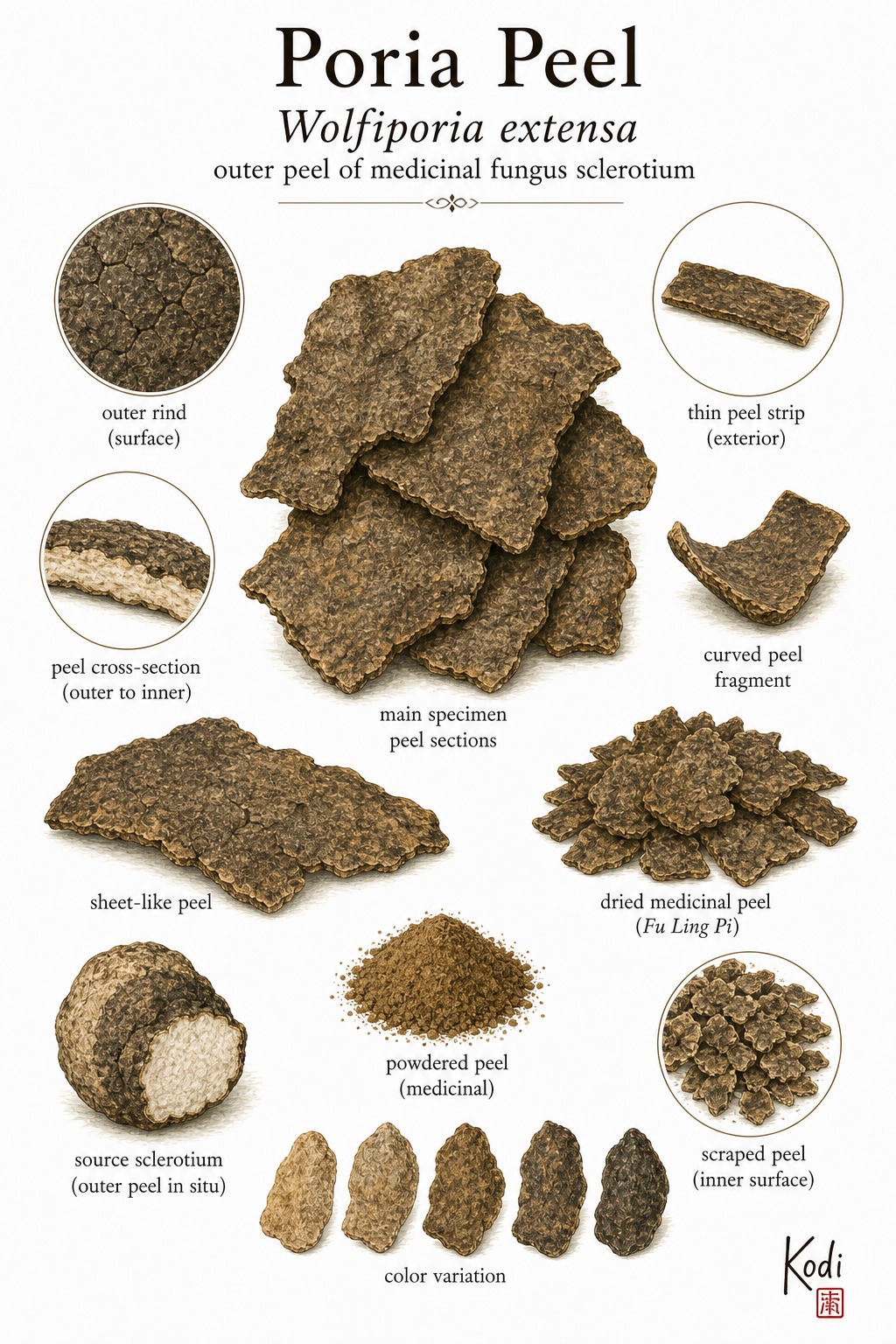
Known in TCM as Fu Ling Pi (茯苓皮), this sweet and bland, neutral herb enters the Lung, Spleen, and Kidney. Traditionally, it promotes urination and reduces edema - Fu Ling Pi specializes in moving superficial and generalized water swelling downward, especially puffy skin and edema of the face or limbs, most often applied for edema, frequent urination, and abdominal distension. Modern research has identified Part-specific among its active constituents.
Part used: Sclerotium (fungus)
Also Known As
Latin: Poriae Cutis | Pinyin: Fu Ling Pi | Chinese: 茯苓皮
TCM Properties
- Taste
- sweet, bland
- Temperature
- neutral
- Channels
- Lung, Spleen, Kidney
Traditional Use
Primary Actions
- Promotes urination and reduces edema - Fu Ling Pi specializes in moving superficial and generalized water swelling downward, especially puffy skin and edema of the face or limbs.
- Opens the water pathways more directly than the inner sclerotium - compared with whole Fu Ling, the peel is less about digestion and Shen support and more about visible edema and damp retention.
- Supports qi-moving edema formulas - it is often combined with other peels and damp-draining herbs when swelling, distention, and sluggish water movement predominate.
Secondary Actions
- This is the part-specific outer peel of the Poria material, not just a duplicate of Fu Ling. In practice it narrows the family toward edema rather than toward Spleen support or calming the mind.
- Because it is milder and more superficial, Fu Ling Pi is often chosen when the goal is steady fluid movement rather than strong purgation or harsh diuresis.
Classic Formulas
- Wu Pi San - classic five-peel formula in which Fu Ling Pi helps reduce generalized edema and promote urination.
- Fu Ling Pi with Da Fu Pi and Sheng Jiang Pi - common edema-focused pairing for puffy swelling and damp water retention.
- Formulas for ascitic or abdominal water distention often use Fu Ling Pi when the skin and body surface look visibly burdened with retained fluid.
Classical References
- Official Chinese references describe Fu Ling Pi as sweet, bland, and neutral, entering the Lung, Spleen, and Kidney to promote urination and reduce edema.
- Traditional explanation consistently contrasts it with the inner Poria body: the peel is more edema-directed, while the interior has broader Spleen and Shen actions.
- Its main indications are edema, puffiness, and difficult water movement rather than palpitations or insomnia.
Modern Research
Active Compounds
- Part-specific polysaccharide fractions - different from the inner sclerotium profile
- Triterpenoids including pachymic-acid-related compounds - present across Poria parts in different proportions
- Carbohydrate-rich cell-wall material - relevant to part-comparison research
- Minor fungal sterols and metabolites - supportive constituents in broader Poria pharmacology
Studied Effects
- A 2013 study found that the epidermis of Poria cocos had diuretic activity and showed part-dependent differences compared with other Poria sections, directly supporting why Fu Ling Pi is treated as the edema-focused portion (PMID 24184192).
- A 2019 comparison of different medicinal parts of Poria cocos reported distinct carbohydrate profiles and preliminary health-effect differences, reinforcing the rationale for separate monographs within the Fu Ling family (PMID 31816475).
- Broader Poria review literature continues to support diuretic and anti-inflammatory interest in the species, but most studies remain part-group or experimental rather than direct clinical trials on Fu Ling Pi alone (PMID 21347995).
PubMed References
Safety & Interactions
Contraindications
- Pronounced dryness or fluid depletion without retained dampness
Cautions
- Although gentle, Fu Ling Pi is still a fluid-moving herb and can be a poor fit for people who are already very dry or depleted.
- Part-specific research is growing, but direct human clinical evidence for Fu Ling Pi alone is still limited.
- Commercial Poria extracts often do not specify whether they are made from whole sclerotium, peel, or another section.
Conditions
- Edema Traditional ★★★★☆ JSON
- Frequent Urination Traditional ★★☆☆☆ JSON
- Abdominal Distension Traditional ★★☆☆☆ JSON
Frequently Asked Questions
What is Poria Peel used for?
Poria Peel is traditionally used to Promotes urination and reduces edema - Fu Ling Pi specializes in moving superficial and generalized water swelling downward, especially puffy skin and edema of the face or limbs., Opens the water pathways more directly than the inner sclerotium - compared with whole Fu Ling, the peel is less about digestion and Shen support and more about visible edema and damp retention., Supports qi-moving edema formulas - it is often combined with other peels and damp-draining herbs when swelling, distention, and sluggish water movement predominate.. Research has investigated its effects on: A 2013 study found that the epidermis of Poria cocos had diuretic activity and showed part-dependent differences compared with other Poria sections, directly supporting why Fu Ling Pi is treated as the edema-focused portion (PMID 24184192).; A 2019 comparison of different medicinal parts of Poria cocos reported distinct carbohydrate profiles and preliminary health-effect differences, reinforcing the rationale for separate monographs within the Fu Ling family (PMID 31816475)..
What are other names for Poria Peel?
Poria Peel is also known as Poria Skin, Ling Pi. In TCM: 茯苓皮 (Fu Ling Pi); Poriae Cutis.
Is Poria Peel safe during pregnancy?
The safety of Poria Peel during pregnancy has not been established. Consult a qualified healthcare provider before use.
What are the contraindications for Poria Peel?
Poria Peel should not be used in: Pronounced dryness or fluid depletion without retained dampness. Consult a qualified practitioner before use.