Poria with Pine Root
- Chinese
- 茯神
- Pinyin
- Fu Shen
- Latin
- Poria Cum Radice Pini
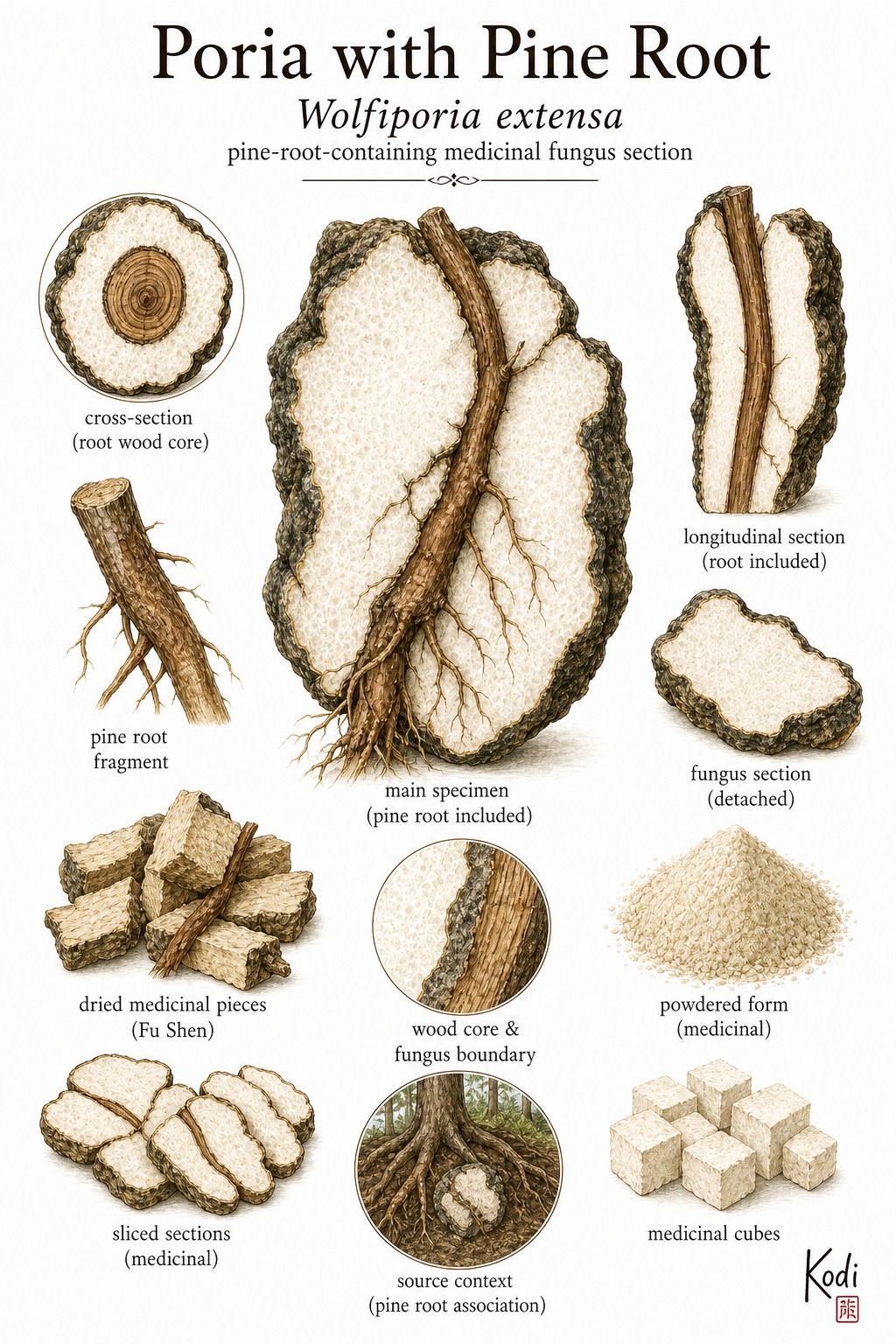
Known in TCM as Fu Shen (茯神), this sweet and bland, neutral herb enters the Heart and Spleen. Traditionally, it calms the Heart and quiets the spirit - Fu Shen is best known for palpitations, insomnia, fright, poor memory, and restlessness when the Shen is unsettled by deficiency or phlegm-damp, most often applied for insomnia, palpitations, and anxiety. Modern research has identified Poria among its active constituents.
Part used: Sclerotium (fungus)
Also Known As
Latin: Poria Cum Radice Pini | Pinyin: Fu Shen | Chinese: 茯神
TCM Properties
- Taste
- sweet, bland
- Temperature
- neutral
- Channels
- Heart, Spleen
Traditional Use
Primary Actions
- Calms the Heart and quiets the spirit - Fu Shen is best known for palpitations, insomnia, fright, poor memory, and restlessness when the Shen is unsettled by deficiency or phlegm-damp.
- Strengthens the Spleen gently - because it remains a Poria material, it also supports digestion and damp transformation, though less prominently than standard Fu Ling.
- Addresses spirit disturbance without heavy sedation - classical use often suits constitutional irritability, poor sleep, or forgetfulness that coexist with deficiency and dampness.
Secondary Actions
- Fu Shen is the pine-root-containing portion of the Poria material family. Its defining difference from Fu Ling is the added Shen-calming emphasis, not a completely separate species or chemistry.
- This page should also remain distinct from the later `Fu Shen Mu` hostwood record, which is a different medicinal section and not just a second name for Fu Shen.
Classic Formulas
- Zhu Que Wan - spirit-calming formula context in which Fu Shen supports sleep, memory, and Heart stability.
- Fu Shen Wan - classical naming pattern for formulas centered on insomnia, palpitations, and deficiency agitation.
- Fu Shen Tang or pairings with Yuan Zhi and Long Gu - traditional strategy for fright palpitations, insomnia, and poor concentration.
Classical References
- Official Chinese references describe Fu Shen as sweet, bland, and neutral, entering the Heart and Spleen to calm the mind while supporting the middle.
- Traditional teaching consistently treats it as the spirit-focused specialization within the Fu Ling family.
- Its indications center on insomnia, palpitations, fright, and forgetfulness rather than on edema as the first priority.
Modern Research
Active Compounds
- Poria polysaccharides - shared immunomodulatory and supportive fungal fraction
- Pachymic acid and related triterpenoids - broad Poria pharmacology constituents with sedative-hypnotic interest
- Volatile compounds associated with the pine-root-containing section - increasingly studied for part-specific differentiation
- Fungal sterols and small metabolites - supportive constituents in broader neuroactive and anti-inflammatory discussion
Studied Effects
- A 2011 review of Poria cocos pharmacology described sedative activity alongside diuretic, anti-inflammatory, and immune effects, which helps explain why Fu Shen evolved as the Shen-calming specialization of the family (PMID 21347995).
- A 2022 pachymic-acid review summarized anti-inflammatory, neuroprotective, and sedative-hypnotic potential from a major Poria triterpenoid, supporting the modern bridge for Fu Shen's calming reputation while remaining largely preclinical (PMID 35978941).
- A 2025 part-comparison study reported distinct volatile compounds in Poria cum radice pini and suggested anxiolytic or sedative relevance for constituents such as l-perillaldehyde and linalool, offering useful but still early support for Fu Shen's traditional niche (PMID 41994219).
PubMed References
- Pharmacological activities of Wolfiporia extensa (Poria cocos): a review. (2011)
- Progress in Pharmacology, Toxicology, and Pharmaceutical Developments of Pachymic Acid: A Review. (2022)
- Comparative analysis of volatile organic compounds in different parts of Poria cocos as potential food-derived health products and targeted quantification of key components in Poria cum radice pini. (2025)
Safety & Interactions
Contraindications
- Pronounced kidney insecurity with frequent urination and essence leakage when a more stabilizing herb is required
Cautions
- Fu Shen is generally gentle, but modern calming claims often rely on whole-species or constituent research rather than robust human insomnia trials on this exact part.
- It should not be mistaken for a strong sedative or used in place of evaluation for severe anxiety, suicidal depression, or dangerous palpitations.
- Part labeling matters because not every commercial Poria product actually specifies the pine-root-containing section.
Conditions
Frequently Asked Questions
What is Poria with Pine Root used for?
Poria with Pine Root is traditionally used to Calms the Heart and quiets the spirit - Fu Shen is best known for palpitations, insomnia, fright, poor memory, and restlessness when the Shen is unsettled by deficiency or phlegm-damp., Strengthens the Spleen gently - because it remains a Poria material, it also supports digestion and damp transformation, though less prominently than standard Fu Ling., Addresses spirit disturbance without heavy sedation - classical use often suits constitutional irritability, poor sleep, or forgetfulness that coexist with deficiency and dampness.. Research has investigated its effects on: A 2011 review of Poria cocos pharmacology described sedative activity alongside diuretic, anti-inflammatory, and immune effects, which helps explain why Fu Shen evolved as the Shen-calming specialization of the family (PMID 21347995).; A 2022 pachymic-acid review summarized anti-inflammatory, neuroprotective, and sedative-hypnotic potential from a major Poria triterpenoid, supporting the modern bridge for Fu Shen's calming reputation while remaining largely preclinical (PMID 35978941)..
What are other names for Poria with Pine Root?
Poria with Pine Root is also known as Spirit Poria, Poria with Hostwood. In TCM: 茯神 (Fu Shen); Poria Cum Radice Pini.
Is Poria with Pine Root safe during pregnancy?
The safety of Poria with Pine Root during pregnancy has not been established. Consult a qualified healthcare provider before use.
What are the contraindications for Poria with Pine Root?
Poria with Pine Root should not be used in: Pronounced kidney insecurity with frequent urination and essence leakage when a more stabilizing herb is required. Consult a qualified practitioner before use.