Poria Hostwood
- Chinese
- 茯神木
- Pinyin
- Fu Shen Mu
- Latin
- Poria Cum Ligno Hospite
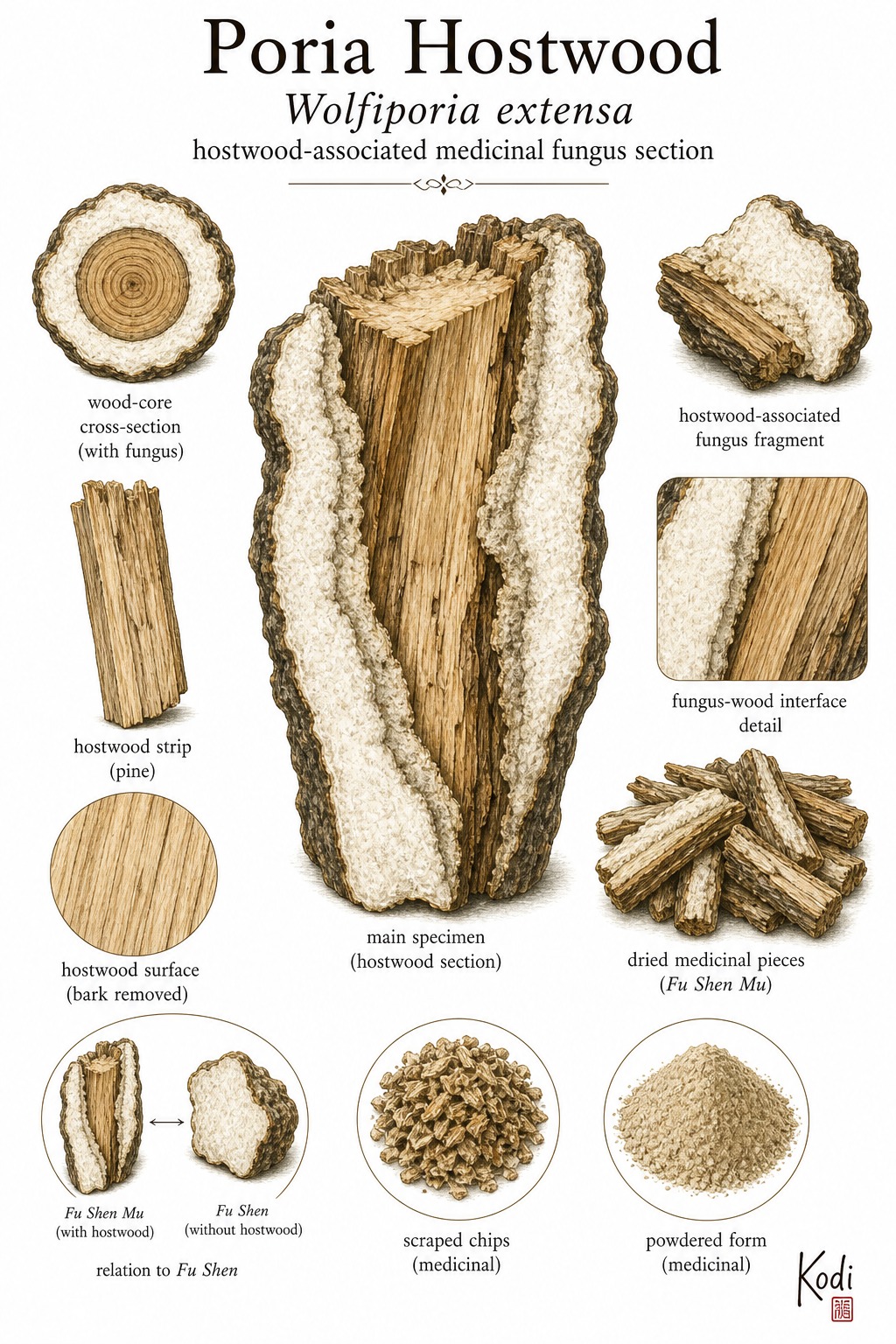
Known in TCM as Fu Shen Mu (茯神木), this sweet, neutral herb enters the Liver and Heart. Traditionally, it calms the spirit and settles fright - Fu Shen Mu is the wood core associated with Poria and is used for palpitations, forgetfulness, fright, and restlessness when the spirit is unsettled, most often applied for palpitations, insomnia, and anxiety. Modern research has identified Poria among its active constituents.
Part used: Sclerotium (fungus)
Also Known As
Latin: Poria Cum Ligno Hospite | Pinyin: Fu Shen Mu | Chinese: 茯神木
TCM Properties
- Taste
- sweet
- Temperature
- neutral
- Channels
- Liver, Heart
Traditional Use
Primary Actions
- Calms the spirit and settles fright - Fu Shen Mu is the wood core associated with Poria and is used for palpitations, forgetfulness, fright, and restlessness when the spirit is unsettled.
- Pacifies the Liver and relaxes spasm - official indications include post-stroke muteness, leg cramping, and wind-stirred sinew tension rather than only simple insomnia.
- Supports speech and movement recovery in deficiency-wind contexts - regional use extends to speech difficulty and sinew spasm after internal wind or lingering depletion.
Secondary Actions
- The Latin source clearly identifies this as Fu Shen Mu, the hostwood-associated Poria section, not as Zhu Fu Shen. Zhu Fu Shen is a different cinnabar-prepared product, so the stub pinyin has been corrected here for accuracy.
- Fu Shen Mu is related to Fu Shen but leans more toward calming, anchoring, and sinew-spasm indications than toward the gentler Spleen-supporting Shen-calming role of ordinary Fu Shen.
Classic Formulas
- Fu Shen San - traditional use pattern for speech difficulty, fright, or post-stroke disturbance in which Fu Shen Mu helps settle the spirit and support recovery.
- Song Jie San - official regional formula context for leg cramping or sinew spasm where the wood-associated material helps relax and settle.
- Pairings with Tian Ma, Gou Teng, or Long Gu - modernized traditional logic when internal wind, fright, and palpitations coexist.
Classical References
- Official Chinese references describe Fu Shen Mu as the pine root found within Poria, sweet and neutral, with functions of calming the Liver and spirit.
- The standard indications include fright palpitations, forgetfulness, post-stroke speech difficulty, and leg cramping.
- Correcting this page to Fu Shen Mu preserves a real medicinal identity that would otherwise be lost under the misleading stub pinyin.
Modern Research
Active Compounds
- Poria polysaccharides - shared fungal-support fraction across the Fu Ling family
- Pachymic acid and related triterpenoids - major Poria pharmacology constituents relevant to sedative and anti-inflammatory discussion
- Wood-associated volatile compounds - part of the reason hostwood and pine-root sections are studied separately
- Minor fungal sterols and metabolites - supportive neuroactive and immune-research constituents
Studied Effects
- The broader Poria literature summarized in a 2011 review supports sedative, anti-inflammatory, and fluid-regulating activity across the species, but direct indexed research on Fu Shen Mu itself remains sparse (PMID 21347995).
- A 2022 pachymic-acid review reinforced continuing preclinical interest in neuroprotective and sedative-hypnotic mechanisms from major Poria triterpenes, which offers only indirect support for this specialized hostwood section (PMID 35978941).
- A 2025 part-comparison study on Poria materials found distinct volatile profiles in pine-root-containing sections, supporting the idea that part differentiation within the Fu Ling family matters even when direct clinical data are limited (PMID 41994219).
PubMed References
- Pharmacological activities of Wolfiporia extensa (Poria cocos): a review. (2011)
- Progress in Pharmacology, Toxicology, and Pharmaceutical Developments of Pachymic Acid: A Review. (2022)
- Comparative analysis of volatile organic compounds in different parts of Poria cocos as potential food-derived health products and targeted quantification of key components in Poria cum radice pini. (2025)
Safety & Interactions
Contraindications
- Severe yin deficiency agitation in which a neutral settling herb is too weak or too drying
Cautions
- Direct modern clinical research on Fu Shen Mu is sparse, so most modern discussion is extrapolated from broader Poria and part-comparison literature.
- This should not substitute for urgent stroke, seizure, or neurologic evaluation when speech difficulty or limb spasm is new or severe.
- Because the identity is easily confused with Fu Shen and Zhu Fu Shen, authenticated sourcing matters.
Conditions
Frequently Asked Questions
What is Poria Hostwood used for?
Poria Hostwood is traditionally used to Calms the spirit and settles fright - Fu Shen Mu is the wood core associated with Poria and is used for palpitations, forgetfulness, fright, and restlessness when the spirit is unsettled., Pacifies the Liver and relaxes spasm - official indications include post-stroke muteness, leg cramping, and wind-stirred sinew tension rather than only simple insomnia., Supports speech and movement recovery in deficiency-wind contexts - regional use extends to speech difficulty and sinew spasm after internal wind or lingering depletion.. Research has investigated its effects on: The broader Poria literature summarized in a 2011 review supports sedative, anti-inflammatory, and fluid-regulating activity across the species, but direct indexed research on Fu Shen Mu itself remains sparse (PMID 21347995).; A 2022 pachymic-acid review reinforced continuing preclinical interest in neuroprotective and sedative-hypnotic mechanisms from major Poria triterpenes, which offers only indirect support for this specialized hostwood section (PMID 35978941)..
What are other names for Poria Hostwood?
Poria Hostwood is also known as Poria Rootwood, Fu Shen Mu, Zhu Fu Shen. In TCM: 茯神木 (Fu Shen Mu); Poria Cum Ligno Hospite.
Is Poria Hostwood safe during pregnancy?
The safety of Poria Hostwood during pregnancy has not been established. Consult a qualified healthcare provider before use.
What are the contraindications for Poria Hostwood?
Poria Hostwood should not be used in: Severe yin deficiency agitation in which a neutral settling herb is too weak or too drying. Consult a qualified practitioner before use.