Indian Trumpetflower Seed
- Chinese
- 木蝴蝶
- Pinyin
- Mu Hu Die
- Latin
- Semen Oroxyli
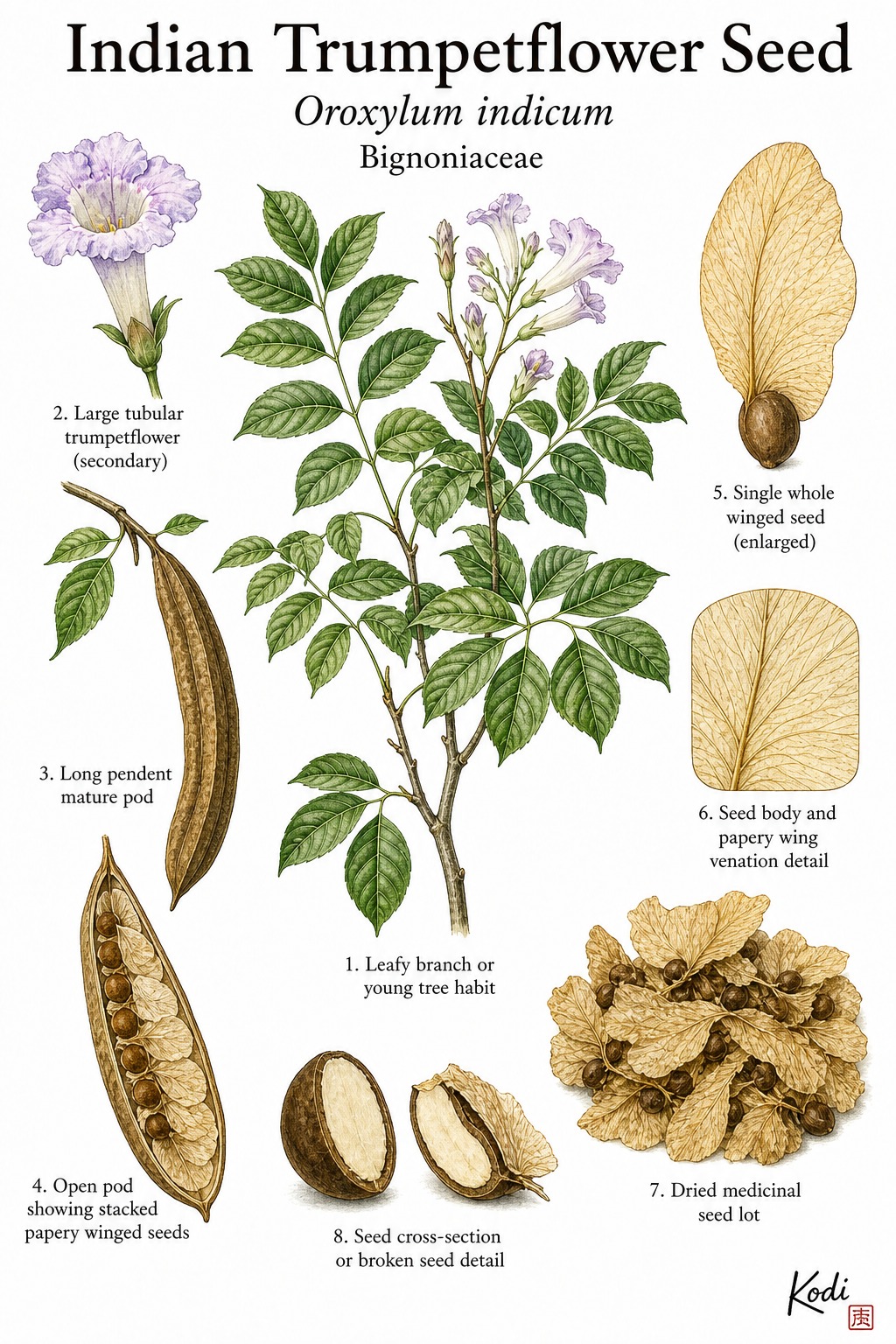
Known in TCM as Mu Hu Die (木蝴蝶), this bitter and sweet, cool herb enters the Lung, Liver, and Stomach. Traditionally, it clears the Lung and benefits the throat - Mu Hu Die is best known for hoarseness, sore throat, dry or irritated cough, and loss of voice, most often applied for pharyngitis, cough, and hypochondriac pain. Modern research has identified Flavones among its active constituents.
Part used: Seed
Also Known As
Latin: Semen Oroxyli | Pinyin: Mu Hu Die | Chinese: 木蝴蝶
TCM Properties
- Taste
- bitter, sweet
- Temperature
- cool
- Channels
- Lung, Liver, Stomach
Traditional Use
Primary Actions
- Clears the Lung and benefits the throat - Mu Hu Die is best known for hoarseness, sore throat, dry or irritated cough, and loss of voice.
- Soothes the Liver and harmonizes the Stomach - older usage includes hypochondriac discomfort and epigastric or stomach pain when constrained qi and irritation overlap.
- Transforms phlegm and eases cough - it appears in formulas for lingering throat inflammation with cough, especially when dryness or heat has irritated the airway.
Secondary Actions
- The seed is light, papery, and almost wing-like, which suits its long-standing association with the throat and the free movement of voice and qi.
- Modern pharmacology on Oroxylum indicum often studies the whole species, bark, or broader extracts, so seed-specific evidence remains thinner than the herb's reputation for throat relief.
Classic Formulas
- Mu Hu Die with Pang Da Hai and Shan Dou Gen - classic sore-throat and hoarseness pairing logic.
- Mu Hu Die with Chai Hu or Xiang Fu - traditional approach when throat irritation coexists with hypochondriac constraint or stomach discomfort.
- Mu Hu Die with Bei Mu or Jie Geng - cough-and-throat combination for phlegm, hoarseness, and lingering airway irritation.
Classical References
- Chinese materia medica references describe Mu Hu Die as bitter, sweet, and cool, entering the Lung, Liver, and Stomach to clear the Lung, benefit the throat, soothe the Liver, and harmonize the Stomach.
- Its standard indications are hoarseness, sore throat, cough, and hypochondriac or stomach pain.
- The throat-focused identity is much more important than any generalized tonic or detoxifying role.
Modern Research
Active Compounds
- Flavones such as baicalein, chrysin, and oroxylin derivatives - key modern research constituents in Oroxylum seeds
- Baicalin and related glycosides - supportive anti-inflammatory and antioxidant compounds
- Seed phenolics and tannins - additional contributors to antimicrobial and anti-inflammatory literature
- Other whole-species extract constituents - relevant because many studies are not seed-only
Studied Effects
- A 2020 HPLC analysis quantified ten major flavones in Oroxylum indicum seeds and related these compounds to antioxidant and anti-inflammatory interest, helping anchor modern chemistry for Mu Hu Die itself (PMID 32231034).
- A 2012 phytochemical and antimicrobial study of Oroxylum indicum identified bioactive compounds and antimicrobial activity, which loosely supports the herb's traditional throat-and-heat use while remaining preclinical (PMID 22557440).
- A 2007 review summarized pharmacognostic and pharmacological research on Oroxylum indicum, reinforcing long-running interest in anti-inflammatory, hepatoprotective, and antimicrobial actions across the species (PMID 18161282).
PubMed References
Safety & Interactions
Contraindications
- Pronounced cold-deficiency cough or abdominal pain without heat or irritation
Cautions
- Most modern research is preclinical or whole-species rather than direct human evidence for classical throat use.
- Persistent hoarseness, weight loss, or one-sided throat pain should not be self-treated without evaluation.
- As a cool throat herb, Mu Hu Die can be a poor fit for very cold, weak digestion if used heavily.
Conditions
- Pharyngitis Traditional ★★★★☆ JSON
- Cough Traditional ★★★☆☆ JSON
- Hypochondriac Pain Traditional ★★☆☆☆ JSON
- Dyspepsia Traditional ★★☆☆☆ JSON
Frequently Asked Questions
What is Indian Trumpetflower Seed used for?
Indian Trumpetflower Seed is traditionally used to Clears the Lung and benefits the throat - Mu Hu Die is best known for hoarseness, sore throat, dry or irritated cough, and loss of voice., Soothes the Liver and harmonizes the Stomach - older usage includes hypochondriac discomfort and epigastric or stomach pain when constrained qi and irritation overlap., Transforms phlegm and eases cough - it appears in formulas for lingering throat inflammation with cough, especially when dryness or heat has irritated the airway.. Research has investigated its effects on: A 2020 HPLC analysis quantified ten major flavones in Oroxylum indicum seeds and related these compounds to antioxidant and anti-inflammatory interest, helping anchor modern chemistry for Mu Hu Die itself (PMID 32231034).; A 2012 phytochemical and antimicrobial study of Oroxylum indicum identified bioactive compounds and antimicrobial activity, which loosely supports the herb's traditional throat-and-heat use while remaining preclinical (PMID 22557440)..
What are other names for Indian Trumpetflower Seed?
Indian Trumpetflower Seed is also known as Oroxylum Seed, Wood Butterfly Seed. In TCM: 木蝴蝶 (Mu Hu Die); Semen Oroxyli.
Is Indian Trumpetflower Seed safe during pregnancy?
The safety of Indian Trumpetflower Seed during pregnancy has not been established. Consult a qualified healthcare provider before use.
What are the contraindications for Indian Trumpetflower Seed?
Indian Trumpetflower Seed should not be used in: Pronounced cold-deficiency cough or abdominal pain without heat or irritation. Consult a qualified practitioner before use.