Indigo Plant Leaf
- Chinese
- 蓼大青叶
- Pinyin
- Liao Da Qing Ye
- Latin
- Folium Polygoni Tinctorii
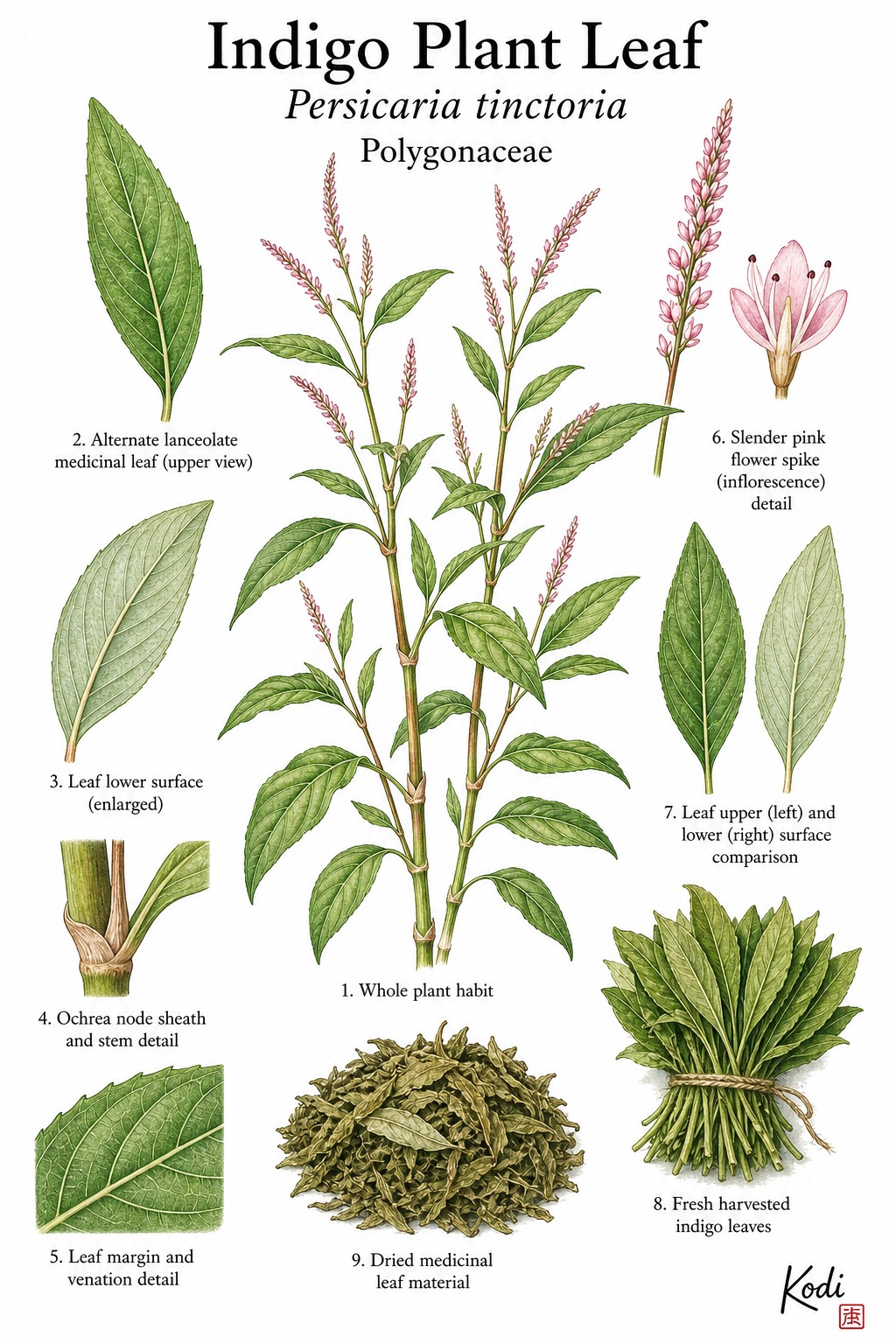
Known in TCM as Liao Da Qing Ye (蓼大青叶), this bitter, cold herb enters the Heart and Stomach. Traditionally, it clears heat and resolves toxin - Liao Da Qing Ye is used for warm-toxic sore throat, febrile disease, and hot inflammatory disorders with redness and swelling, most often applied for pharyngitis, upper respiratory infection, and furunculosis. Modern research has identified Indigo among its active constituents.
Part used: Leaf
Also Known As
Latin: Folium Polygoni Tinctorii | Pinyin: Liao Da Qing Ye | Chinese: 蓼大青叶
TCM Properties
- Taste
- bitter
- Temperature
- cold
- Channels
- Heart, Stomach
Traditional Use
Primary Actions
- Clears heat and resolves toxin - Liao Da Qing Ye is used for warm-toxic sore throat, febrile disease, and hot inflammatory disorders with redness and swelling.
- Cools the blood - traditional usage includes blood-heat patterns with macules, rash, or heat entering the nutritive-blood level.
- Assists with external toxic swellings - like the broader Da Qing Ye family, it is used for boils, hot sores, and inflammatory lesions in which heat toxin is prominent.
Secondary Actions
- This page is intentionally kept distinct from the later `Isatis Leaf / Da Qing Ye` page. Historically multiple plant sources circulated under the broader dark-blue leaf category, but this entry preserves the specific Persicaria/Polygonum tinctorium source.
- Its clinical profile closely parallels Da Qing Ye, yet the source plant and some modern phytochemistry differ enough that collapsing them into one page would blur a real medicinal-material distinction.
Classic Formulas
- Da Qing Ye pairings with Ban Lan Gen and Qing Dai - classic heat-toxic throat and epidemic-heat strategy that historically drew from related blue-dye plant sources.
- Heat-entering-blood formulas with Shui Niu Jiao and Xuan Shen - pattern logic for high fever, rash, and blood-level heat.
- Topical or internal toxic-heat combinations with Jin Yin Hua and Lian Qiao - a practical modern continuation of its detoxifying role.
Classical References
- Regional materia medica sources describe Liao Da Qing Ye as bitter and cold, entering the Heart and Stomach to clear heat, resolve toxin, and cool the blood.
- Traditional use overlaps strongly with Da Qing Ye, but the plant source here is specifically the dye-plant polygonum/persicaria leaf.
- Because source-plant overlap has long existed in commerce, preserving the species-level identity is the main value of this separate monograph.
Modern Research
Active Compounds
- Indigo and indirubin-related pigments - hallmark dye-plant compounds with anti-inflammatory interest
- Indican and related indole precursors - characteristic metabolites in indigo-producing leaves
- Flavonoid glycosides - increasingly studied for anti-inflammatory activity in Persicaria tinctoria
- Tryptanthrin-like aromatic compounds - relevant to antimicrobial and anti-inflammatory discussion
Studied Effects
- A 2000 study found that Polygonum tinctorium leaves and stems suppressed nitric-oxide production in activated macrophages, supporting a long-standing anti-inflammatory interpretation for the plant (PMID 10967465).
- A 2020 study isolated anti-inflammatory glycosides from Persicaria tinctoria and showed benefit in a murine inflammatory-bowel-disease model, expanding the modern pharmacology beyond dye chemistry alone (PMID 33152603).
- A 2022 study reported that Persicaria tinctoria leaf extract and indigo powder improved atopic-dermatitis-like inflammation in vivo and in vitro, which offers a useful modern bridge to the herb's traditional heat-toxic and skin-soothing reputation (PMID 35008979).
PubMed References
- Anti-inflammatory constituents in Polygonum tinctorium Lour. (2000)
- Anti-inflammatory glycosides from Persicaria tinctoria Lour. ameliorate murine inflammatory bowel disease. (2020)
- Persicaria tinctoria leaf extract and indigo powder ameliorate DNCB-induced atopic dermatitis-like responses in vivo and in vitro. (2022)
Safety & Interactions
Contraindications
- Cold-deficiency digestion without heat or toxin
Cautions
- This is a cold detoxifying leaf and can be a poor fit for weak digestion if used heavily without clear heat signs.
- Most modern evidence is preclinical and species-focused rather than direct human data on the classical indications.
- Because several dark-blue leaves have circulated in trade, authenticated source material matters.
Conditions
- Pharyngitis Traditional ★★★☆☆ JSON
- Upper Respiratory Infection Research ★★☆☆☆ JSON
- Furunculosis Traditional ★★☆☆☆ JSON
- Eczema Research ★★☆☆☆ JSON
Frequently Asked Questions
What is Indigo Plant Leaf used for?
Indigo Plant Leaf is traditionally used to Clears heat and resolves toxin - Liao Da Qing Ye is used for warm-toxic sore throat, febrile disease, and hot inflammatory disorders with redness and swelling., Cools the blood - traditional usage includes blood-heat patterns with macules, rash, or heat entering the nutritive-blood level., Assists with external toxic swellings - like the broader Da Qing Ye family, it is used for boils, hot sores, and inflammatory lesions in which heat toxin is prominent.. Research has investigated its effects on: A 2000 study found that Polygonum tinctorium leaves and stems suppressed nitric-oxide production in activated macrophages, supporting a long-standing anti-inflammatory interpretation for the plant (PMID 10967465).; A 2020 study isolated anti-inflammatory glycosides from Persicaria tinctoria and showed benefit in a murine inflammatory-bowel-disease model, expanding the modern pharmacology beyond dye chemistry alone (PMID 33152603)..
What are other names for Indigo Plant Leaf?
Indigo Plant Leaf is also known as Persicaria Tinctoria Leaf, Liao Lan Leaf. In TCM: 蓼大青叶 (Liao Da Qing Ye); Folium Polygoni Tinctorii.
Is Indigo Plant Leaf safe during pregnancy?
The safety of Indigo Plant Leaf during pregnancy has not been established. Consult a qualified healthcare provider before use.
What are the contraindications for Indigo Plant Leaf?
Indigo Plant Leaf should not be used in: Cold-deficiency digestion without heat or toxin. Consult a qualified practitioner before use.