Inula Flower
- Chinese
- 旋覆花
- Pinyin
- Xuan Fu Hua
- Latin
- Flos Inulae
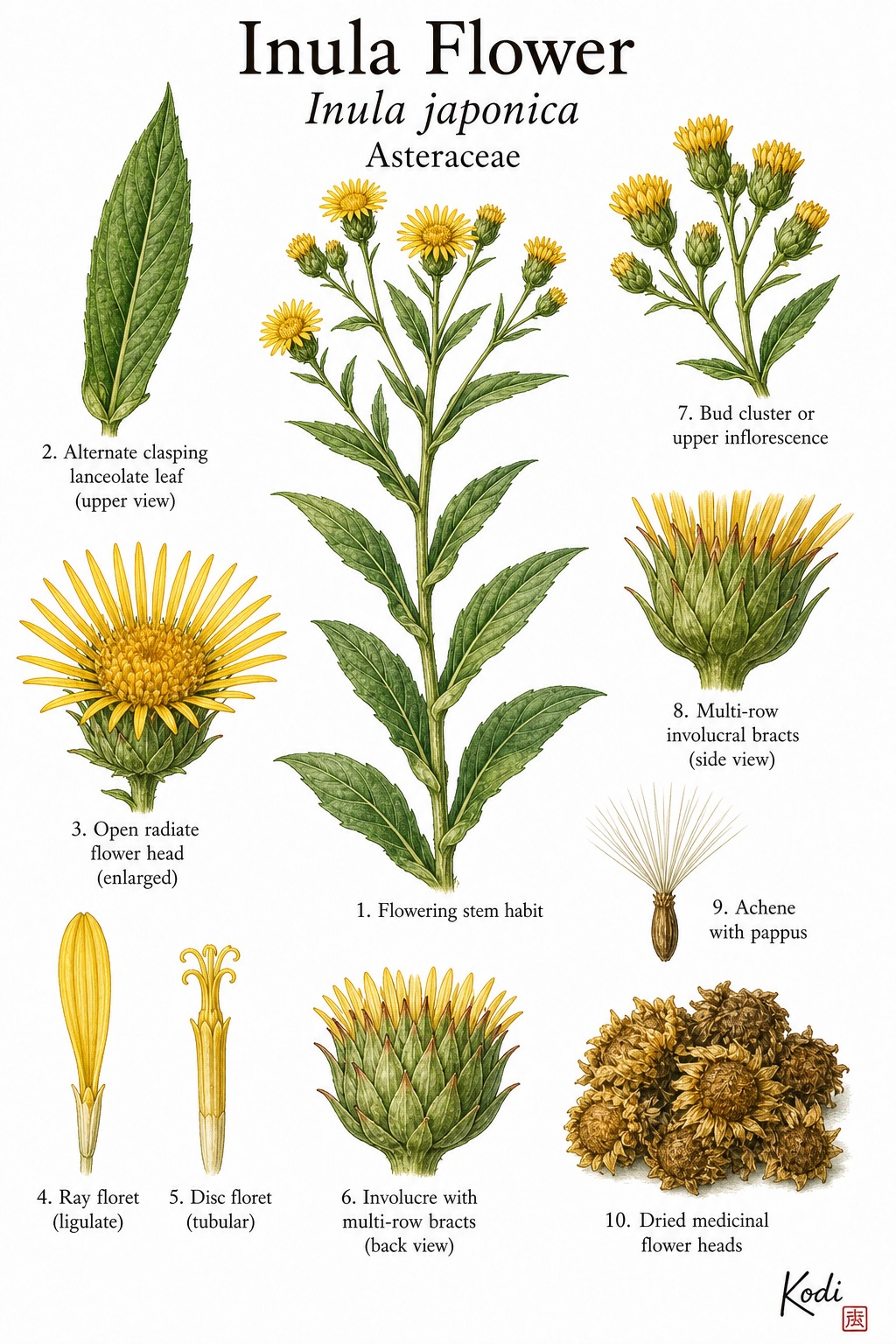
Known in TCM as Xuan Fu Hua (旋覆花), this bitter and pungent and salty, slightly warm herb enters the Lung, Spleen, Stomach, and Large Intestine. Traditionally, it descends rebellious qi and transforms phlegm - Xuan Fu Hua is a classic herb for productive cough, wheezing, chest oppression, and stubborn phlegm lodged in the Lung, most often applied for productive cough, nausea, and asthma. Modern research has identified Sesquiterpene among its active constituents.
Part used: Flower
Also Known As
Latin: Flos Inulae | Pinyin: Xuan Fu Hua | Chinese: 旋覆花
TCM Properties
- Taste
- bitter, pungent, salty
- Temperature
- slightly warm
- Channels
- Lung, Spleen, Stomach, Large Intestine
Traditional Use
Primary Actions
- Descends rebellious qi and transforms phlegm - Xuan Fu Hua is a classic herb for productive cough, wheezing, chest oppression, and stubborn phlegm lodged in the Lung.
- Directs Stomach qi downward and stops vomiting - it is used for belching, nausea, hiccup, and vomiting, especially when phlegm, dampness, or focal hardness obstruct the middle.
- Softens hardness and dissipates clumping - formula traditions use it when phlegm, qi, and retained fluids create fullness or hardness under the heart or in the chest.
Secondary Actions
- Because the flower heads are fuzzy, classical practice often wraps Xuan Fu Hua in gauze for decoction so the hairs do not irritate the throat.
- Its descending action is central: the same herb that helps pull Lung qi and phlegm downward also helps reverse upward Stomach qi.
Classic Formulas
- Xuan Fu Dai Zhe Tang - classic Zhang Zhongjing formula for epigastric focal hardness, belching, and vomiting with mixed deficiency and phlegm.
- Xiang Fu Xuan Fu Hua Tang - traditional pairing logic when liver constraint, phlegm, and chest or epigastric oppression coexist.
- Xuan Fu Hua with Ban Xia and Dai Zhe Shi - practical descending-qi strategy for nausea, vomiting, and phlegm obstruction.
Classical References
- Official Chinese references describe Xuan Fu Hua as bitter, pungent, salty, and slightly warm, entering the Lung, Spleen, Stomach, and Large Intestine to descend qi, transform phlegm, soften hardness, and stop vomiting.
- The standard indications are cough with copious sputum, vomiting, belching, hiccup, and focal hardness below the heart.
- Its strong downward direction makes it a classic bridge herb between phlegm-cough and rebellious-Stomach-qi formulas.
Modern Research
Active Compounds
- Sesquiterpene lactones - major anti-inflammatory constituents in Inula japonica flowers
- Flavonoids and phenolic acids - supportive antioxidant and anti-inflammatory compounds
- Inulanolide-type constituents - repeatedly studied for immune and inflammation pathways
- Volatile aromatic fractions - supportive constituents relevant to respiratory and digestive use
Studied Effects
- A 2010 study reported that methanol extract of Inula japonica flowers attenuated inflammatory responses in activated macrophages through HO-1 induction, supporting the flower's modern anti-inflammatory profile (PMID 21165243).
- A 2014 study identified anti-inflammatory terpenes from Inula japonica flowers, strengthening the case that the flower heads themselves, not just the broader plant, have significant pharmacologic activity (PMID 24710901).
- A 2023 study found that flower extract of Inula japonica attenuated acute lung injury in mice through PPAR-gamma-mediated pathways, providing a useful research bridge to its traditional Lung-phlegm role while remaining preclinical (PMID 36617177).
PubMed References
- Methanol extract of Inula japonica flower attenuates oxidative stress and inflammatory responses in macrophages by inducing heme oxygenase-1 via Nrf2 activation. (2010)
- Anti-inflammatory terpenes from the flowers of Inula japonica. (2014)
- Flower extract of Inula japonica attenuates acute lung injury through regulation of PPAR-gamma and inflammatory signaling in mice. (2023)
Safety & Interactions
Contraindications
- Yin deficiency dry cough without phlegm
- Active throat irritation aggravated by the flower hairs if not properly decocted
Cautions
- The fine hairs can irritate the throat or digestive tract if the herb is not wrapped for decoction.
- Its downward-moving action makes it less suitable when upward symptoms reflect severe depletion without phlegm or obstruction.
- Most modern evidence remains preclinical even though the anti-inflammatory and lung-protective research is encouraging.
Conditions
- Productive Cough Traditional ★★★★☆ JSON
- Nausea Traditional ★★★☆☆ JSON
- Asthma Traditional ★★★☆☆ JSON
- Chest Pain Traditional ★★☆☆☆ JSON
Frequently Asked Questions
What is Inula Flower used for?
Inula Flower is traditionally used to Descends rebellious qi and transforms phlegm - Xuan Fu Hua is a classic herb for productive cough, wheezing, chest oppression, and stubborn phlegm lodged in the Lung., Directs Stomach qi downward and stops vomiting - it is used for belching, nausea, hiccup, and vomiting, especially when phlegm, dampness, or focal hardness obstruct the middle., Softens hardness and dissipates clumping - formula traditions use it when phlegm, qi, and retained fluids create fullness or hardness under the heart or in the chest.. Research has investigated its effects on: A 2010 study reported that methanol extract of Inula japonica flowers attenuated inflammatory responses in activated macrophages through HO-1 induction, supporting the flower's modern anti-inflammatory profile (PMID 21165243).; A 2014 study identified anti-inflammatory terpenes from Inula japonica flowers, strengthening the case that the flower heads themselves, not just the broader plant, have significant pharmacologic activity (PMID 24710901)..
What are other names for Inula Flower?
Inula Flower is also known as Inulae Flos, Xuanfuhua. In TCM: 旋覆花 (Xuan Fu Hua); Flos Inulae.
Is Inula Flower safe during pregnancy?
The safety of Inula Flower during pregnancy has not been established. Consult a qualified healthcare provider before use.
What are the contraindications for Inula Flower?
Inula Flower should not be used in: Yin deficiency dry cough without phlegm; Active throat irritation aggravated by the flower hairs if not properly decocted. Consult a qualified practitioner before use.