Inula Root
- Chinese
- 土木香
- Pinyin
- Tu Mu Xiang
- Latin
- Radix Inulae
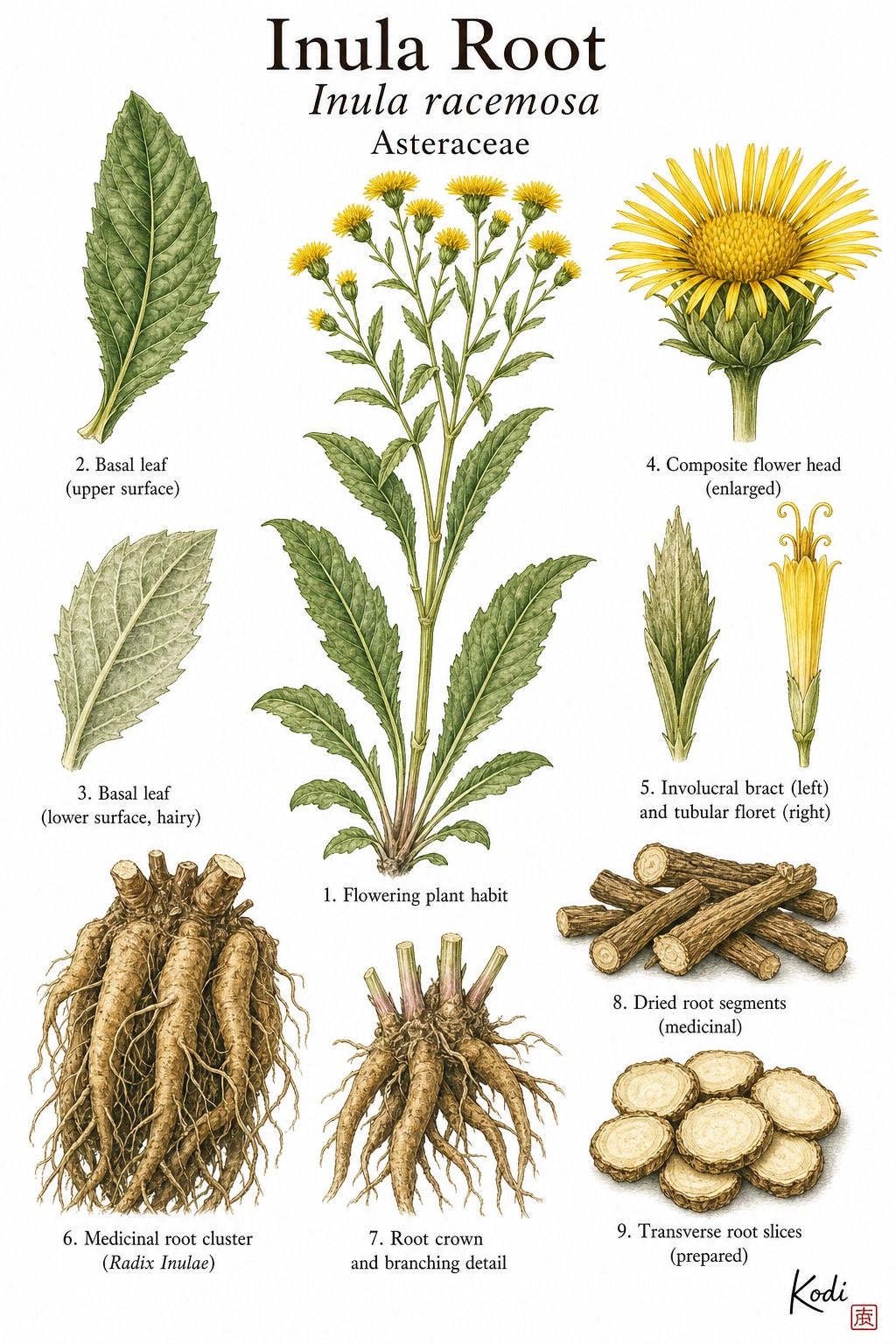
Known in TCM as Tu Mu Xiang (土木香), this pungent and bitter, warm herb enters the Liver and Spleen. Traditionally, it strengthens the Spleen and harmonizes the Stomach - Tu Mu Xiang is used for chronic weak digestion with poor appetite, abdominal fullness, and lingering discomfort after eating, most often applied for dyspepsia, abdominal distension, and hypochondriac pain. Modern research has identified Alantolactone among its active constituents.
Part used: Root
Also Known As
Latin: Radix Inulae | Pinyin: Tu Mu Xiang | Chinese: 土木香
TCM Properties
- Taste
- pungent, bitter
- Temperature
- warm
- Channels
- Liver, Spleen
Traditional Use
Primary Actions
- Strengthens the Spleen and harmonizes the Stomach - Tu Mu Xiang is used for chronic weak digestion with poor appetite, abdominal fullness, and lingering discomfort after eating.
- Moves qi and relieves pain - official and regional use includes hypochondriac pain, chest-wall pain, intercostal discomfort, and epigastric pain when constraint and cold stagnation are involved.
- Calms the fetus - in Tibetan and Chinese reference use it may be chosen when qi stagnation and middle-burner disharmony contribute to restless pregnancy.
Secondary Actions
- The current official entry is under Zang Mu Xiang with Tu Mu Xiang as an accepted name, so this page preserves the queue wording while staying anchored to the Inula racemosa/Inula helenium root identity rather than to unrelated `Mu Xiang` look-alikes.
- It should not be confused with the aristolochia-linked `small-nan-muxiang` style names that carry very different safety implications.
Classic Formulas
- Tu Mu Xiang with Chen Pi or Sha Ren - middle-burner qi-stagnation strategy for poor appetite, fullness, and chronic gastritis-type discomfort.
- Tu Mu Xiang with Yan Hu Suo or Xiang Fu - pain-focused pairing when chest wall, flank, or epigastric pain reflects constraint and stagnation.
- Pregnancy-support combinations with Bai Zhu and Sha Ren - traditional logic when fetal restlessness coexists with weak digestion and qi constraint.
Classical References
- Official Chinese references describe Zang Mu Xiang, also called Tu Mu Xiang, as pungent, bitter, and warm, entering the Liver and Spleen to strengthen the Spleen, harmonize the Stomach, regulate qi, relieve depression, stop pain, and calm the fetus.
- The listed indications include chronic gastritis, gastrointestinal dysfunction, intercostal neuralgia, chest-wall contusion pain, and fetal restlessness.
- Its identity sits between aromatic qi-regulating root and Tibetan-style stomach-pain medicine rather than between heat-clearing or phlegm herbs.
Modern Research
Active Compounds
- Alantolactone - a signature sesquiterpene lactone in Inula roots with anti-inflammatory and antiproliferative interest
- Isoalantolactone - closely related major sesquiterpene lactone studied across multiple models
- Other sesquiterpene lactones and essential-oil constituents - contributors to the root's aromatic and pharmacologic profile
- Inulin and related storage polysaccharides - supportive root constituents relevant to digestive interpretation
Studied Effects
- A 2025 murine study found that Inula racemosa root extract ameliorated diethylnitrosamine-induced hepatic injury and linked the effect partly to alantolactone and isoalantolactone, supporting continued interest in the root's anti-inflammatory and tissue-protective potential (PMID 40638963).
- A 2019 study reported radioprotective effects of Inula racemosa root extract via Nrf2-linked antioxidant pathways, expanding the modern pharmacology beyond digestive use while remaining preclinical (PMID 30998083).
- Analytical work on Inula helenium and related roots confirms substantial variability in secondary metabolites such as sesquiterpene lactones, which matters for quality control and helps explain why modern activity can vary by source and processing (PMID 31213017).
PubMed References
- Ameliorative effect of Inula racemosa Hook. F root extract against diethylnitrosamine induced hepatic damage in murine model. (2025)
- Role of Nrf2-antioxidant in radioprotection by root extract of Inula racemosa. (2019)
- Temporal, Plant Part, and Interpopulation Variability of Secondary Metabolites and Antioxidant Activity of Inula helenium L. (2019)
Safety & Interactions
Contraindications
- Heat patterns with pronounced dryness rather than cold constraint or stagnation
Cautions
- Although traditional references include fetal-calming use, pregnancy treatment should still be clinician-guided rather than self-directed.
- Modern research is preclinical and should not be overread as proof for chronic gastritis or pain treatment in people.
- Inula roots can be confused with other aromatic roots in trade, so authenticated sourcing matters.
Conditions
- Dyspepsia Traditional ★★★☆☆ JSON
- Abdominal Distension Traditional ★★★☆☆ JSON
- Hypochondriac Pain Traditional ★★☆☆☆ JSON
- Nausea Traditional ★★☆☆☆ JSON
Frequently Asked Questions
What is Inula Root used for?
Inula Root is traditionally used to Strengthens the Spleen and harmonizes the Stomach - Tu Mu Xiang is used for chronic weak digestion with poor appetite, abdominal fullness, and lingering discomfort after eating., Moves qi and relieves pain - official and regional use includes hypochondriac pain, chest-wall pain, intercostal discomfort, and epigastric pain when constraint and cold stagnation are involved., Calms the fetus - in Tibetan and Chinese reference use it may be chosen when qi stagnation and middle-burner disharmony contribute to restless pregnancy.. Research has investigated its effects on: A 2025 murine study found that Inula racemosa root extract ameliorated diethylnitrosamine-induced hepatic injury and linked the effect partly to alantolactone and isoalantolactone, supporting continued interest in the root's anti-inflammatory and tissue-protective potential (PMID 40638963).; A 2019 study reported radioprotective effects of Inula racemosa root extract via Nrf2-linked antioxidant pathways, expanding the modern pharmacology beyond digestive use while remaining preclinical (PMID 30998083)..
What are other names for Inula Root?
Inula Root is also known as Zang Mu Xiang, Qi Mu Xiang. In TCM: 土木香 (Tu Mu Xiang); Radix Inulae.
Is Inula Root safe during pregnancy?
The safety of Inula Root during pregnancy has not been established. Consult a qualified healthcare provider before use.
What are the contraindications for Inula Root?
Inula Root should not be used in: Heat patterns with pronounced dryness rather than cold constraint or stagnation. Consult a qualified practitioner before use.