Isatis Leaf
- Chinese
- 大青叶
- Pinyin
- Da Qing Ye
- Latin
- Folium Isatidis
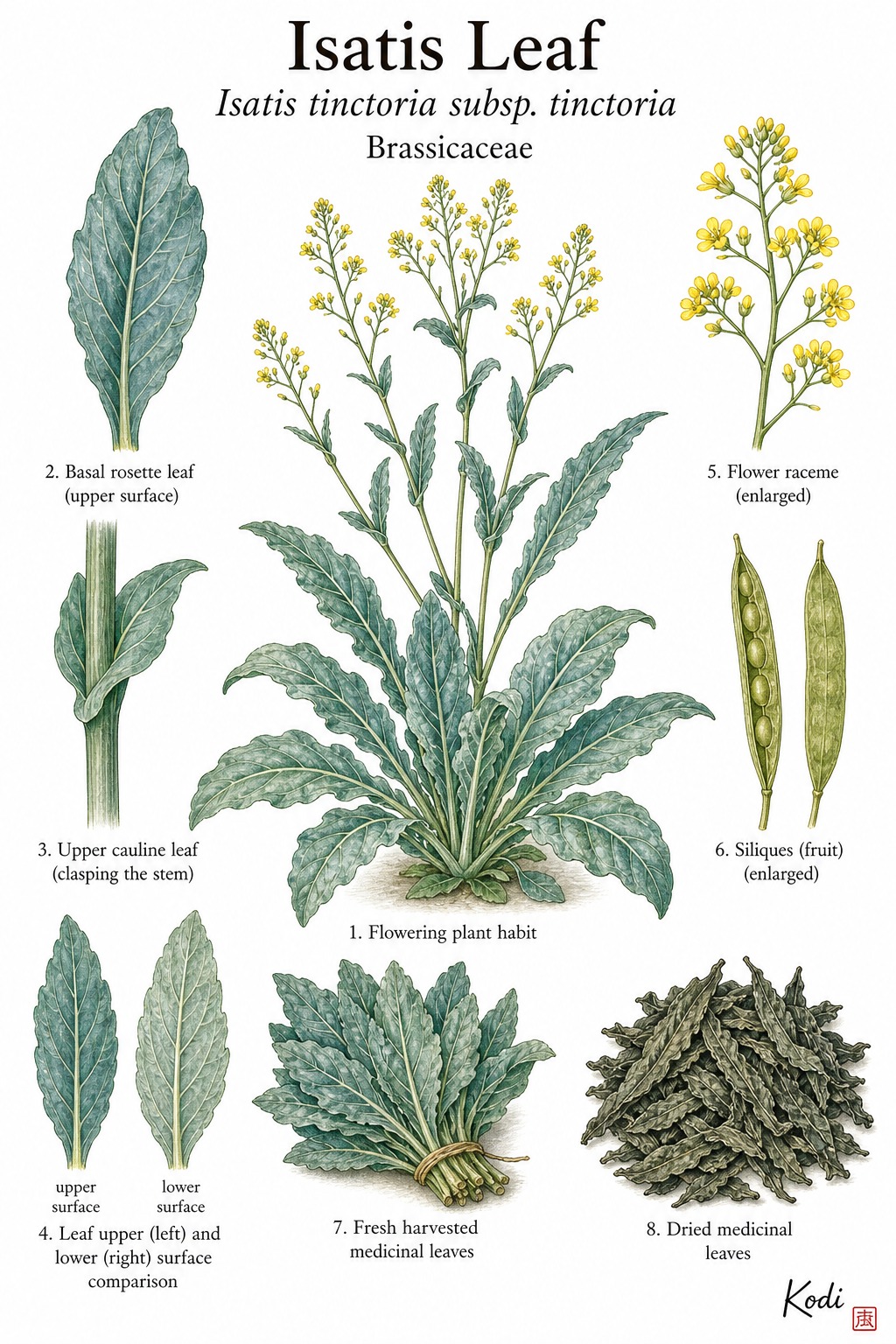
Known in TCM as Da Qing Ye (大青叶), this bitter, cold herb enters the Heart and Stomach. Traditionally, it clears heat and resolves toxin - Da Qing Ye is a classic leaf for epidemic heat, sore throat, mumps-like swelling, hot boils, and toxic febrile conditions, most often applied for pharyngitis, upper respiratory infection, and furunculosis. Modern research has identified Indigo among its active constituents.
Part used: Leaf
Also Known As
Latin: Folium Isatidis | Pinyin: Da Qing Ye | Chinese: 大青叶
TCM Properties
- Taste
- bitter
- Temperature
- cold
- Channels
- Heart, Stomach
Traditional Use
Primary Actions
- Clears heat and resolves toxin - Da Qing Ye is a classic leaf for epidemic heat, sore throat, mumps-like swelling, hot boils, and toxic febrile conditions.
- Cools the blood and relieves spotted eruptions - textbook use includes high fever, agitation, macules, and rash when heat enters the blood level.
- Assists with external hot swellings - fresh or prepared leaf can also be used in topical heat-toxic applications for red swollen lesions.
Secondary Actions
- This is the canonical pharmacopoeial Isatis leaf page and should be kept separate from the earlier `Liao Da Qing Ye` page, which preserves a different dye-plant source within the broader blue-leaf family.
- Its strong cold detoxifying nature explains both its popularity in heat-toxic patterns and its poor fit for weak cold digestion.
Classic Formulas
- Xi Jiao Da Qing Tang - classic blood-heat and spotted-rash context in which Da Qing Ye helps cool the nutritive and blood levels.
- Qing Wen Jie Du Wan - surface-and-interior toxic-heat formula context where Da Qing Ye helps with sore throat, fever, and epidemic heat.
- Da Qing Tang with Sheng Di, Da Huang, and Sheng Ma - traditional throat-fire and oral-ulcer strategy preserved in classical references.
Classical References
- Official Chinese references describe Da Qing Ye as bitter and cold, entering the Heart and Stomach to clear heat, resolve toxin, cool blood, and dissipate spots.
- The standard indications include warm disease with high fever, delirium, spotted eruptions, mumps, sore throat, erysipelas-like redness, and boils.
- The current pharmacopoeial source is the dried leaf of Isatis indigotica, which distinguishes it from older multi-source blue-leaf traditions.
Modern Research
Active Compounds
- Indigo and indirubin - hallmark Isatis pigments with antiviral and anti-inflammatory research interest
- Indole alkaloid glycosides - increasingly studied leaf constituents in Da Qing Ye
- Lignan glycosides such as clemastanin-type compounds - associated with antiviral research pathways
- Tryptanthrin and related aromatic metabolites - supportive anti-inflammatory and antimicrobial constituents
Studied Effects
- A 2013 study found that extracts derived from Folium isatidis showed antiviral activity in vitro and in vivo against several RNA and DNA viruses, directly supporting modern interest in Da Qing Ye as more than just a root-adjacent herb (PMID 23895163).
- A 2020 phytochemical study isolated seven new indole alkaloid glycosides from Isatis indigotica leaves, strengthening the leaf-specific chemistry base for Da Qing Ye rather than leaving it entirely overshadowed by Ban Lan Gen research (PMID 32528835).
- A 2020 animal study reported that Isatidis Folium alleviated acetaminophen-induced liver injury by enhancing endogenous antioxidant systems, which broadens the modern pharmacology while remaining preclinical (PMID 32677766).
PubMed References
- Antiviral activity of Folium isatidis derived extracts in vitro and in vivo. (2013)
- Indole alkaloid glycosides with a 1'-(phenyl)ethyl unit from Isatis indigotica leaves. (2020)
- Isatidis Folium alleviates acetaminophen-induced liver injury in mice by enhancing the endogenous antioxidant system. (2020)
Safety & Interactions
Contraindications
- Spleen-Stomach deficiency cold without clear heat or toxin
Cautions
- Da Qing Ye is very cold and can aggravate weak digestion or loose stool in people without strong heat signs.
- Most modern evidence remains preclinical even though antiviral and anti-inflammatory research is substantial.
- This leaf page should not be treated as interchangeable with Ban Lan Gen root products or with the separate Liao Da Qing Ye source.
Conditions
- Pharyngitis Traditional ★★★★☆ JSON
- Upper Respiratory Infection Research ★★★☆☆ JSON
- Furunculosis Traditional ★★★☆☆ JSON
Frequently Asked Questions
What is Isatis Leaf used for?
Isatis Leaf is traditionally used to Clears heat and resolves toxin - Da Qing Ye is a classic leaf for epidemic heat, sore throat, mumps-like swelling, hot boils, and toxic febrile conditions., Cools the blood and relieves spotted eruptions - textbook use includes high fever, agitation, macules, and rash when heat enters the blood level., Assists with external hot swellings - fresh or prepared leaf can also be used in topical heat-toxic applications for red swollen lesions.. Research has investigated its effects on: A 2013 study found that extracts derived from Folium isatidis showed antiviral activity in vitro and in vivo against several RNA and DNA viruses, directly supporting modern interest in Da Qing Ye as more than just a root-adjacent herb (PMID 23895163).; A 2020 phytochemical study isolated seven new indole alkaloid glycosides from Isatis indigotica leaves, strengthening the leaf-specific chemistry base for Da Qing Ye rather than leaving it entirely overshadowed by Ban Lan Gen research (PMID 32528835)..
What are other names for Isatis Leaf?
Isatis Leaf is also known as Lan Ye, Blue Isatis Leaf. In TCM: 大青叶 (Da Qing Ye); Folium Isatidis.
Is Isatis Leaf safe during pregnancy?
The safety of Isatis Leaf during pregnancy has not been established. Consult a qualified healthcare provider before use.
What are the contraindications for Isatis Leaf?
Isatis Leaf should not be used in: Spleen-Stomach deficiency cold without clear heat or toxin. Consult a qualified practitioner before use.