Arisaema Rhizome
- Chinese
- 天南星
- Pinyin
- Tian Nan Xing
- Latin
- Rhizoma Arisaematis
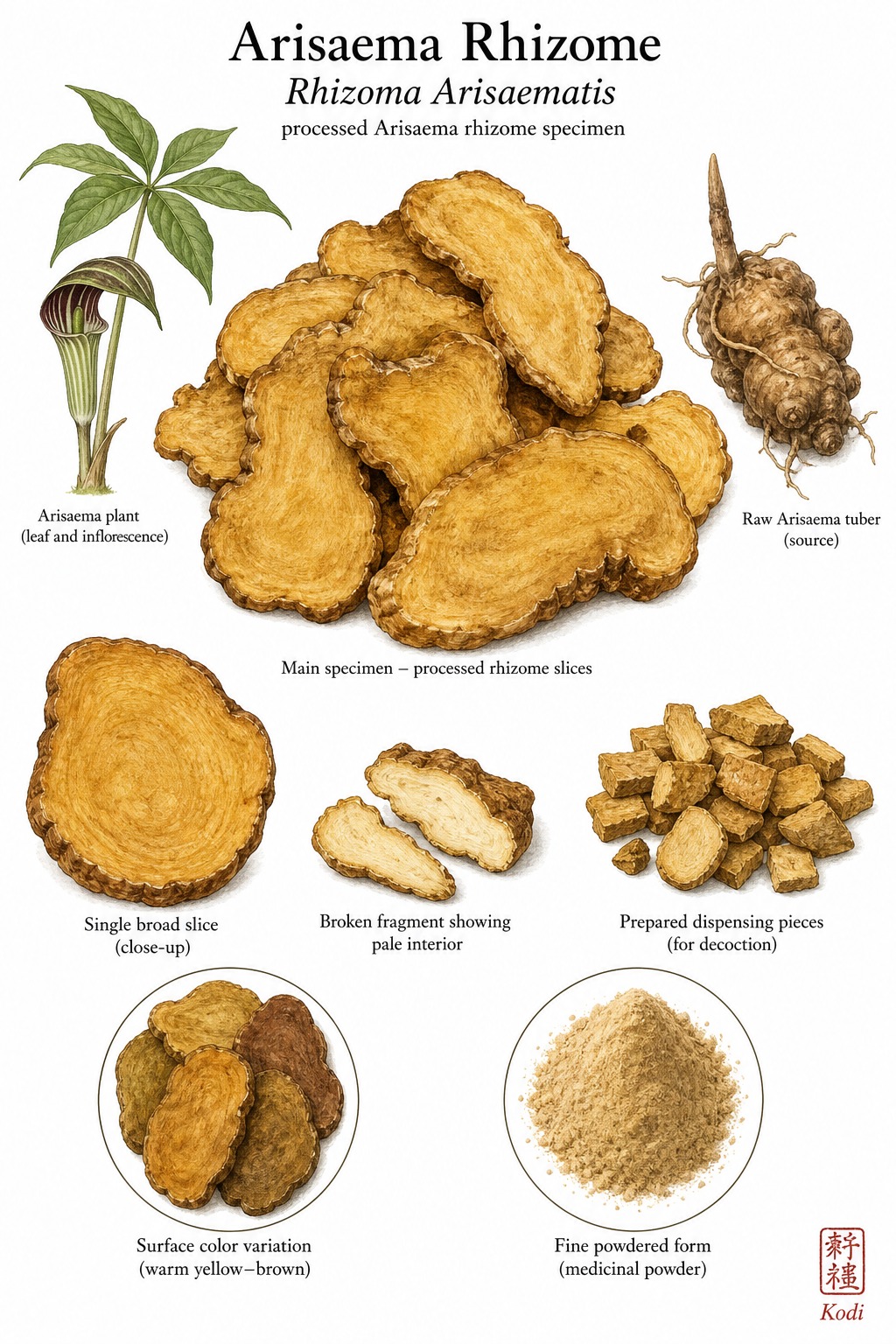
Known in TCM as Tian Nan Xing (天南星), this bitter and acrid, warm herb enters the Lung, Liver, and Spleen. Traditionally, it dries dampness and transforms cold-damp or stubborn phlegm - Tian Nan Xing is warmer, drier, and more forceful than Ban Xia when thick obstructive phlegm needs to be broken up, most often applied for productive cough, asthma, and dizziness. Modern research has identified Calcium among its active constituents.
Part used: Rhizome
Also Known As
Latin: Rhizoma Arisaematis | Pinyin: Tian Nan Xing | Chinese: 天南星
TCM Properties
- Taste
- bitter, acrid
- Temperature
- warm
- Channels
- Lung, Liver, Spleen
Traditional Use
Primary Actions
- Dries dampness and transforms cold-damp or stubborn phlegm - Tian Nan Xing is warmer, drier, and more forceful than Ban Xia when thick obstructive phlegm needs to be broken up.
- Dispels wind-phlegm and opens the channels - classic use includes facial paralysis, numbness, dizziness, and stroke-like channel obstruction when phlegm blocks the collaterals.
- Stops spasms and addresses phlegm-obstructed seizures - it is used when turbid phlegm closes the clear orifices and contributes to epilepsy or convulsive disorders.
- Dissipates swelling externally - topical application extends to abscesses, painful nodules, and other toxic swellings.
Secondary Actions
- In modern dispensing, internal Tian Nan Xing usually means the properly processed ginger-and-alum form even when prescriptions shorten the name to Tian Nan Xing; the raw and bile-processed forms deserve their own separate pages.
- Compared with Dan Nan Xing, this page keeps the classic warm-drying cold-phlegm and wind-phlegm identity rather than the cooler heat-phlegm and convulsion profile created by bile processing.
Classic Formulas
- Dao Tan Tang - classical stubborn-phlegm formula in which Tian Nan Xing helps dry dampness and break up obstructive phlegm.
- Qing Zhou Bai Wan Zi - famous wind-phlegm channel-obstruction formula using Tian Nan Xing for numbness, facial deviation, and stubborn phlegm in the collaterals.
- Wu Xian Wan - classical seizure formula in which Tian Nan Xing helps address phlegm closing the clear orifices.
Classical References
- TCM Wiki lists Tian Nan Xing as bitter, acrid, warm, and toxic, entering the Lung, Liver, and Spleen with core actions of drying dampness, resolving phlegm, extinguishing wind, and reducing swelling.
- Classical comparison texts say Ban Xia primarily works the Stomach and intestines, while Nan Xing more strongly travels the channels and collaterals for wind-phlegm.
- Standard modern processing with ginger juice and alum reflects the long-standing recognition that the internal medicinal is safer and clinically more usable after preparation.
Modern Research
Active Compounds
- Calcium oxalate raphides - major irritant crystals tied to the herb's raw toxicity
- Lectins and related proteins - contributors to irritant and neurotoxic discussion
- Flavonoids and phenylpropanoid derivatives - part of the expanding Arisaematis Rhizoma chemistry literature
- Sterols, glycosides, and polysaccharides - supportive constituents in broader Arisaema pharmacology research
Studied Effects
- A 2011 mouse study found that traditional ginger-alum or bile processing improved sedative and analgesic effects while reducing neurotoxic changes compared with crude Rhizoma Arisaematis, helping justify why modern internal use favors processed Tian Nan Xing over raw Sheng Nan Xing (PMID 21905287).
- A 2021 review summarized the reported chemical constituents and bioactivities of Arisaematis Rhizoma and showed that current evidence remains largely preclinical despite long traditional use (PMID 34738419).
- A 2015 metabolomics toxicity study in rats demonstrated raw-material renal and metabolic injury signals, reinforcing the importance of correct processing and cautious internal use (PMID 25407163).
PubMed References
- Evidence for improved neuropharmacological efficacy and decreased neurotoxicity in mice with traditional processing of Rhizoma Arisaematis. (2011)
- [Research progress on chemical constituents and biological activities of Arisaematis Rhizoma]. (2021)
- Toxicity assessment of Arisaematis Rhizoma in rats by a (1)H NMR-based metabolomics approach. (2015)
Safety & Interactions
Contraindications
- Pregnancy
- Yin deficiency with dry cough or depleted fluids
- Wind from extreme heat or blood deficiency without real phlegm obstruction
Cautions
- Modern internal use generally assumes proper processing; the raw tuber belongs under Sheng Nan Xing and carries much higher toxicity.
- Tian Nan Xing is strongly drying and can aggravate dryness, heat, or irritated mucosa when the pattern is wrong.
- Because Dan Nan Xing shifts to a cooler heat-phlegm profile, the two Nan Xing forms should not be substituted casually.
Conditions
Frequently Asked Questions
What is Arisaema Rhizome used for?
Arisaema Rhizome is traditionally used to Dries dampness and transforms cold-damp or stubborn phlegm - Tian Nan Xing is warmer, drier, and more forceful than Ban Xia when thick obstructive phlegm needs to be broken up., Dispels wind-phlegm and opens the channels - classic use includes facial paralysis, numbness, dizziness, and stroke-like channel obstruction when phlegm blocks the collaterals., Stops spasms and addresses phlegm-obstructed seizures - it is used when turbid phlegm closes the clear orifices and contributes to epilepsy or convulsive disorders., Dissipates swelling externally - topical application extends to abscesses, painful nodules, and other toxic swellings.. Research has investigated its effects on: A 2011 mouse study found that traditional ginger-alum or bile processing improved sedative and analgesic effects while reducing neurotoxic changes compared with crude Rhizoma Arisaematis, helping justify why modern internal use favors processed Tian Nan Xing over raw Sheng Nan Xing (PMID 21905287).; A 2021 review summarized the reported chemical constituents and bioactivities of Arisaematis Rhizoma and showed that current evidence remains largely preclinical despite long traditional use (PMID 34738419)..
What are other names for Arisaema Rhizome?
Arisaema Rhizome is also known as Nan Xing, Arisaema Rhizome, Arisaematis. In TCM: 天南星 (Tian Nan Xing); Rhizoma Arisaematis.
Is Arisaema Rhizome safe during pregnancy?
The safety of Arisaema Rhizome during pregnancy has not been established. Consult a qualified healthcare provider before use.
What are the contraindications for Arisaema Rhizome?
Arisaema Rhizome should not be used in: Pregnancy; Yin deficiency with dry cough or depleted fluids; Wind from extreme heat or blood deficiency without real phlegm obstruction. Consult a qualified practitioner before use.