Chinese Date
- Chinese
- 大枣
- Pinyin
- Da Zao
- Latin
- Fructus Jujubae
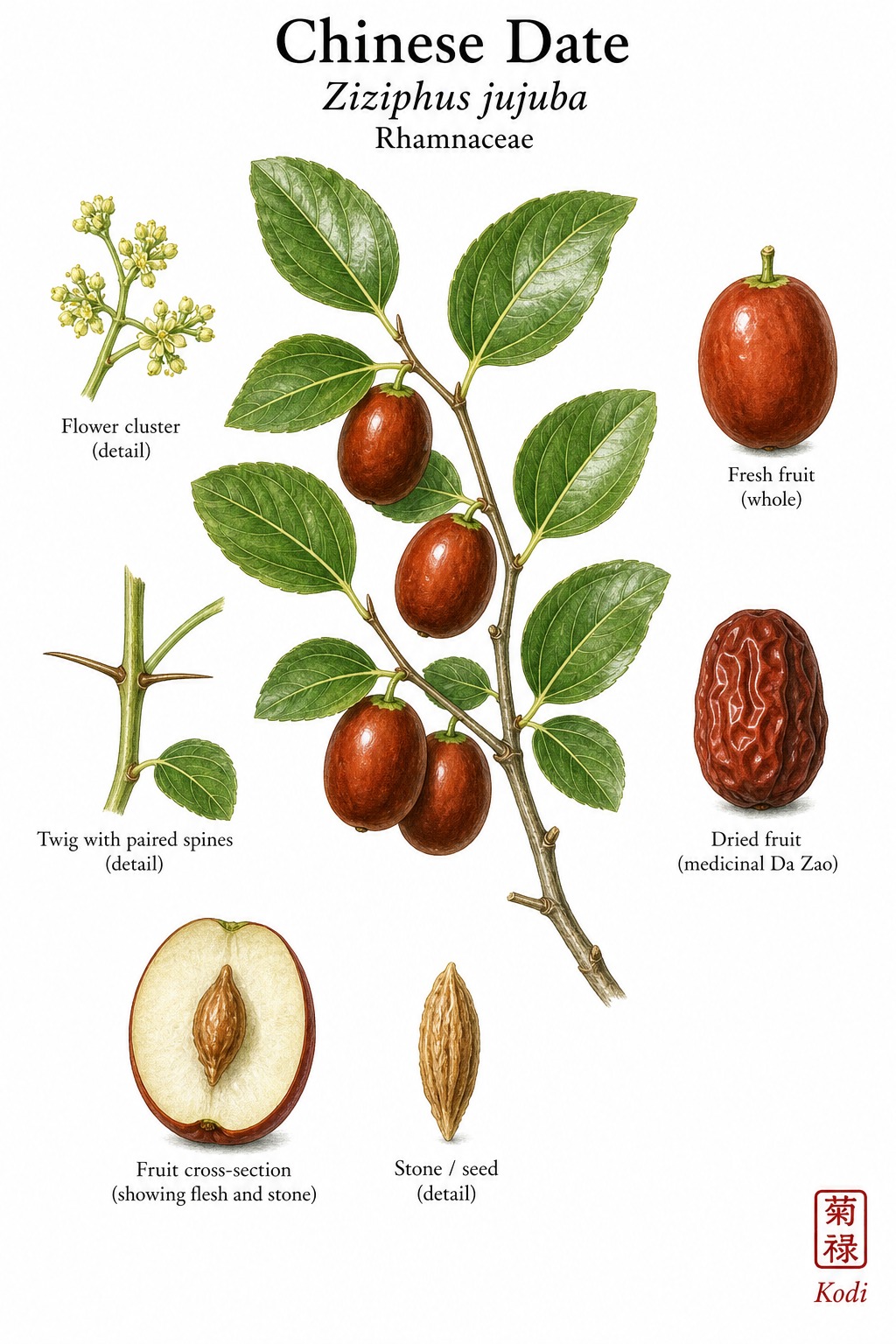
Known in TCM as Da Zao (大枣), this sweet, warm herb enters the Spleen, Stomach, and Heart. Traditionally, it tonifies Spleen and Stomach qi - Da Zao is a classic deficiency-support fruit for fatigue, weak appetite, loose stool, and recovery after illness or overwork, most often applied for fatigue, poor appetite, and diarrhea. Modern research has identified Jujube among its active constituents.
Part used: Fruit
Also Known As
Latin: Fructus Jujubae | Pinyin: Da Zao | Chinese: 大枣
TCM Properties
- Taste
- sweet
- Temperature
- warm
- Channels
- Spleen, Stomach, Heart
Traditional Use
Primary Actions
- Tonifies Spleen and Stomach qi - Da Zao is a classic deficiency-support fruit for fatigue, weak appetite, loose stool, and recovery after illness or overwork.
- Nourishes blood and calms the spirit - traditional use includes irritability, palpitations, and insomnia when Heart-Spleen support has been depleted.
- Moderates harsh herbs and protects middle qi - one of its most important classical functions is to soften the effects of bitter, acrid, or drastic medicinals.
- Assists the harmonization of nutritive and defensive qi - especially in formula pairings with Sheng Jiang in exterior-relieving prescriptions.
Secondary Actions
- This is the canonical medicinal Da Zao page; the separate Hong Zao slug preserves the common red-date market name rather than a different species or fundamentally different drug.
- Because Da Zao is both food and medicine, concentrated extracts, candy-like snack products, and whole decoction fruits should not be treated as interchangeable in sugar load or clinical effect.
Classic Formulas
- Gui Zhi Tang - Da Zao with Sheng Jiang harmonizes the nutritive and defensive qi while supporting the middle.
- Gan Mai Da Zao Tang - famous spirit-calming formula in which Da Zao nourishes deficiency and eases restlessness.
- Gui Pi Tang - Da Zao supports the Spleen, nourishes blood, and helps calm palpitations and insomnia from Heart-Spleen deficiency.
Classical References
- American Dragon and multiple TCM teaching references describe Da Zao as sweet and warm, entering the Spleen and Stomach and often extending to Heart involvement through blood and Shen support.
- Traditional formula usage repeatedly shows Da Zao protecting Stomach qi and softening the harshness of stronger herbs rather than acting only as a simple food tonic.
- The classic pairing with Sheng Jiang is especially important for harmonizing the middle and the nutritive-defensive interface in exterior formulas.
Modern Research
Active Compounds
- Jujube polysaccharides - major nutritive and immunomodulatory constituents
- Flavonoids and phenolic acids - antioxidant compounds linked to neuroprotective and metabolic research
- Triterpenic acids such as betulinic and oleanolic acid derivatives - repeatedly discussed bioactive fruit constituents
- Cyclic AMP and nutritive sugars - characteristic fruit constituents relevant to food-medicine framing
Studied Effects
- A 2017 review focused on jujube fruit and summarized neuroprotective, differentiation-promoting, and sleep-related research themes, supporting but not proving the traditional mind-calming reputation of Da Zao (PMID 28680447).
- A 2024 review examined Ziziphus jujuba in metabolic syndrome and highlighted ongoing research into antihyperlipidemic, antihypertensive, antidiabetic, and antioxidant mechanisms, most of it still preclinical or nutraceutical rather than direct TCM clinical proof (PMID 39354208).
- A 2015 review summarized broad anti-inflammatory, gastrointestinal-protective, and anticancer research around Ziziphus jujuba fruit, reinforcing that modern interest centers on the fruit as a functional food as much as a classical herb (PMID 26392706).
PubMed References
Safety & Interactions
Contraindications
- Damp-phlegm or food stagnation with marked bloating
- Excess heat or damp-heat patterns without deficiency
Cautions
- Da Zao is sweet and cloying enough to worsen bloating or dampness in susceptible patients.
- Whole fruits, syrups, snack dates, and standardized extracts can differ substantially in sugar density and dose.
- Most modern research studies jujube as food or extract rather than as one ingredient inside classical formulas.
Conditions
- Fatigue Traditional ★★★★☆ JSON
- Poor Appetite Traditional ★★★★☆ JSON
- Diarrhea Traditional ★★☆☆☆ JSON
- Insomnia Traditional ★★☆☆☆ JSON
- Palpitations Traditional ★★☆☆☆ JSON
Frequently Asked Questions
What is Chinese Date used for?
Chinese Date is traditionally used to Tonifies Spleen and Stomach qi - Da Zao is a classic deficiency-support fruit for fatigue, weak appetite, loose stool, and recovery after illness or overwork., Nourishes blood and calms the spirit - traditional use includes irritability, palpitations, and insomnia when Heart-Spleen support has been depleted., Moderates harsh herbs and protects middle qi - one of its most important classical functions is to soften the effects of bitter, acrid, or drastic medicinals., Assists the harmonization of nutritive and defensive qi - especially in formula pairings with Sheng Jiang in exterior-relieving prescriptions.. Research has investigated its effects on: A 2017 review focused on jujube fruit and summarized neuroprotective, differentiation-promoting, and sleep-related research themes, supporting but not proving the traditional mind-calming reputation of Da Zao (PMID 28680447).; A 2024 review examined Ziziphus jujuba in metabolic syndrome and highlighted ongoing research into antihyperlipidemic, antihypertensive, antidiabetic, and antioxidant mechanisms, most of it still preclinical or nutraceutical rather than direct TCM clinical proof (PMID 39354208)..
What are other names for Chinese Date?
Chinese Date is also known as Jujube, Chinese Date, Zizyphi. In TCM: 大枣 (Da Zao); Fructus Jujubae.
Is Chinese Date safe during pregnancy?
The safety of Chinese Date during pregnancy has not been established. Consult a qualified healthcare provider before use.
What are the contraindications for Chinese Date?
Chinese Date should not be used in: Damp-phlegm or food stagnation with marked bloating; Excess heat or damp-heat patterns without deficiency. Consult a qualified practitioner before use.