Red Date
- Chinese
- 红枣
- Pinyin
- Hong Zao
- Latin
- Fructus Jujubae
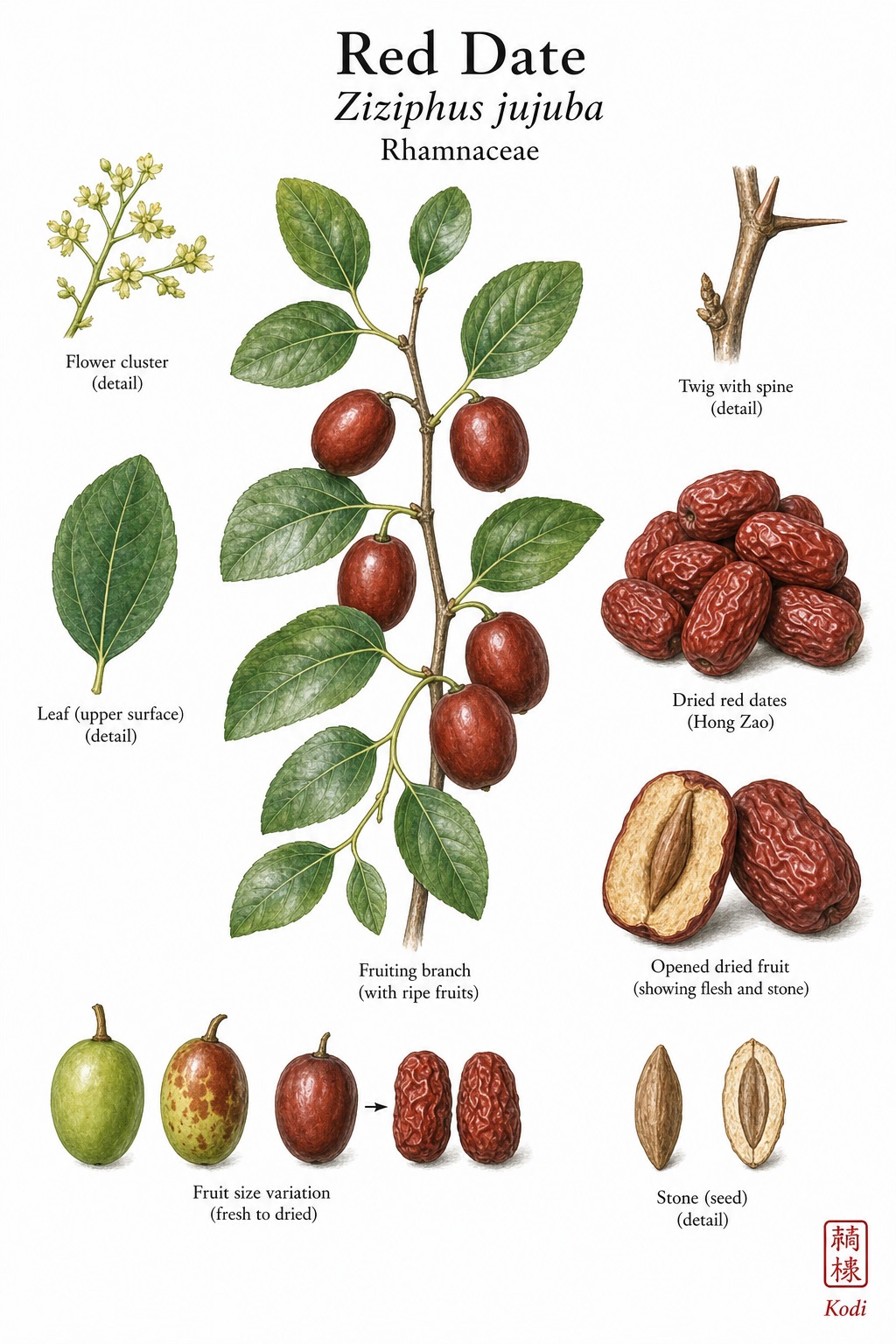
Known in TCM as Hong Zao (红枣), this sweet, warm herb enters the Spleen, Stomach, and Heart. Traditionally, it tonifies qi and supports the middle in everyday food-medicine practice - Hong Zao is the common red-date kitchen name for gentle support of weak appetite, tiredness, and convalescence, most often applied for fatigue, poor appetite, and insomnia. Modern research has identified Jujube among its active constituents.
Part used: Fruit
Also Known As
Latin: Fructus Jujubae | Pinyin: Hong Zao | Chinese: 红枣
TCM Properties
- Taste
- sweet
- Temperature
- warm
- Channels
- Spleen, Stomach, Heart
Traditional Use
Primary Actions
- Tonifies qi and supports the middle in everyday food-medicine practice - Hong Zao is the common red-date kitchen name for gentle support of weak appetite, tiredness, and convalescence.
- Nourishes blood and settles restlessness - it is widely associated with mild Heart-Spleen support for insomnia, palpitations, and deficiency-related emotional fragility.
- Harmonizes formulas and protects Stomach qi - like Da Zao, it softens harsher medicinals and helps tonic combinations digest more comfortably.
Secondary Actions
- Hong Zao is not a separate species from Da Zao; this page is preserved because the source queue split the common red-date name from the canonical materia medica entry.
- Some later references describe Hong Zao as the more food-facing or slightly milder presentation of the same fruit, so the distinction here is naming and usage emphasis rather than a hard pharmacological divide.
Classic Formulas
- Gan Mai Da Zao Tang - Hong Zao as the everyday red-date expression of the spirit-calming date role.
- Gui Pi Tang - red dates commonly stand in for Da Zao in practice when nourishing Heart-Spleen deficiency with palpitations and poor sleep.
- Shi Zao Tang - the red-date layer of the same fruit preserves the classic role of protecting the middle from harsh draining herbs.
Classical References
- TCM Wiki's Hong Zao entry gives the same core properties as the mature jujube medicinal: sweet and warm, entering the Spleen, Stomach, and Heart to tonify qi, nourish blood, and calm restlessness.
- Traditional teaching preserves Hong Zao as dual food and medicine, especially in soups, porridges, and gentle tonic combinations.
- The separate Hong Zao naming layer is clinically useful mainly for matching market language and culinary usage, not for implying a different botany.
Modern Research
Active Compounds
- Jujube polysaccharides - major nutritive and antioxidant-support constituents
- Flavonoids and phenolic acids - key compounds in functional-food research
- Triterpenic acids such as betulinic and oleanolic acid derivatives - widely discussed fruit constituents
- Cyclic AMP and fruit sugars - part of the common food-medicine chemistry base
Studied Effects
- Because Hong Zao and Da Zao are the same fruit, modern evidence is shared across the Ziziphus jujuba food-medicine literature rather than unique to a separate Hong Zao product.
- The 2017 review on dietary jujube highlighted neuroprotective and sleep-related research that helps explain the traditional calming reputation of red dates in food therapy (PMID 28680447).
- The 2024 metabolic syndrome review and 2015 broad pharmacology review both show that modern jujube research is expanding, but still mostly sits in preclinical or functional-food territory rather than direct clinical validation of Hong Zao kitchen use (PMIDs 39354208, 26392706).
PubMed References
Safety & Interactions
Contraindications
- Damp-phlegm or food stagnation with marked bloating
- Excess heat or damp-heat patterns without deficiency
Cautions
- Red dates are sweet enough to worsen bloating or damp accumulation when overeaten.
- Household soups, snack dates, candies, and concentrated extracts can vary widely in sugar load and practical dose.
- The modern evidence base is shared with Da Zao and mostly reflects jujube as a food or extract, not a separately studied Hong Zao medicinal.
Conditions
- Fatigue Traditional ★★★☆☆ JSON
- Poor Appetite Traditional ★★★☆☆ JSON
- Insomnia Traditional ★★☆☆☆ JSON
- Palpitations Traditional ★★☆☆☆ JSON
- Anxiety Traditional ★☆☆☆☆ JSON
Frequently Asked Questions
What is Red Date used for?
Red Date is traditionally used to Tonifies qi and supports the middle in everyday food-medicine practice - Hong Zao is the common red-date kitchen name for gentle support of weak appetite, tiredness, and convalescence., Nourishes blood and settles restlessness - it is widely associated with mild Heart-Spleen support for insomnia, palpitations, and deficiency-related emotional fragility., Harmonizes formulas and protects Stomach qi - like Da Zao, it softens harsher medicinals and helps tonic combinations digest more comfortably.. Research has investigated its effects on: Because Hong Zao and Da Zao are the same fruit, modern evidence is shared across the Ziziphus jujuba food-medicine literature rather than unique to a separate Hong Zao product.; The 2017 review on dietary jujube highlighted neuroprotective and sleep-related research that helps explain the traditional calming reputation of red dates in food therapy (PMID 28680447)..
What are other names for Red Date?
Red Date is also known as Red Jujube, Chinese Red Date, Zizyphi. In TCM: 红枣 (Hong Zao); Fructus Jujubae.
Is Red Date safe during pregnancy?
The safety of Red Date during pregnancy has not been established. Consult a qualified healthcare provider before use.
What are the contraindications for Red Date?
Red Date should not be used in: Damp-phlegm or food stagnation with marked bloating; Excess heat or damp-heat patterns without deficiency. Consult a qualified practitioner before use.