Kelp
- Chinese
- 昆布
- Pinyin
- Kun Bu
- Latin
- Thallus Laminariae
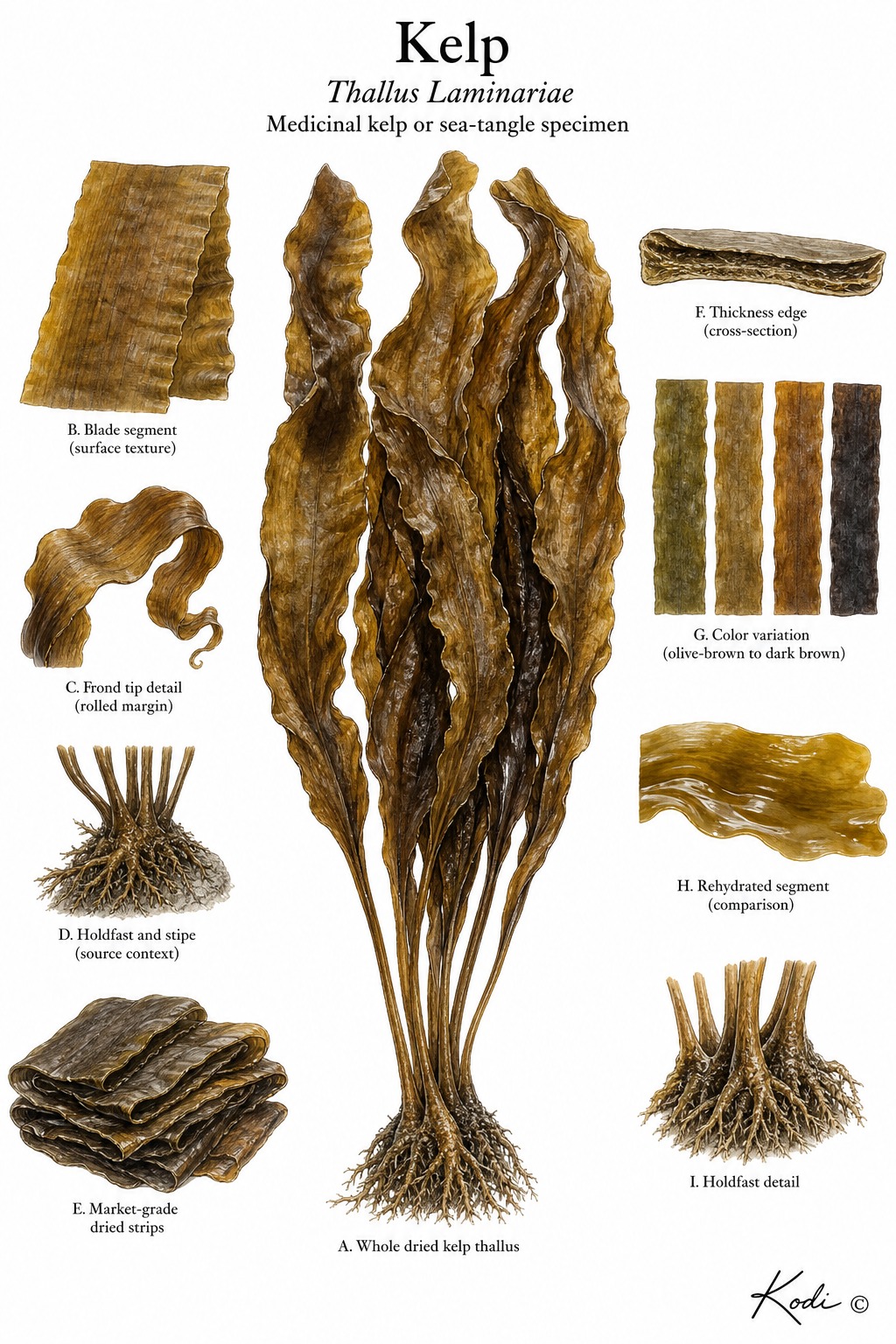
Known in TCM as Kun Bu (昆布), this salty, cold herb enters the Kidney, Liver, and Stomach. Traditionally, it softens hardness and dissipates phlegm nodules - Kun Bu is classically used for goiter, scrofula, and other firm masses from phlegm clumping, most often applied for thyroid nodule, scrofula, and edema. Modern research has identified Iodine among its active constituents.
Part used: Thallus
Also Known As
Latin: Thallus Laminariae | Pinyin: Kun Bu | Chinese: 昆布
TCM Properties
- Taste
- salty
- Temperature
- cold
- Channels
- Kidney, Liver, Stomach
Traditional Use
Primary Actions
- Softens hardness and dissipates phlegm nodules - Kun Bu is classically used for goiter, scrofula, and other firm masses from phlegm clumping.
- Transforms phlegm and relieves fullness - it is chosen when congealed phlegm obstructs the neck, throat, or chest and needs a stronger softening seaweed.
- Promotes urination and reduces edema - traditional sources also preserve a secondary water-pathway role for swelling and damp accumulation.
Secondary Actions
- Kun Bu overlaps with Hai Zao and sometimes Hai Dai in seaweed sourcing, but classical teaching usually treats Kun Bu as somewhat stronger at softening hard masses.
- Modern products may derive from Laminaria or Ecklonia species and can vary widely in iodine content, so authenticated sourcing matters clinically.
Classic Formulas
- Hai Zao Yu Hu Tang - classic seaweed and fritillaria formula for goiter and scrofula in which Kun Bu supports lump-softening.
- Kun Bu with Hai Zao and Xia Ku Cao - common nodules strategy when phlegm-fire and hardness dominate the neck.
- Kun Bu with Ge Qiao or Wa Leng Zi - traditional shell-seaweed pairing for harder masses, dysphagia, or stubborn phlegm nodulation.
Classical References
- American Dragon describes Kun Bu as salty and cold, entering the Kidney, Liver, and Stomach to resolve phlegm nodules and promote urination.
- TCM teaching sources commonly compare Kun Bu with Hai Zao and note that Kun Bu is often treated as the somewhat stronger hardness-softening seaweed of the pair.
- Traditional usage focuses on excess phlegm clumping, not deficiency-cold swelling.
Modern Research
Active Compounds
- Iodine and other halogen-rich minerals - major thyroid-relevant constituents
- Fucoidan and laminarin polysaccharides - widely studied sulfated and storage polysaccharides
- Alginates and mannitol - characteristic structural and osmotic seaweed constituents
- Polyphenols and trace minerals - supportive secondary constituents that vary by species and harvest conditions
Studied Effects
- A 2022 systematic review summarized anti-obesity, antihyperlipidemic, antihyperglycemic, antioxidant, and vascular research on Laminaria japonica, but most evidence remains preclinical or nutraceutical rather than direct support for TCM nodule use (PMID 35893900).
- A 2008 human study found that short-term and longer-term ingestion of Kombu (Laminaria japonica) raised TSH levels in some healthy adults, providing concrete modern support for thyroid caution around iodine-heavy kelp use (PMID 18689954).
- A 2024 review of Saccharina japonica polysaccharides highlighted ongoing structural and bioactivity research around sea-tangle polysaccharides, reinforcing the functional-food interest in Kun Bu even as classical nodule indications remain under-studied clinically (PMID 41558427).
PubMed References
- The Effect of Laminaria japonica on Metabolic Syndrome: A Systematic Review of Its Efficacy and Mechanism of Action. (2022)
- Suppression of thyroid function during ingestion of seaweed "Kombu" (Laminaria japonoca) in normal Japanese adults. (2008)
- Extraction, purification, structure characteristics and biological activities of polysaccharides from Saccharina japonica (Laminaria japonica): A review. (2024)
Safety & Interactions
Contraindications
- Spleen and Stomach deficiency cold
- Cold-phlegm without hard masses or heat signs
Cautions
- Kelp can deliver large and highly variable iodine doses that may worsen or destabilize thyroid disease, especially in people with nodules, Graves' disease, or autoimmune thyroid conditions.
- Brown seaweeds can also accumulate heavy metals or arsenic depending on source and processing quality.
- Kun Bu should not be treated as interchangeable with over-the-counter kelp supplements, snacks, or iodized products with unknown iodine content.
Drug Interactions
- Levothyroxine - iodine-rich kelp and mineral content may complicate thyroid management; use only with clinician oversight and separate from medication when relevant
- Antithyroid drugs - high iodine intake can alter response or monitoring in hyperthyroid treatment
Conditions
Frequently Asked Questions
What is Kelp used for?
Kelp is traditionally used to Softens hardness and dissipates phlegm nodules - Kun Bu is classically used for goiter, scrofula, and other firm masses from phlegm clumping., Transforms phlegm and relieves fullness - it is chosen when congealed phlegm obstructs the neck, throat, or chest and needs a stronger softening seaweed., Promotes urination and reduces edema - traditional sources also preserve a secondary water-pathway role for swelling and damp accumulation.. Research has investigated its effects on: A 2022 systematic review summarized anti-obesity, antihyperlipidemic, antihyperglycemic, antioxidant, and vascular research on Laminaria japonica, but most evidence remains preclinical or nutraceutical rather than direct support for TCM nodule use (PMID 35893900).; A 2008 human study found that short-term and longer-term ingestion of Kombu (Laminaria japonica) raised TSH levels in some healthy adults, providing concrete modern support for thyroid caution around iodine-heavy kelp use (PMID 18689954)..
What are other names for Kelp?
Kelp is also known as Sea Tangle, Kun Bu, Laminaria. In TCM: 昆布 (Kun Bu); Thallus Laminariae.
Is Kelp safe during pregnancy?
The safety of Kelp during pregnancy has not been established. Consult a qualified healthcare provider before use.
What are the contraindications for Kelp?
Kelp should not be used in: Spleen and Stomach deficiency cold; Cold-phlegm without hard masses or heat signs. Consult a qualified practitioner before use.
Does Kelp interact with any medications?
Kelp may interact with: Levothyroxine - iodine-rich kelp and mineral content may complicate thyroid management; use only with clinician oversight and separate from medication when relevant; Antithyroid drugs - high iodine intake can alter response or monitoring in hyperthyroid treatment. Always inform your healthcare provider of any herbal supplements you are taking.