Knotty Pine Wood, Pine Nodular Branch
- Chinese
- 松节
- Pinyin
- Song Jie
- Latin
- Lignum Pini Nodi
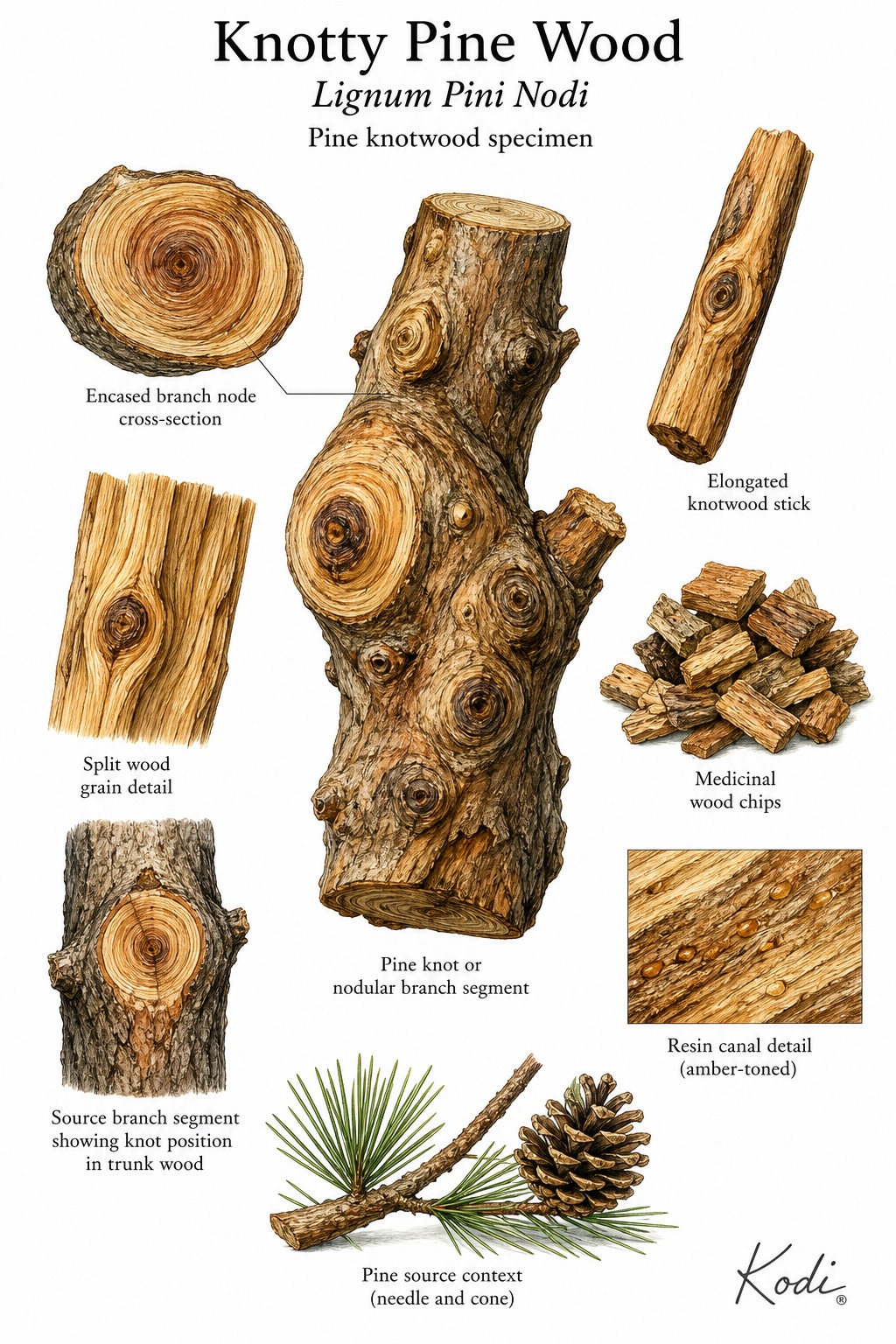
Known in TCM as Song Jie (松节), this bitter, warm herb enters the Liver. Traditionally, it dispels wind-damp and unblocks the channels - Song Jie is used for painful obstruction with heavy, fixed, or aching joints that worsen in cold and damp weather, most often applied for joint pain, rheumatism, and traumatic injury. Modern research has identified Knotwood among its active constituents.
Part used: Heartwood
Also Known As
Latin: Lignum Pini Nodi | Pinyin: Song Jie | Chinese: 松节
TCM Properties
- Taste
- bitter
- Temperature
- warm
- Channels
- Liver
Traditional Use
Primary Actions
- Dispels wind-damp and unblocks the channels - Song Jie is used for painful obstruction with heavy, fixed, or aching joints that worsen in cold and damp weather.
- Relieves pain and relaxes the sinews - traditional use includes traumatic pain, bruising, chronic limb pain, and cramping or stiffness of the tendons and bones.
- Warms cold lodged in the collaterals - it is chosen when woody, penetrating warmth is preferred over stronger toxic painkillers.
Secondary Actions
- Song Jie refers to the knot or node where the pine branch is encased in the trunk, not to pine needles, bark, resin, or turpentine products.
- Its clinical role is relatively narrow and channel-focused, so it is usually paired with other wind-damp, blood-moving, or trauma herbs rather than used as a broad internal tonic.
Classic Formulas
- Song Jie Jiu - a traditional medicated-wine approach for severe wind-damp joint pain and cold painful obstruction.
- Song Jie with Du Huo, Qin Jiao, or Sang Zhi - a common pairing style for arthralgia, stiffness, and numb painful limbs.
- Song Jie with Tao Ren, Hong Hua, Ru Xiang, and Mo Yao - trauma-oriented combinations used when pain and bruising coexist.
Classical References
- Traditional herb references describe Song Jie as bitter and warm, entering the Liver to dispel wind-damp and stop pain.
- Older materia medica identify the medicinal part as knotty pine wood from species such as Pinus tabuliformis and Pinus massoniana, preserving the wood-node identity rather than treating it as generic pine.
- Its classic use is strongest for rheumatic and traumatic pain, not for deficiency syndromes or generalized tonic use.
Modern Research
Active Compounds
- Knotwood polyphenols and lignans - characteristic phenolic fractions enriched in woody nodes
- Stilbenoid constituents such as pinosylvin-type compounds - anti-inflammatory metabolites repeatedly discussed in pine knotwood literature
- Resin acids and diterpenoid fractions - supportive lipophilic compounds relevant to pine pain-relief and anti-inflammatory research
Studied Effects
- A 2003 study found that hydrophilic knotwood extracts from several tree species had strong antioxidant and radical-scavenging activity, supporting the general idea that wood-node material concentrates bioactive phenolics even though this was not a direct Song Jie clinical study (PMID 14664514).
- A 2009 cell study reported that softwood knot extracts showed antioxidant activity, protected cultured cells against oxidative injury, and in one pine extract reduced IL-2 production, offering an indirect modern correlate for anti-inflammatory use of knotwood material (PMID 20041777).
- A 2023 paper identified pinosylvin from pine knotwood as a suppressor of LPS-induced pro-inflammatory cytokines and JAK/STAT signaling, which helps explain why pine node medicinals remain plausible pain-and-inflammation herbs despite sparse direct TCM-specific trials (PMID 37242501).
PubMed References
- Antioxidant activity of knotwood extractives and phenolic compounds of selected tree species. (2003)
- Bioactive properties of wood knot extracts on cultured human cells. (2009)
- Identification of Pinosylvin in Pinus nigra subsp. laricio: A Naturally Occurring Stilbenoid Suppressing LPS-Induced Expression of Pro-Inflammatory Cytokines and Mediators and Inhibiting the JAK/STAT Signaling Pathway. (2023)
Safety & Interactions
Contraindications
- Marked yin-deficiency dryness or heat without cold-damp obstruction
Cautions
- Direct indexed clinical research on Song Jie itself is sparse, so modern discussion relies heavily on broader pine knotwood chemistry and cell-model data.
- The herb should not be confused with pine resin, turpentine, or concentrated essential-oil products, which have different safety profiles.
- MSK page not found - drug interaction data not available from Memorial Sloan Kettering integrative medicine database
Conditions
- Joint Pain Traditional ★★★☆☆ JSON
- Rheumatism Traditional ★★★☆☆ JSON
- Traumatic Injury Traditional ★★★☆☆ JSON
Frequently Asked Questions
What is Knotty Pine Wood, Pine Nodular Branch used for?
Knotty Pine Wood, Pine Nodular Branch is traditionally used to Dispels wind-damp and unblocks the channels - Song Jie is used for painful obstruction with heavy, fixed, or aching joints that worsen in cold and damp weather., Relieves pain and relaxes the sinews - traditional use includes traumatic pain, bruising, chronic limb pain, and cramping or stiffness of the tendons and bones., Warms cold lodged in the collaterals - it is chosen when woody, penetrating warmth is preferred over stronger toxic painkillers.. Research has investigated its effects on: A 2003 study found that hydrophilic knotwood extracts from several tree species had strong antioxidant and radical-scavenging activity, supporting the general idea that wood-node material concentrates bioactive phenolics even though this was not a direct Song Jie clinical study (PMID 14664514).; A 2009 cell study reported that softwood knot extracts showed antioxidant activity, protected cultured cells against oxidative injury, and in one pine extract reduced IL-2 production, offering an indirect modern correlate for anti-inflammatory use of knotwood material (PMID 20041777)..
What are other names for Knotty Pine Wood, Pine Nodular Branch?
Knotty Pine Wood, Pine Nodular Branch is also known as Pine Node, Pini. In TCM: 松节 (Song Jie); Lignum Pini Nodi.
Is Knotty Pine Wood, Pine Nodular Branch safe during pregnancy?
The safety of Knotty Pine Wood, Pine Nodular Branch during pregnancy has not been established. Consult a qualified healthcare provider before use.
What are the contraindications for Knotty Pine Wood, Pine Nodular Branch?
Knotty Pine Wood, Pine Nodular Branch should not be used in: Marked yin-deficiency dryness or heat without cold-damp obstruction. Consult a qualified practitioner before use.