Knoxia Root
- Chinese
- 红大戟
- Pinyin
- Hong Da Ji
- Latin
- Radix Knoxiae
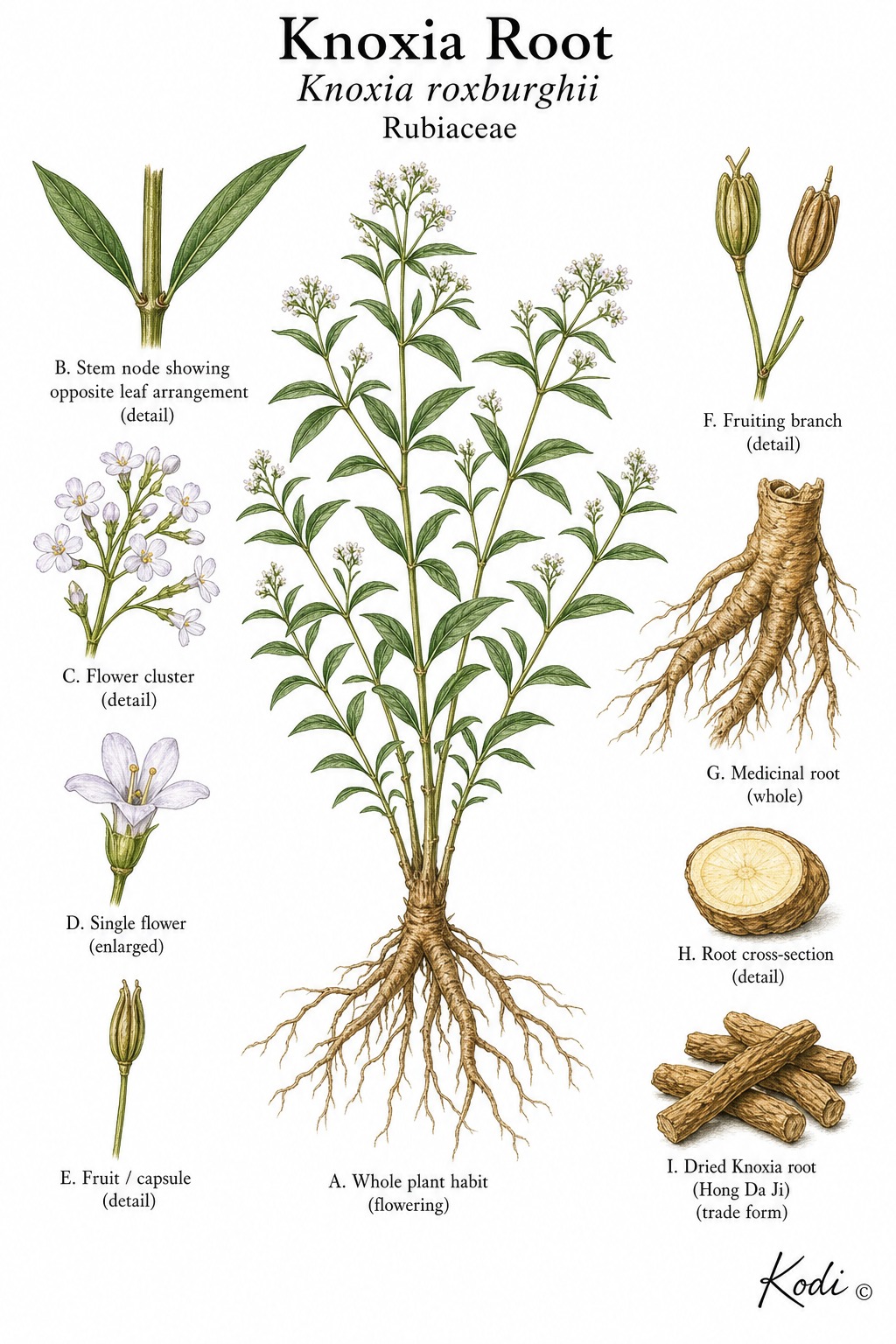
Known in TCM as Hong Da Ji (红大戟), this bitter, cold herb enters the Lung, Spleen, and Kidney. Traditionally, it resolves toxicity, reduces swelling, and dissipates nodules - Hong Da Ji is used for scrofula, sores, boils, abscesses, and hard toxic swellings, most often applied for scrofula, abscess, and carbuncle. Modern research has identified Anthraquinones among its active constituents.
Part used: Root
Also Known As
Latin: Radix Knoxiae | Pinyin: Hong Da Ji | Chinese: 红大戟
TCM Properties
- Taste
- bitter
- Temperature
- cold
- Channels
- Lung, Spleen, Kidney
Traditional Use
Primary Actions
- Resolves toxicity, reduces swelling, and dissipates nodules - Hong Da Ji is used for scrofula, sores, boils, abscesses, and hard toxic swellings.
- Drives out retained water and relieves fluid accumulation - traditional indications include thoracic or abdominal effusion, edema, and difficult urination or defecation when accumulation is severe.
- Breaks up stubborn masses - it is selected when swelling is hard, fixed, and obstructive rather than mild and diffuse.
Secondary Actions
- Hong Da Ji must be kept separate from Jing Da Ji, the Euphorbia-family harsh purgative; the two were historically conflated but now represent different species, toxicity profiles, and clinical emphasis.
- Compared with Jing Da Ji, Hong Da Ji is still a strong downward-driving herb but is generally regarded as less harshly purgative and more nodule- and swelling-oriented.
Classic Formulas
- Zi Jin Ding / Yu Shu Dan - classical detoxifying emergency pill tradition in which Hong Da Ji helps attack toxic accumulations and hard swelling.
- Hong Da Ji with Qian Jin Zi Shuang and Wu Bei Zi - a classical harsh-toxin strategy for severe swelling, phlegm-turbidity, and foul accumulations.
- Hong Da Ji with Ban Bian Lian or Xia Ku Cao - pairing logic for scrofula, nodules, and stubborn toxic swellings.
Classical References
- Modern TCM references describe Hong Da Ji as bitter, cold, and slightly toxic, entering the Lung, Spleen, and Kidney to counter toxin, drive out accumulated water, reduce swelling, and dissipate nodules.
- The Chinese pharmacopoeial separation of Hong Da Ji from Jing Da Ji is clinically important and should not be blurred during sourcing or interpretation.
- This page follows the Rubiaceae Knoxia identity rather than treating Hong Da Ji as a mere variant of Euphorbia Da Ji.
Modern Research
Active Compounds
- Anthraquinones such as rubiadin, lucidin, and damnacanthol-type constituents - the core chemical group repeatedly isolated from Knoxia valerianoides roots
- Anthraquinone glycosides - newer marker compounds investigated for metabolic and signaling effects
- Minor phenolic and non-anthraquinone constituents - supportive compounds that broaden the species chemical profile
Studied Effects
- A 2010 study found that anthraquinones isolated from Knoxia valerianoides roots inhibited advanced glycation end-product formation and rat lens aldose reductase in vitro, showing that the root has measurable bioactivity beyond its traditional swelling indications (PMID 20195820).
- A 2022 paper isolated new anthraquinone glycosides from Knoxia valerianoides with selective PTP1B inhibition, supporting ongoing metabolic-signaling interest in this pharmacopoeial root (PMID 36399709).
- A 2021 metabolomics study on Knoxiae Radix and licorice compatibility emphasized that the herb's chemistry and toxicity handling are clinically meaningful, particularly because Hong Da Ji is often used in processed form and remains a strong medicine rather than a casual tonic (PMID 33749888).
PubMed References
- Anthraquinones from the roots of Knoxia valerianoides inhibit the formation of advanced glycation end products and rat lens aldose reductase in vitro. (2010)
- Selective Inhibition of PTP1B by New Anthraquinone Glycosides from Knoxia valerianoides. (2022)
- Investigation of the incompatibility of Knoxiae Radix and Glycyrrhizae Radix et Rhizoma in rats by 1 H NMR and MS-based untargeted metabolomic analysis. (2021)
Safety & Interactions
Contraindications
- Pregnancy
- Marked weakness, frailty, or severe Spleen deficiency
- Unsuspected internal effusions or masses without proper diagnosis
Cautions
- Hong Da Ji is a strong, slightly toxic herb and is not interchangeable with the much more common Jing Da Ji of the Euphorbia family.
- Because it can irritate and strongly move fluids downward, it should be used conservatively in debilitated patients.
- Modern literature focuses mainly on phytochemistry and preclinical signaling effects rather than direct clinical trials for ascites, scrofula, or abscess care.
Conditions
Frequently Asked Questions
What is Knoxia Root used for?
Knoxia Root is traditionally used to Resolves toxicity, reduces swelling, and dissipates nodules - Hong Da Ji is used for scrofula, sores, boils, abscesses, and hard toxic swellings., Drives out retained water and relieves fluid accumulation - traditional indications include thoracic or abdominal effusion, edema, and difficult urination or defecation when accumulation is severe., Breaks up stubborn masses - it is selected when swelling is hard, fixed, and obstructive rather than mild and diffuse.. Research has investigated its effects on: A 2010 study found that anthraquinones isolated from Knoxia valerianoides roots inhibited advanced glycation end-product formation and rat lens aldose reductase in vitro, showing that the root has measurable bioactivity beyond its traditional swelling indications (PMID 20195820).; A 2022 paper isolated new anthraquinone glycosides from Knoxia valerianoides with selective PTP1B inhibition, supporting ongoing metabolic-signaling interest in this pharmacopoeial root (PMID 36399709)..
What are other names for Knoxia Root?
Knoxia Root is also known as Red Da Ji, Knoxia. In TCM: 红大戟 (Hong Da Ji); Radix Knoxiae.
Is Knoxia Root safe during pregnancy?
The safety of Knoxia Root during pregnancy has not been established. Consult a qualified healthcare provider before use.
What are the contraindications for Knoxia Root?
Knoxia Root should not be used in: Pregnancy; Marked weakness, frailty, or severe Spleen deficiency; Unsuspected internal effusions or masses without proper diagnosis. Consult a qualified practitioner before use.