Korean Ginseng
- Chinese
- 高丽参
- Pinyin
- Gao Li Shen
- Latin
- Ginseng Coreensis Radix
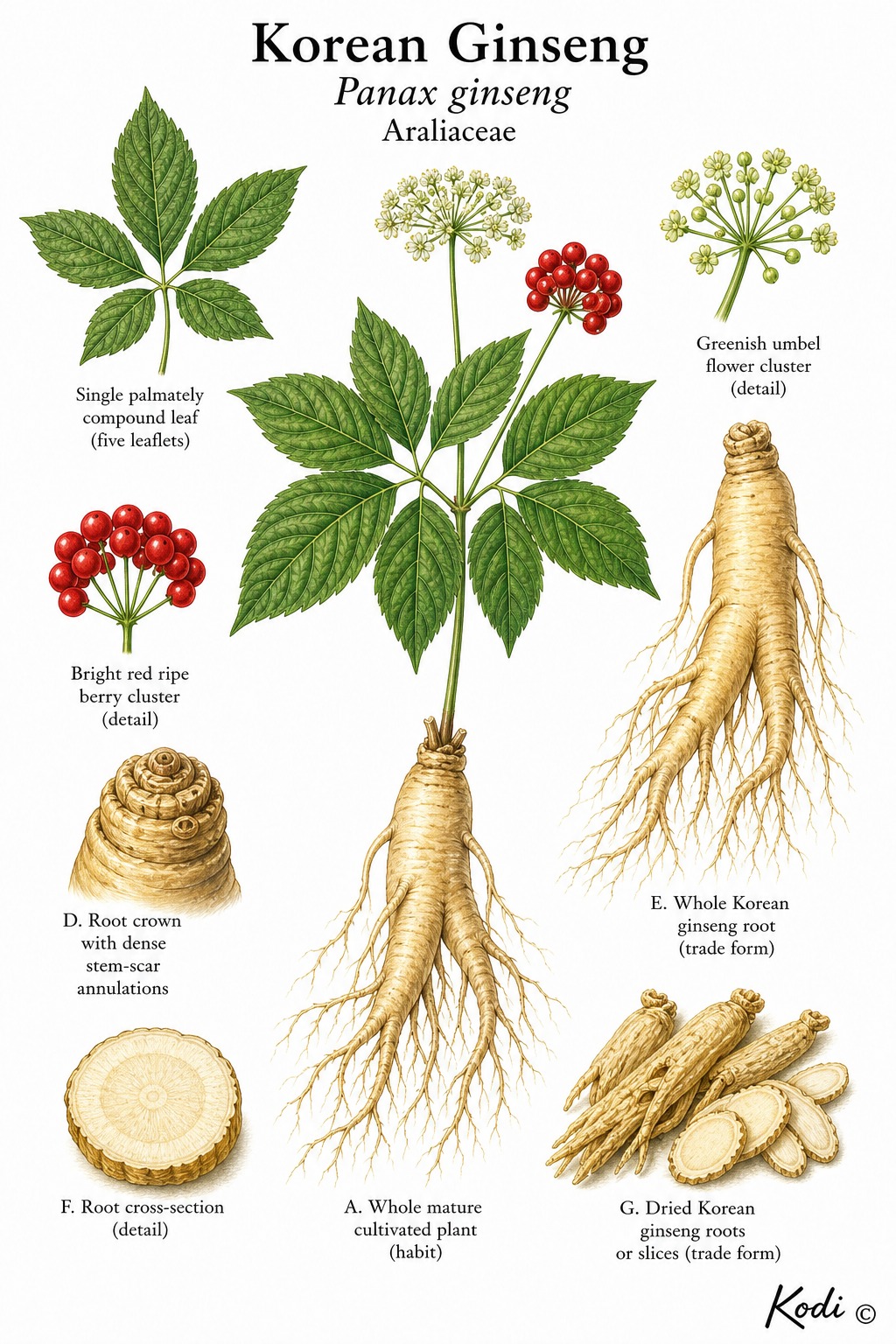
Known in TCM as Gao Li Shen (高丽参), this sweet and slightly bitter, slightly warm herb enters the Spleen, Lung, and Heart. Traditionally, it powerfully tonifies source qi - Gao Li Shen is used for marked fatigue, weak pulse, shortness of breath, and constitutional depletion in the same core clinical family as Ren Shen, most often applied for fatigue, digestive weakness, and palpitations. Modern research has identified Ginsenosides among its active constituents.
Also Known As
Latin: Ginseng Coreensis Radix | Pinyin: Gao Li Shen | Chinese: 高丽参
TCM Properties
- Taste
- sweet, slightly bitter
- Temperature
- slightly warm
- Channels
- Spleen, Lung, Heart
Traditional Use
Primary Actions
- Powerfully tonifies source qi - Gao Li Shen is used for marked fatigue, weak pulse, shortness of breath, and constitutional depletion in the same core clinical family as Ren Shen.
- Strengthens the Spleen and Lung - traditional use includes poor appetite, weak digestion, chronic weakness, and deficiency-type cough or breathlessness.
- Generates fluids and supports the Heart spirit - it is selected for thirst, fluid depletion after illness, palpitations, and depletion states in which qi and fluids fail together.
Secondary Actions
- This record preserves Gao Li Shen as a Korea-sourced Panax ginseng naming layer rather than inventing a different species or pretending it is automatically identical to the later processing-specific Hong Shen page.
- In real trade literature, Gao Li Shen may overlap with premium Korean commercial grades and sometimes with steamed products, so source and processing should be clarified rather than assumed.
Classic Formulas
- Si Jun Zi Tang - foundational Spleen-Qi formula that illustrates the core tonifying role shared by Korea-sourced Panax ginseng.
- Sheng Mai San - classic formula in which ginseng restores qi while preserving fluids and protecting the pulse.
- Gui Pi Tang and related Heart-Spleen formulas - traditional pattern context for fatigue, palpitations, forgetfulness, and poor appetite.
Classical References
- Traditional herb references treat Gao Li Shen as Panax ginseng in the Ren Shen family, with sweet, slightly bitter, slightly warm tonifying properties.
- Modern materia medica and trade usage distinguish it mainly by origin and grading rather than by a wholly separate set of actions.
- This page intentionally leaves room for the later `red-ginseng` record to cover the steaming-based Hong Shen identity more specifically.
Modern Research
Active Compounds
- Ginsenosides such as Rg1, Rb1, Rc, Rd, and Re - the core Panax ginseng marker compounds
- Processed-product ginsenosides such as Rg3, Rk1, and Rg5 - especially relevant when Korean commercial material has been steamed
- Ginseng polysaccharides - major immune and metabolic research fractions
- Polyacetylenes such as panaxynol and panaxydol - supportive anti-inflammatory constituents
Studied Effects
- A 2022 systematic review and meta-analysis found that Panax ginseng products, including Korean red ginseng, improved several cardiometabolic measures such as glucose and lipid parameters and blood pressure in pooled analyses, although study contexts were mixed (PMID 35509826).
- A 2023 review described how steaming and related processing markedly transform ginsenoside profiles in red ginseng products, which is important because modern Korean ginseng research often mixes origin and processing categories (PMID 37188270).
- A randomized trial reported benefit of Korean red ginseng for cold hypersensitivity of the hands and feet, providing one human clinical example from the Korean ginseng literature while still reflecting a processed-product context rather than all Gao Li Shen commerce equally (PMID 25284751).
PubMed References
- Effects of Panax ginseng on hyperglycemia, hypertension, and hyperlipidemia: A systematic review and meta-analysis. (2022)
- Saponins of ginseng products: a review of their transformation in processing. (2023)
- Efficacy and safety of Korean red ginseng for cold hypersensitivity in the hands and feet: a randomized, double-blind, placebo-controlled trial. (2014)
Safety & Interactions
Contraindications
- Acute excess heat or agitation without deficiency
- Concurrent warfarin therapy without close monitoring
- Marked stimulant-type insomnia, palpitations, or uncontrolled hypertension with clear excess signs
Cautions
- Memorial Sloan Kettering lists interaction concerns for Asian ginseng with warfarin, insulin, imatinib, and raltegravir, and that guidance is relevant here because Gao Li Shen remains a Panax ginseng product.
- Because Korean ginseng in commerce may refer to source, grade, or processing status, it should not automatically be treated as identical to fresh Ren Shen or later Hong Shen preparations.
- High-dose use may cause insomnia, nervousness, blood-pressure changes, or gastrointestinal upset.
Drug Interactions
- Warfarin - possible change in anticoagulant effect or bleeding risk.
- Insulin or hypoglycemic drugs - possible additive glucose-lowering effect.
- Imatinib or raltegravir - potential increase in liver injury risk noted by MSK.
Conditions
- Fatigue Traditional ★★★★☆ JSON
- Digestive Weakness Traditional ★★★☆☆ JSON
- Palpitations Traditional ★★☆☆☆ JSON
- Type 2 Diabetes Research ★★☆☆☆ JSON
Frequently Asked Questions
What is Korean Ginseng used for?
Korean Ginseng is traditionally used to Powerfully tonifies source qi - Gao Li Shen is used for marked fatigue, weak pulse, shortness of breath, and constitutional depletion in the same core clinical family as Ren Shen., Strengthens the Spleen and Lung - traditional use includes poor appetite, weak digestion, chronic weakness, and deficiency-type cough or breathlessness., Generates fluids and supports the Heart spirit - it is selected for thirst, fluid depletion after illness, palpitations, and depletion states in which qi and fluids fail together.. Research has investigated its effects on: A 2022 systematic review and meta-analysis found that Panax ginseng products, including Korean red ginseng, improved several cardiometabolic measures such as glucose and lipid parameters and blood pressure in pooled analyses, although study contexts were mixed (PMID 35509826).; A 2023 review described how steaming and related processing markedly transform ginsenoside profiles in red ginseng products, which is important because modern Korean ginseng research often mixes origin and processing categories (PMID 37188270)..
What are other names for Korean Ginseng?
Korean Ginseng is also known as Panax ginseng, Korean Panax Ginseng, Asian Ginseng. In TCM: 高丽参 (Gao Li Shen); Ginseng Coreensis Radix.
Is Korean Ginseng safe during pregnancy?
The safety of Korean Ginseng during pregnancy has not been established. Consult a qualified healthcare provider before use.
What are the contraindications for Korean Ginseng?
Korean Ginseng should not be used in: Acute excess heat or agitation without deficiency; Concurrent warfarin therapy without close monitoring; Marked stimulant-type insomnia, palpitations, or uncontrolled hypertension with clear excess signs. Consult a qualified practitioner before use.
Does Korean Ginseng interact with any medications?
Korean Ginseng may interact with: Warfarin - possible change in anticoagulant effect or bleeding risk.; Insulin or hypoglycemic drugs - possible additive glucose-lowering effect.; Imatinib or raltegravir - potential increase in liver injury risk noted by MSK.. Always inform your healthcare provider of any herbal supplements you are taking.