Kusnezoff Monkshood Leaf
- Chinese
- 草乌叶
- Pinyin
- Cao Wu Ye
- Latin
- Folium Aconiti Kusnezoffii
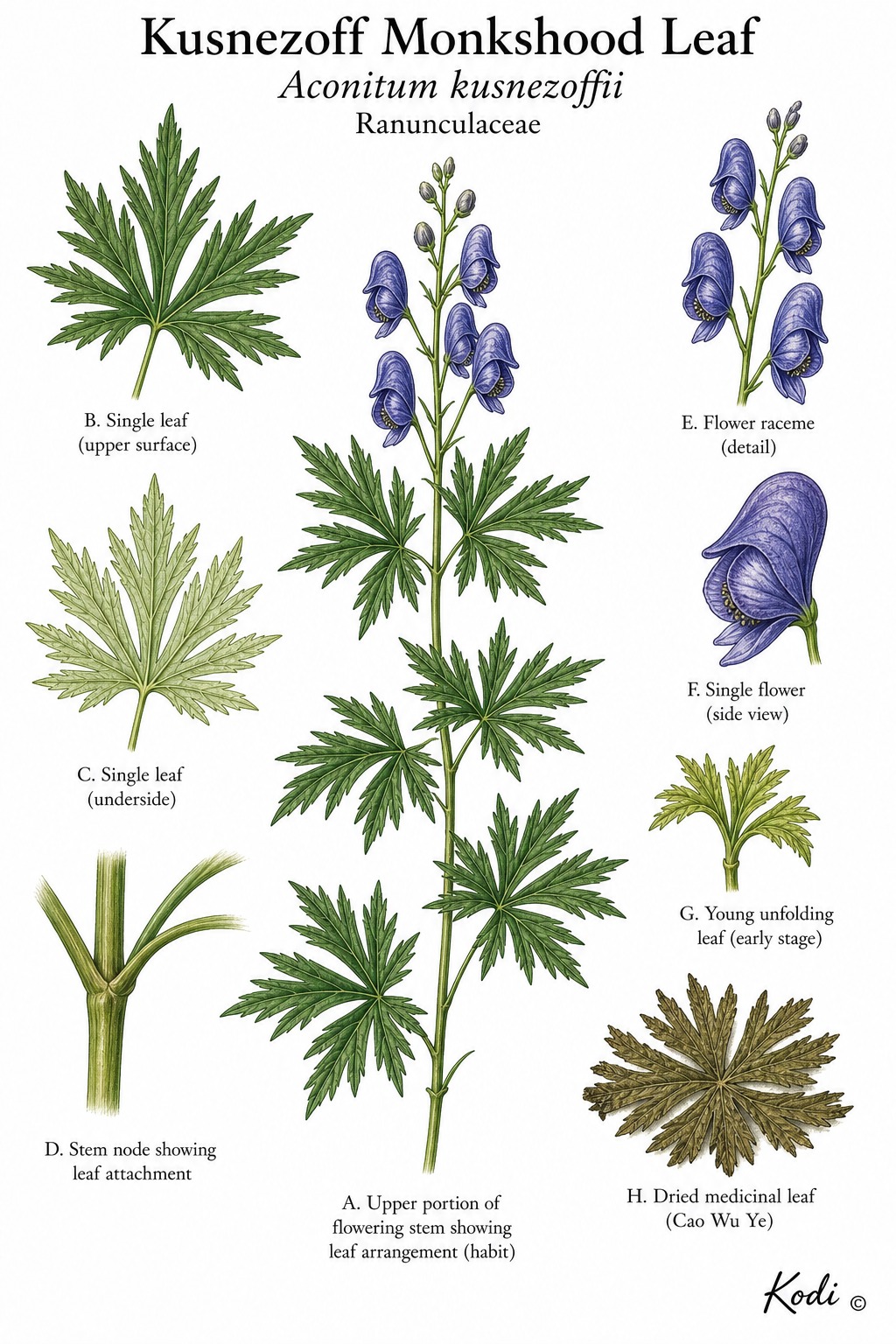
Known in TCM as Cao Wu Ye (草乌叶), this acrid and astringent, neutral herb enters the Liver. Traditionally, it clears heat and relieves pain in regional practice - Cao Wu Ye is used for headache, toothache, fever, and painful inflammatory complaints where the leaf is chosen instead of the far more toxic root-focused internal strategies, most often applied for headache, toothache, and diarrhea. Modern research has identified Aconitine-type among its active constituents.
Part used: Leaf
Also Known As
Latin: Folium Aconiti Kusnezoffii | Pinyin: Cao Wu Ye | Chinese: 草乌叶
TCM Properties
- Taste
- acrid, astringent
- Temperature
- neutral
- Channels
- Liver
Traditional Use
Primary Actions
- Clears heat and relieves pain in regional practice - Cao Wu Ye is used for headache, toothache, fever, and painful inflammatory complaints where the leaf is chosen instead of the far more toxic root-focused internal strategies.
- Resolves toxicity - traditional use includes certain toxic-heat or painful conditions in folk and Mongolian practice, often in small internal doses or external applications.
- Treats localized pain with a lighter aerial-part logic than Cao Wu root - the leaf is kept separate because its indications, dosage, and preparation are not identical to root tuber use.
Secondary Actions
- This is a marginal and safety-sensitive medicinal compared with mainstream root-based aconite records; the leaf should not be casually substituted for Cao Wu, Chuan Wu, or processed Fu Zi products.
- Even though some traditional references assign a more neutral profile to the leaf than to the root, the presence of aconitine-type alkaloids means practical toxicity caution still dominates interpretation.
Classic Formulas
- Cao Wu Ye powder or pill use in small doses - a traditional pattern for headache, fever, toothache, or diarrhea in local practice.
- Cao Wu Ye topical or wash-style use - external application logic when painful toxic swelling is present and strong internal aconite exposure is undesirable.
- Mongolian formula traditions containing Cao Wu Ye - modern regional preservation of the leaf as a distinct medicinal part rather than an accidental byproduct.
Classical References
- Traditional references for Cao Wu Ye describe it as acrid, astringent, neutral, and slightly toxic, entering the Liver and being used for pain, fever, headache, and toothache.
- Modern standards and materia medica vocabularies preserve Cao Wu Ye as a distinct medicinal part of Aconitum kusnezoffii rather than collapsing it into root-based aconite records.
- Because many standard TCM textbooks focus on root preparations instead, this page keeps the leaf monograph conservative and narrow.
Modern Research
Active Compounds
- Aconitine-type diterpenoid alkaloids - the main toxicity-defining compounds expected across Aconitum kusnezoffii tissues
- Mesaconitine and hypaconitine-type congeners - representative alkaloid families relevant to cardiotoxicity and neurotoxicity
- Lipo-aconitines and related aerial-part alkaloids - compounds reported from flowers and other non-root tissues
Studied Effects
- A 2026 review of Aconitum kusnezoffii summarized analgesic, anti-inflammatory, antitumor, and toxicology literature across the species, but direct leaf-specific evidence remained limited, supporting a deliberately narrow monograph for Cao Wu Ye (PMID 41151648).
- A 2003 mass-spectrometry study characterized numerous aconitine-type alkaloids in Aconitum kusnezoffii flowers and reported new lipo-aconitines, reinforcing that aerial parts also carry meaningful toxic-alkaloid burden rather than being assumed benign (PMID 14505324).
- A 2018 safety review of Aconiti Kusnezoffii Radix emphasized cardiovascular, nervous-system, renal, and reproductive toxicity risks from the species, a warning that remains relevant when interpreting leaf use because direct human safety data for the leaf are sparse (PMID 30200703).
PubMed References
- A comprehensive review of the traditional usages, phytochemistry, pharmacology, toxicology, quality control and other applications of Aconitum kusnezoffii Reichb. (2026)
- Characterization of aconitine-type alkaloids in the flowers of Aconitum kusnezoffii by electrospray ionization tandem mass spectrometry. (2003)
- Safety evaluation and risk control measures for Aconiti Kusnezoffii Radix. (2018)
Safety & Interactions
Contraindications
- Pregnancy
- Any unsupervised internal use of Aconitum leaf material
- Arrhythmia, severe cardiac disease, or unexplained neurologic symptoms
- Concurrent use with Ban Xia, Gua Lou, Tian Hua Fen, Bai Ji, Bai Lian, or Bei Mu species
Cautions
- Cao Wu Ye belongs to the Aconitum family and should be treated as toxic unless expertly sourced, prepared, and supervised.
- Early aconite poisoning may include mouth numbness, tingling, nausea, vomiting, weakness, hypotension, and dangerous ventricular arrhythmias; suspected toxicity requires emergency care.
- The leaf record is especially low-evidence, so absence of human trial data should not be mistaken for proof of safety.
Drug Interactions
- Cardiac glycosides such as digoxin - additive arrhythmogenic risk.
- Class I and III antiarrhythmic drugs - unpredictable electrophysiologic interaction.
- QT-prolonging medications - additive risk of malignant ventricular arrhythmias.
Conditions
Frequently Asked Questions
What is Kusnezoff Monkshood Leaf used for?
Kusnezoff Monkshood Leaf is traditionally used to Clears heat and relieves pain in regional practice - Cao Wu Ye is used for headache, toothache, fever, and painful inflammatory complaints where the leaf is chosen instead of the far more toxic root-focused internal strategies., Resolves toxicity - traditional use includes certain toxic-heat or painful conditions in folk and Mongolian practice, often in small internal doses or external applications., Treats localized pain with a lighter aerial-part logic than Cao Wu root - the leaf is kept separate because its indications, dosage, and preparation are not identical to root tuber use.. Research has investigated its effects on: A 2026 review of Aconitum kusnezoffii summarized analgesic, anti-inflammatory, antitumor, and toxicology literature across the species, but direct leaf-specific evidence remained limited, supporting a deliberately narrow monograph for Cao Wu Ye (PMID 41151648).; A 2003 mass-spectrometry study characterized numerous aconitine-type alkaloids in Aconitum kusnezoffii flowers and reported new lipo-aconitines, reinforcing that aerial parts also carry meaningful toxic-alkaloid burden rather than being assumed benign (PMID 14505324)..
What are other names for Kusnezoff Monkshood Leaf?
Kusnezoff Monkshood Leaf is also known as Aconite Leaf, Aconiti. In TCM: 草乌叶 (Cao Wu Ye); Folium Aconiti Kusnezoffii.
Is Kusnezoff Monkshood Leaf safe during pregnancy?
Kusnezoff Monkshood Leaf is not recommended during pregnancy.
What are the contraindications for Kusnezoff Monkshood Leaf?
Kusnezoff Monkshood Leaf should not be used in: Pregnancy; Any unsupervised internal use of Aconitum leaf material; Arrhythmia, severe cardiac disease, or unexplained neurologic symptoms; Concurrent use with Ban Xia, Gua Lou, Tian Hua Fen, Bai Ji, Bai Lian, or Bei Mu species. Consult a qualified practitioner before use.
Does Kusnezoff Monkshood Leaf interact with any medications?
Kusnezoff Monkshood Leaf may interact with: Cardiac glycosides such as digoxin - additive arrhythmogenic risk.; Class I and III antiarrhythmic drugs - unpredictable electrophysiologic interaction.; QT-prolonging medications - additive risk of malignant ventricular arrhythmias.. Always inform your healthcare provider of any herbal supplements you are taking.