Largeleaf Japanese Ginseng Rhizome
- Chinese
- 珠子参
- Pinyin
- Zhu Zi Shen
- Latin
- Rhizoma Panacis Majoris
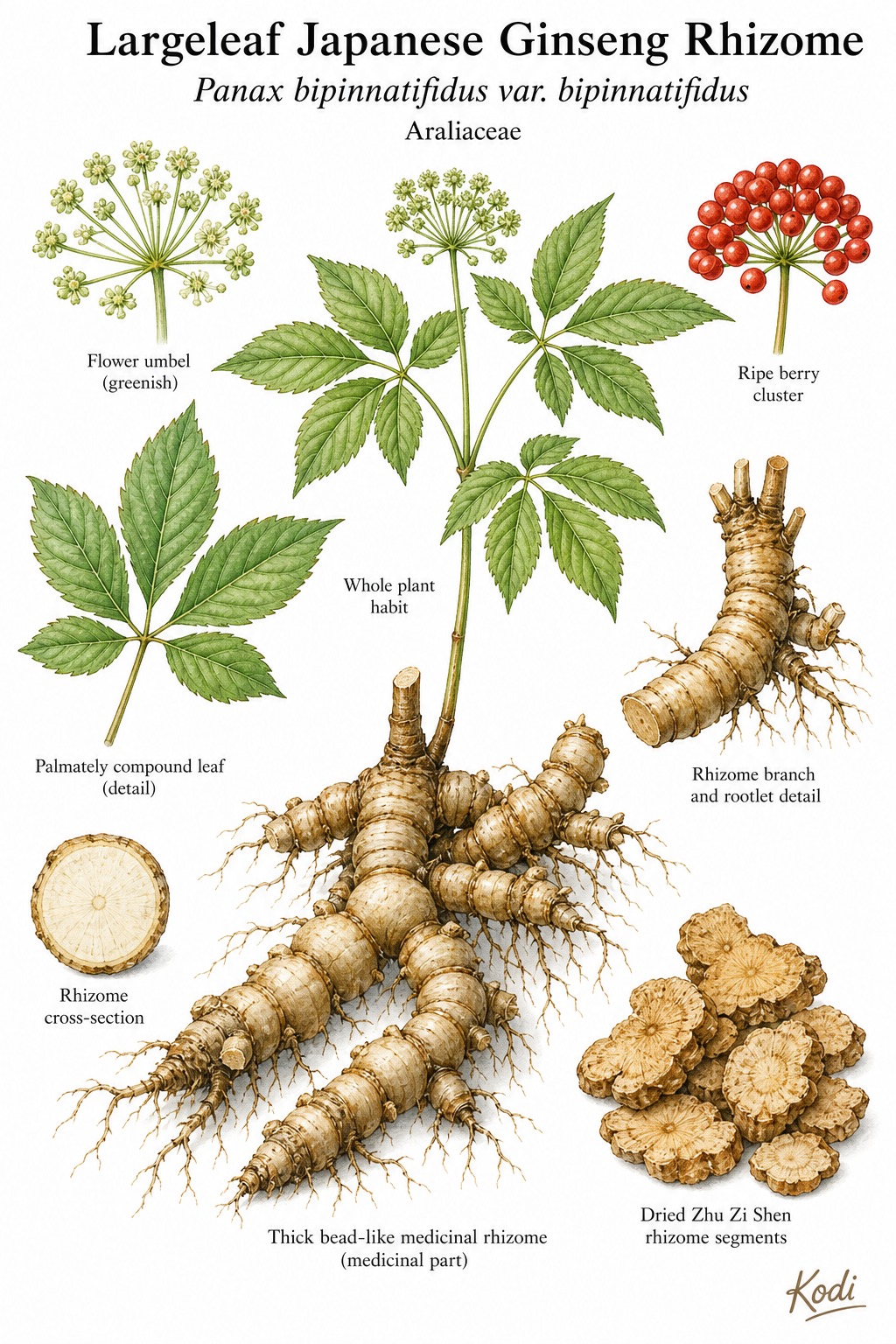
Known in TCM as Zhu Zi Shen (珠子参), this sweet and slightly bitter, slightly cold herb enters the Lung, Liver, and Stomach. Traditionally, it tonifies qi and nourishes yin - Zhu Zi Shen is used for chronic weakness, dry cough, thirst, and post-illness depletion when the patient needs support without the warmer push of Ren Shen, most often applied for hemoptysis, traumatic injury, and rheumatism. Modern research has identified Oleanane-type among its active constituents.
Part used: Rhizome
Also Known As
Latin: Rhizoma Panacis Majoris | Pinyin: Zhu Zi Shen | Chinese: 珠子参
TCM Properties
- Taste
- sweet, slightly bitter
- Temperature
- slightly cold
- Channels
- Lung, Liver, Stomach
Traditional Use
Primary Actions
- Tonifies qi and nourishes yin - Zhu Zi Shen is used for chronic weakness, dry cough, thirst, and post-illness depletion when the patient needs support without the warmer push of Ren Shen.
- Invigorates blood and stops pain - unlike ordinary ginseng tonics, it also has a traditional role in traumatic pain, bruising, and rheumatic obstruction.
- Stops bleeding - classic use extends to hemoptysis, traumatic bleeding, and other deficiency- or injury-linked bleeding patterns in which support and restraint are both needed.
Secondary Actions
- Zhu Zi Shen should not be flattened into ordinary Ren Shen: it belongs to the broader Panax family but acts more like a cooler, rhizome-centered qi-yin tonic with blood-moving traits.
- Current botanical literature often places the source under Panax bipinnatifidus var. bipinnatifidus even though TCM and pharmacopoeial records still commonly use the Panax japonicus var. major naming layer.
Classic Formulas
- Zhu Zi Shen with San Qi or Bai Ji - a traditional pairing style for bleeding with tissue damage or trauma.
- Zhu Zi Shen with Mai Men Dong or Sha Shen - qi-yin restoring combinations for dry cough, thirst, and post-febrile depletion.
- Zhu Zi Shen with Du Huo or Qin Jiao - pattern logic when weakness coexists with painful obstruction and blood stasis.
Classical References
- Modern Chinese materia medica describe Zhu Zi Shen as sweet, slightly bitter, and slightly cold, entering the Lung, Liver, and Stomach to tonify qi, nourish yin, move blood, stop pain, and stop bleeding.
- The medicinal part is the rhizome rather than the ordinary ginseng root, which helps explain why this Panax drug carries a distinct pain-and-bleeding profile.
- This page follows the pharmacopoeial Rhizoma Panacis Majoris identity while preserving room for accepted botanical synonym updates.
Modern Research
Active Compounds
- Oleanane-type triterpenoid saponins such as chikusetsusaponins - core Panacis Majoris marker compounds
- Additional ginsenoside-family saponins - major constituents contributing to the herb's overlap with broader Panax pharmacology
- Polysaccharides and supportive phenolic fractions - secondary constituents under investigation for immune and anti-inflammatory effects
Studied Effects
- A 2022 review summarized anti-inflammatory, antioxidant, antitumor, and antidiabetic research on Panacis Majoris Rhizoma and emphasized chikusetsusaponins as the dominant marker constituents behind modern pharmacology interest (PMID 36117758).
- A 2023 study characterized 47 triterpenoid saponins in Panacis Majoris Rhizoma and linked several of them to anti-inflammatory and anti-cancer network targets, reinforcing that this rhizome has a chemically coherent profile distinct from ordinary ginseng trade language (PMID 37684699).
- A 2024 experimental arthritis study found that Panacis Majoris Rhizoma attenuated rheumatoid synovitis and osteoclast activity through NF-kB and MAPK-related pathways, giving a plausible modern correlate for the herb's pain-and-obstruction tradition (PMID 40554290).
PubMed References
- Traditional uses, botany, phytochemistry, pharmacology, quality control and toxicity of Panacis Majoris Rhizoma: A review. (2022)
- Chemical characterization and quality evaluation of Panacis Majoris Rhizoma based on UPLC-QTOF-MS and network pharmacology. (2023)
- Panacis Majoris Rhizoma ameliorates rheumatoid arthritis by suppressing synovial inflammation and osteoclast differentiation. (2024)
Safety & Interactions
Contraindications
- Loose stool or cold-damp digestive weakness without qi-yin depletion
Cautions
- Zhu Zi Shen is a real Panax-family medicinal, but it is not interchangeable with Ren Shen, Xi Yang Shen, or San Qi despite overlap in the broader ginseng group.
- Most modern evidence remains preclinical and does not by itself justify stand-alone treatment of autoimmune or bleeding disorders.
- MSK page not found - drug interaction data not available from Memorial Sloan Kettering integrative medicine database
Conditions
- Hemoptysis Traditional ★★★☆☆ JSON
- Traumatic Injury Traditional ★★★☆☆ JSON
- Rheumatism Traditional ★★★☆☆ JSON
- Yin Deficiency Traditional ★★★☆☆ JSON
Frequently Asked Questions
What is Largeleaf Japanese Ginseng Rhizome used for?
Largeleaf Japanese Ginseng Rhizome is traditionally used to Tonifies qi and nourishes yin - Zhu Zi Shen is used for chronic weakness, dry cough, thirst, and post-illness depletion when the patient needs support without the warmer push of Ren Shen., Invigorates blood and stops pain - unlike ordinary ginseng tonics, it also has a traditional role in traumatic pain, bruising, and rheumatic obstruction., Stops bleeding - classic use extends to hemoptysis, traumatic bleeding, and other deficiency- or injury-linked bleeding patterns in which support and restraint are both needed.. Research has investigated its effects on: A 2022 review summarized anti-inflammatory, antioxidant, antitumor, and antidiabetic research on Panacis Majoris Rhizoma and emphasized chikusetsusaponins as the dominant marker constituents behind modern pharmacology interest (PMID 36117758).; A 2023 study characterized 47 triterpenoid saponins in Panacis Majoris Rhizoma and linked several of them to anti-inflammatory and anti-cancer network targets, reinforcing that this rhizome has a chemically coherent profile distinct from ordinary ginseng trade language (PMID 37684699)..
What are other names for Largeleaf Japanese Ginseng Rhizome?
Largeleaf Japanese Ginseng Rhizome is also known as Bead Ginseng, Panacis. In TCM: 珠子参 (Zhu Zi Shen); Rhizoma Panacis Majoris.
Is Largeleaf Japanese Ginseng Rhizome safe during pregnancy?
The safety of Largeleaf Japanese Ginseng Rhizome during pregnancy has not been established. Consult a qualified healthcare provider before use.
What are the contraindications for Largeleaf Japanese Ginseng Rhizome?
Largeleaf Japanese Ginseng Rhizome should not be used in: Loose stool or cold-damp digestive weakness without qi-yin depletion. Consult a qualified practitioner before use.