Largetrifoliolious Bugbane Rhizome
- Chinese
- 升麻
- Pinyin
- Sheng Ma
- Latin
- Rhizoma Cimicifugae
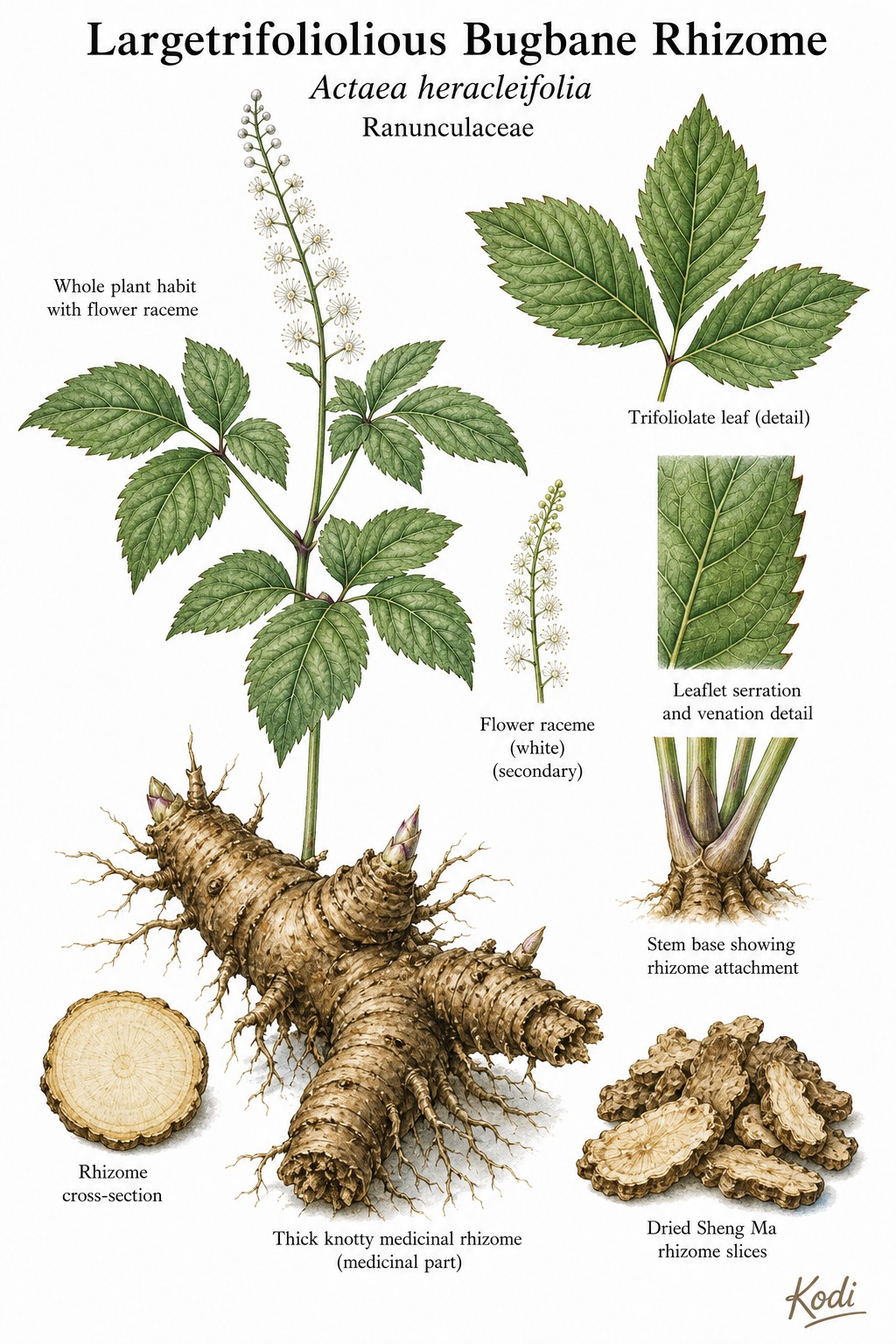
Known in TCM as Sheng Ma (升麻), this acrid and slightly sweet, slightly cold herb enters the Lung, Spleen, Stomach, and Large Intestine. Traditionally, it releases the exterior and vents rashes - Sheng Ma is classically used for early wind-heat, sore throat, and measles or eruptions that need to vent outward, most often applied for sore throat, common cold, and fever. Modern research has identified Triterpene among its active constituents.
Part used: Rhizome
Also Known As
Latin: Rhizoma Cimicifugae | Pinyin: Sheng Ma | Chinese: 升麻
TCM Properties
- Taste
- acrid, slightly sweet
- Temperature
- slightly cold
- Channels
- Lung, Spleen, Stomach, Large Intestine
Traditional Use
Primary Actions
- Releases the exterior and vents rashes - Sheng Ma is classically used for early wind-heat, sore throat, and measles or eruptions that need to vent outward.
- Clears heat and resolves toxin - it is chosen for toxic heat in the throat, mouth, gums, or skin when redness, swelling, and fire are prominent.
- Raises clear yang and lifts sinking qi - traditional indications include chronic diarrhea, prolapse, and collapse of middle-burner lifting function.
Secondary Actions
- Sheng Ma has a dual nature that matters clinically: one side vents heat outward, while the other raises what has sunken inward.
- Prepared Sheng Ma is often used when the lifting function is emphasized, while raw Sheng Ma is more strongly venting and heat-clearing.
Classic Formulas
- Bu Zhong Yi Qi Tang - classic middle-qi lifting formula in which Sheng Ma helps raise clear yang together with Huang Qi and Chai Hu.
- Sheng Ma Ge Gen Tang - famous formula for venting early-stage measles and exterior heat while easing the neck and upper body.
- Pu Ji Xiao Du Yin - toxin-clearing throat and head formula in which Sheng Ma helps vent and disperse upper-burner fire toxin.
Classical References
- Traditional references describe Sheng Ma as acrid, slightly sweet, and slightly cold, entering the Lung, Spleen, Stomach, and Large Intestine.
- Its core classical functions are to release the exterior, vent eruptions, clear heat and toxins, and raise yang qi.
- The current pharmacopoeial drug includes several Cimicifuga sources, so correct sourcing matters even when the traditional action profile is shared.
Modern Research
Active Compounds
- Triterpene glycosides such as cimicifugosides - major Rhizoma Cimicifugae marker compounds
- Phenylpropanoids including cimicifugic acids - characteristic constituents relevant to anti-inflammatory and quality-control work
- Chromones and related minor constituents - supportive compounds in broader pharmacology studies
Studied Effects
- A 2024 review summarized Rhizoma Cimicifugae pharmacology across anti-inflammatory, analgesic, antipyretic, antiviral, and immunoregulatory domains, reflecting why Sheng Ma remains a major heat-toxin herb in both tradition and modern research (PMID 38715120).
- A 2021 study found that an active fraction of Rhizoma Cimicifugae alleviated OVA-induced allergic asthma in mice through regulation of Nrf2/HO-1/NQO1 and NF-kB signaling, providing a mechanistic correlate for heat and throat-lung use (PMID 34679759).
- A 2010 paper isolated triterpenes from Cimicifuga foetida with in vitro anti-inflammatory activity, supporting the relevance of Cimicifuga triterpene chemistry to the medicinal group even when species-level sourcing differs (PMID 20946932).
PubMed References
- A review of medicinal uses, phytochemistry, pharmacology and quality control of Rhizoma Cimicifugae. (2024)
- Active fraction of Rhizoma Cimicifugae alleviates OVA-induced allergic asthma in mice by regulating Nrf2/HO-1/NQO1 and NF-kB signaling pathways. (2021)
- Anti-inflammatory triterpenes from the rhizomes of Cimicifuga foetida. (2010)
Safety & Interactions
Contraindications
- Yin deficiency with floating heat or headache from liver-yang excess without toxin or sinking middle qi
Cautions
- Because Sheng Ma raises clear yang, it should be used more carefully in patients with marked rising yang, severe headache, or active vomiting unrelated to sinking qi.
- Modern Cimicifuga literature includes multiple source species, so authentication matters when concentrated extracts are used.
- MSK page not found - drug interaction data not available from Memorial Sloan Kettering integrative medicine database
Conditions
- Sore Throat Traditional ★★★★☆ JSON
- Common Cold Traditional ★★★☆☆ JSON
- Fever Traditional ★★★☆☆ JSON
- Diarrhea Traditional ★★☆☆☆ JSON
Frequently Asked Questions
What is Largetrifoliolious Bugbane Rhizome used for?
Largetrifoliolious Bugbane Rhizome is traditionally used to Releases the exterior and vents rashes - Sheng Ma is classically used for early wind-heat, sore throat, and measles or eruptions that need to vent outward., Clears heat and resolves toxin - it is chosen for toxic heat in the throat, mouth, gums, or skin when redness, swelling, and fire are prominent., Raises clear yang and lifts sinking qi - traditional indications include chronic diarrhea, prolapse, and collapse of middle-burner lifting function.. Research has investigated its effects on: A 2024 review summarized Rhizoma Cimicifugae pharmacology across anti-inflammatory, analgesic, antipyretic, antiviral, and immunoregulatory domains, reflecting why Sheng Ma remains a major heat-toxin herb in both tradition and modern research (PMID 38715120).; A 2021 study found that an active fraction of Rhizoma Cimicifugae alleviated OVA-induced allergic asthma in mice through regulation of Nrf2/HO-1/NQO1 and NF-kB signaling, providing a mechanistic correlate for heat and throat-lung use (PMID 34679759)..
What are other names for Largetrifoliolious Bugbane Rhizome?
Largetrifoliolious Bugbane Rhizome is also known as Cimicifuga Rhizome, Bugbane Rhizome. In TCM: 升麻 (Sheng Ma); Rhizoma Cimicifugae.
Is Largetrifoliolious Bugbane Rhizome safe during pregnancy?
The safety of Largetrifoliolious Bugbane Rhizome during pregnancy has not been established. Consult a qualified healthcare provider before use.
What are the contraindications for Largetrifoliolious Bugbane Rhizome?
Largetrifoliolious Bugbane Rhizome should not be used in: Yin deficiency with floating heat or headache from liver-yang excess without toxin or sinking middle qi. Consult a qualified practitioner before use.