Larvae of Scarab Beetle
- Chinese
- 蛴螬
- Pinyin
- Qi Cao
- Latin
- Larva Holotrichiae
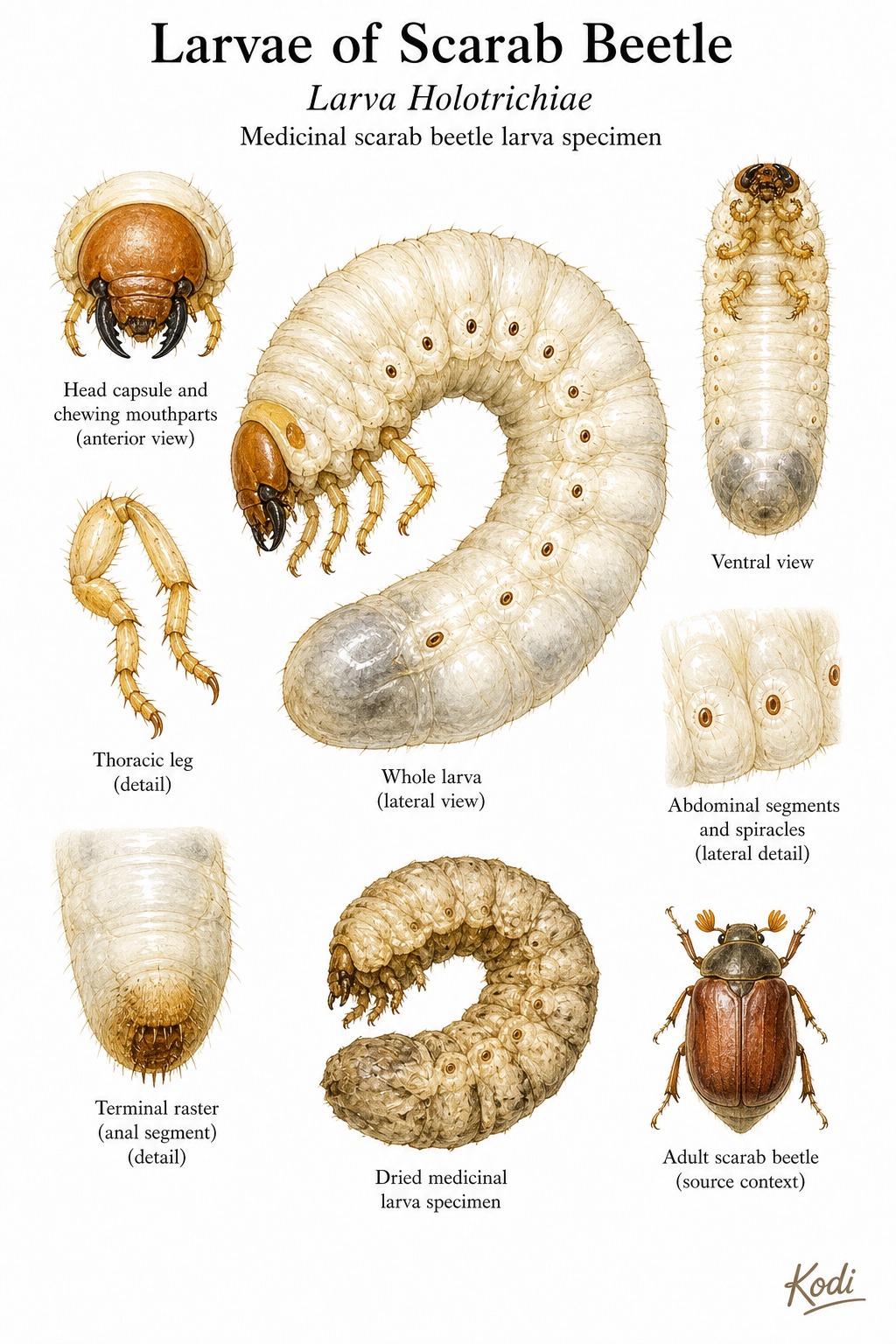
Known in TCM as Qi Cao (蛴螬), this salty, slightly warm herb enters the Liver. Traditionally, it breaks up blood stasis and alleviates pain - Qi Cao is used for traumatic injury, fixed pain, amenorrhea, and painful obstructed menses with palpable stasis, most often applied for blood stasis, traumatic injury, and amenorrhea. Modern research has identified Protein among its active constituents.
Also Known As
Latin: Larva Holotrichiae | Pinyin: Qi Cao | Chinese: 蛴螬
TCM Properties
- Taste
- salty
- Temperature
- slightly warm
- Channels
- Liver
Traditional Use
Primary Actions
- Breaks up blood stasis and alleviates pain - Qi Cao is used for traumatic injury, fixed pain, amenorrhea, and painful obstructed menses with palpable stasis.
- Dissipates nodules and reduces swelling - traditional use extends to hard accumulations and swelling where a strong animal medicine is preferred.
- Promotes lactation in older folk use - some local traditions include postpartum breast obstruction or insufficient milk flow.
Secondary Actions
- Qi Cao is a niche insect medicine rather than a common frontline herb, and modern use is much rarer than for plant-based blood-moving alternatives.
- Source authenticity matters because several scarab and beetle-larva materials circulate in trade, and not all are pharmacopoeial Larva Holotrichiae.
Classic Formulas
- Qi Cao with Tao Ren and Hong Hua - a blood-stasis pairing style for trauma or obstructed menses.
- Qi Cao with Wang Bu Liu Xing - traditional postpartum logic when blood stasis and poor milk flow coexist.
- Qi Cao with E Zhu or San Leng - stronger nodule- and mass-dispersing combinations in regional practice.
Classical References
- Traditional references describe Qi Cao as salty and slightly warm, entering the Liver to break blood stasis, promote lactation, and dissipate hard masses.
- Because it is an animal medicine with strong movement, it is generally used in smaller doses and for more specific indications than common plant-based blood movers.
- This record preserves the true scarab-larva identity instead of leaving it as an unspecified insect powder.
Modern Research
Active Compounds
- Protein and peptide fractions - major biologically active components explored in insect-medicine studies
- Fatty acids and sterol-like lipids - supportive constituents in extract profiling
- Immunomodulatory small molecules and chitin-associated fractions - candidate contributors to species-level bioactivity
Studied Effects
- A 2001 study found that an extract of Holotrichia diomphalia larvae induced nitric oxide and TNF-alpha production by mouse macrophages and showed immunomodulatory activity, demonstrating that this insect medicine has measurable biologic effects rather than being an inert folk material (PMID 11744300).
- A 2019 experimental study reported that Holotrichia diomphalia larva extract reduced airway inflammation and shifted Th2-related signaling in an asthma model, supporting continuing interest in insect-derived immune activity even though this is not a direct classical indication (PMID 30823378).
- A 2024 DNA metabarcoding analysis of Larva Holotrichiae products found species-substitution problems in the market, reinforcing that authentication is a real quality issue for this medicine (PMID 38401835).
PubMed References
- Immunomodulating activity of the extract of larvae of Holotrichia diomphalia. (2001)
- Holotrichia diomphalia larvae extract attenuates allergic airway inflammation through inhibition of GATA-3 and Th2 cytokines in mice. (2019)
- DNA metabarcoding analysis reveals adulteration in Larva Holotrichiae products. (2024)
Safety & Interactions
Contraindications
- Pregnancy
- Bleeding disorders or heavy active bleeding without blood-stasis pattern confirmation
Cautions
- Qi Cao is a strong animal-derived blood-moving medicinal and should be used more cautiously than common food-grade insect products.
- Because market substitution is documented, authenticated sourcing matters for both safety and pharmacologic consistency.
- Shellfish- or insect-sensitive patients may warrant added caution even though direct allergy data are limited.
Conditions
- Blood Stasis Traditional ★★★★☆ JSON
- Traumatic Injury Traditional ★★★☆☆ JSON
- Amenorrhea Traditional ★★★☆☆ JSON
- Insufficient Lactation Traditional ★★☆☆☆ JSON
Frequently Asked Questions
What is Larvae of Scarab Beetle used for?
Larvae of Scarab Beetle is traditionally used to Breaks up blood stasis and alleviates pain - Qi Cao is used for traumatic injury, fixed pain, amenorrhea, and painful obstructed menses with palpable stasis., Dissipates nodules and reduces swelling - traditional use extends to hard accumulations and swelling where a strong animal medicine is preferred., Promotes lactation in older folk use - some local traditions include postpartum breast obstruction or insufficient milk flow.. Research has investigated its effects on: A 2001 study found that an extract of Holotrichia diomphalia larvae induced nitric oxide and TNF-alpha production by mouse macrophages and showed immunomodulatory activity, demonstrating that this insect medicine has measurable biologic effects rather than being an inert folk material (PMID 11744300).; A 2019 experimental study reported that Holotrichia diomphalia larva extract reduced airway inflammation and shifted Th2-related signaling in an asthma model, supporting continuing interest in insect-derived immune activity even though this is not a direct classical indication (PMID 30823378)..
What are other names for Larvae of Scarab Beetle?
Larvae of Scarab Beetle is also known as White Grub, Holotrichia. In TCM: 蛴螬 (Qi Cao); Larva Holotrichiae.
Is Larvae of Scarab Beetle safe during pregnancy?
The safety of Larvae of Scarab Beetle during pregnancy has not been established. Consult a qualified healthcare provider before use.
What are the contraindications for Larvae of Scarab Beetle?
Larvae of Scarab Beetle should not be used in: Pregnancy; Bleeding disorders or heavy active bleeding without blood-stasis pattern confirmation. Consult a qualified practitioner before use.