Leaf of Argy Wormwood
- Chinese
- 艾叶
- Pinyin
- Ai Ye
- Latin
- Folium Artemisiae Argyi
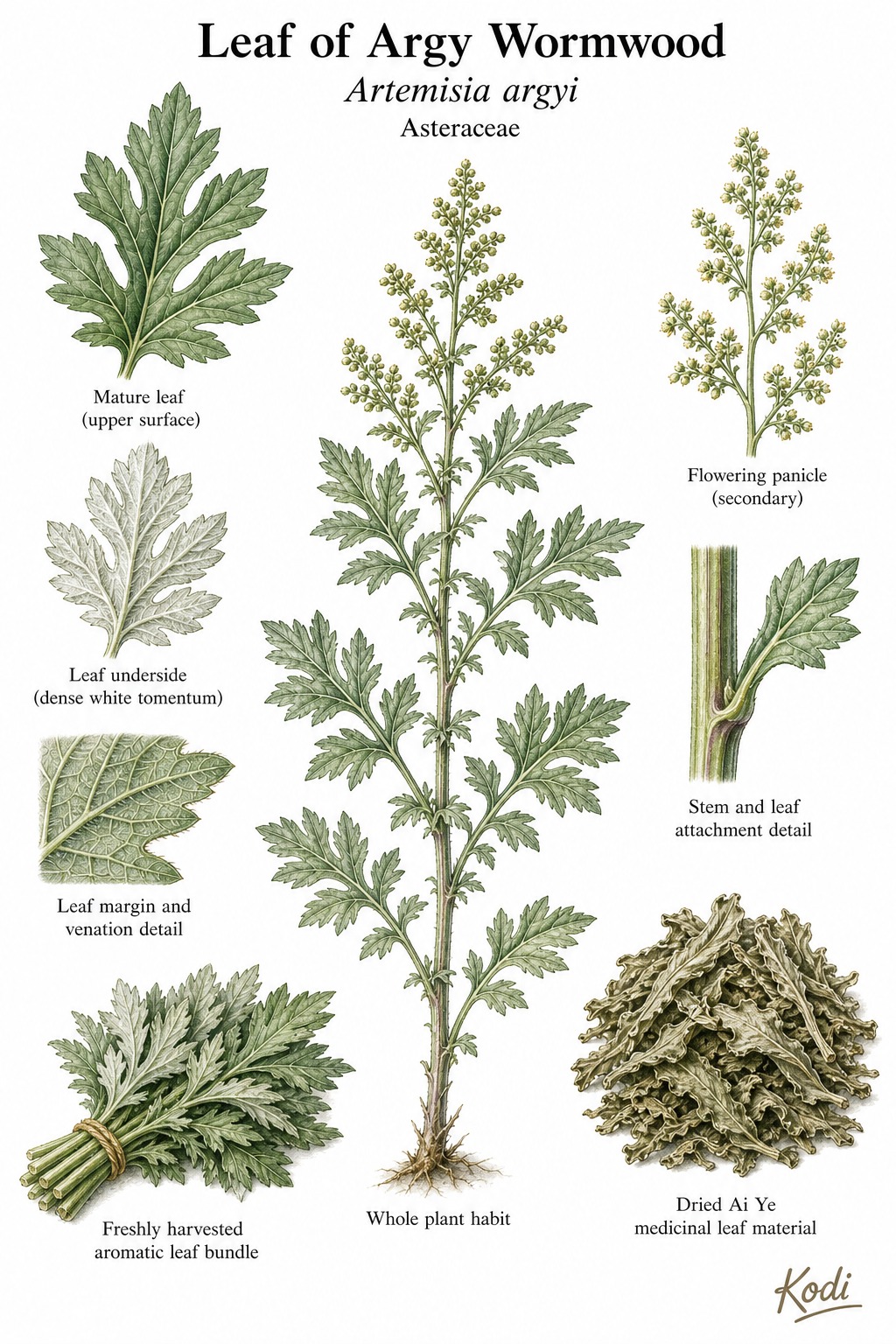
Known in TCM as Ai Ye (艾叶), this acrid and bitter, warm herb enters the Liver, Spleen, and Kidney. Traditionally, it warms the channels and stops bleeding - Ai Ye is a classic uterine and blood-channel herb for cold-pattern bleeding, prolonged spotting, and excessive menstrual loss, most often applied for abnormal uterine bleeding, dysmenorrhea, and threatened miscarriage. Modern research has identified Volatile among its active constituents.
Part used: Leaf
Also Known As
Latin: Folium Artemisiae Argyi | Pinyin: Ai Ye | Chinese: 艾叶
TCM Properties
- Taste
- acrid, bitter
- Temperature
- warm
- Channels
- Liver, Spleen, Kidney
Traditional Use
Primary Actions
- Warms the channels and stops bleeding - Ai Ye is a classic uterine and blood-channel herb for cold-pattern bleeding, prolonged spotting, and excessive menstrual loss.
- Dispels cold and alleviates pain - it is used for dysmenorrhea, abdominal pain from cold in the womb, and cold-damp pain when warmth is needed.
- Calms the fetus - traditional use includes threatened miscarriage when uterine bleeding or restlessness arise from cold and deficiency rather than heat.
Secondary Actions
- Ai Ye is both a decoction herb and the foundational material for moxa, so its internal and external traditions are unusually well developed.
- It must be kept distinct from other Artemisia drugs such as Qing Hao and Yin Chen Hao, which are much cooler and serve very different clinical roles.
Classic Formulas
- Jiao Ai Tang - classic formula for uterine bleeding, abdominal pain, and fetal-restlessness patterns in which Ai Ye anchors the warming and hemostatic strategy.
- Ai Fu Nuan Gong Wan and related womb-warming formulas - traditional use for cold infertility, menstrual pain, and lower-abdomen cold.
- Ai Ye charcoal or moxa preparations - classical part-processing pathways used to emphasize hemostatic or warming-external applications.
Classical References
- Traditional references describe Ai Ye as acrid, bitter, and warm, entering the Liver, Spleen, and Kidney to warm the channels, stop bleeding, dispel cold, and calm the fetus.
- The herb's dual life as internal medicine and moxibustion material explains why it remains one of the most culturally persistent warming gynecologic herbs.
- Dao-di Qichun mugwort is especially prized in moxa traditions, but the monograph here stays focused on the medicinal leaf rather than on branded moxa products.
Modern Research
Active Compounds
- Volatile oils such as cineole, borneol, camphor, and related terpenes - key aromatic constituents of Ai Ye
- Flavonoids and phenolic acids - anti-inflammatory and antioxidant fractions
- Sesquiterpenes and polysaccharides - broader immunomodulatory and bioactive components investigated in the species
Studied Effects
- A 2021 review summarized Artemisia argyi research across anti-inflammatory, hemostatic, antimicrobial, antioxidant, and uterine-related domains, reflecting why Ai Ye remains one of the better studied warming gynecologic herbs (PMID 34847785).
- A 2023 study found that an Artemisia argyi leaf extract reduced inflammatory injury in acute pancreatitis by suppressing caspase-11-mediated pyroptosis, providing a modern mechanistic example of its anti-inflammatory potential outside simple folklore (PMID 36754190).
- A 2016 paper reported anti-inflammatory and anti-blood-stasis effects from Artemisia argyi essential oil in experimental models, supporting the relevance of the leaf's volatile fraction to both pain and circulation-focused traditional use (PMID 26894818).
PubMed References
- Artemisia argyi Levl. et Vant.: A Review of Traditional Uses, Phytochemistry, Pharmacology and Quality Control. (2021)
- Artemisia argyi leaves extract attenuates acute pancreatitis via inhibiting caspase-11-mediated pyroptosis. (2023)
- Anti-inflammatory and anti-blood stasis activities of essential oil extracted from Artemisia argyi leaves. (2016)
Safety & Interactions
Contraindications
- Heat-pattern bleeding or yin deficiency heat with reckless bleeding
- Strong uterine heat signs rather than cold-deficiency pregnancy restlessness
Cautions
- Ai Ye is traditionally used in pregnancy only in specific cold-deficiency bleeding or restless-fetus patterns, not as a general unsupervised pregnancy herb.
- Concentrated essential oil products are not equivalent to ordinary decoction doses or moxa use and may be more irritating.
- Because the herb has real warming and uterine activity, pattern differentiation matters more than with generic mugwort teas.
Conditions
- Abnormal Uterine Bleeding Traditional ★★★★☆ JSON
- Dysmenorrhea Traditional ★★★★☆ JSON
- Threatened Miscarriage Traditional ★★★☆☆ JSON
- Eczema Traditional ★★☆☆☆ JSON
Frequently Asked Questions
What is Leaf of Argy Wormwood used for?
Leaf of Argy Wormwood is traditionally used to Warms the channels and stops bleeding - Ai Ye is a classic uterine and blood-channel herb for cold-pattern bleeding, prolonged spotting, and excessive menstrual loss., Dispels cold and alleviates pain - it is used for dysmenorrhea, abdominal pain from cold in the womb, and cold-damp pain when warmth is needed., Calms the fetus - traditional use includes threatened miscarriage when uterine bleeding or restlessness arise from cold and deficiency rather than heat.. Research has investigated its effects on: A 2021 review summarized Artemisia argyi research across anti-inflammatory, hemostatic, antimicrobial, antioxidant, and uterine-related domains, reflecting why Ai Ye remains one of the better studied warming gynecologic herbs (PMID 34847785).; A 2023 study found that an Artemisia argyi leaf extract reduced inflammatory injury in acute pancreatitis by suppressing caspase-11-mediated pyroptosis, providing a modern mechanistic example of its anti-inflammatory potential outside simple folklore (PMID 36754190)..
What are other names for Leaf of Argy Wormwood?
Leaf of Argy Wormwood is also known as Mugwort Leaf, Moxa Leaf, Artemisia. In TCM: 艾叶 (Ai Ye); Folium Artemisiae Argyi.
Is Leaf of Argy Wormwood safe during pregnancy?
The safety of Leaf of Argy Wormwood during pregnancy has not been established. Consult a qualified healthcare provider before use.
What are the contraindications for Leaf of Argy Wormwood?
Leaf of Argy Wormwood should not be used in: Heat-pattern bleeding or yin deficiency heat with reckless bleeding; Strong uterine heat signs rather than cold-deficiency pregnancy restlessness. Consult a qualified practitioner before use.