Ford Nervilia Herb
- Chinese
- 青天葵
- Pinyin
- Qing Tian Kui
- Latin
- Herba seu Rhizoma Nerviliae Fordii
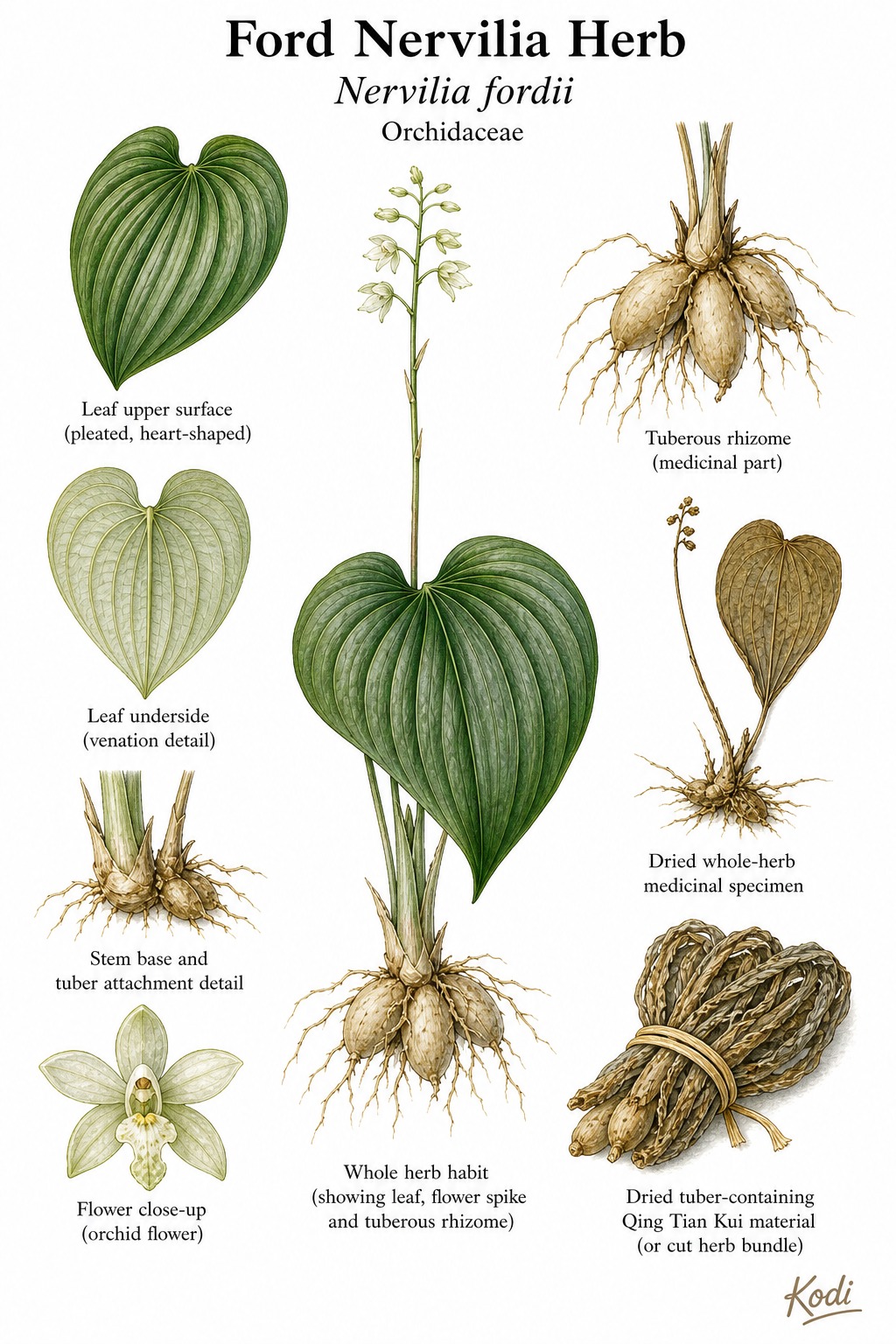
Known in TCM as Qing Tian Kui (青天葵), this sweet and slightly bitter, cool herb enters the Lung and Liver. Traditionally, it moistens the Lung and relieves cough - Qing Tian Kui is used for lung-heat cough, dry irritated cough, and chronic pulmonary weakness with heat and blood-streaking, most often applied for cough, sore throat, and scrofula. Modern research has identified Flavonoid among its active constituents.
Part used: Whole herb
Also Known As
Latin: Herba seu Rhizoma Nerviliae Fordii | Pinyin: Qing Tian Kui | Chinese: 青天葵
TCM Properties
- Taste
- sweet, slightly bitter
- Temperature
- cool
- Channels
- Lung, Liver
Traditional Use
Primary Actions
- Moistens the Lung and relieves cough - Qing Tian Kui is used for lung-heat cough, dry irritated cough, and chronic pulmonary weakness with heat and blood-streaking.
- Clears heat and removes toxicity - traditional indications include sore throat, scrofula, sores, boils, and inflammatory mouth or throat conditions.
- Dissipates blood stasis and alleviates pain - it is also used for traumatic injury and painful swelling.
Secondary Actions
- The import stub called this a leaf, but the real medicinal material is usually the whole herb or herb-and-rhizome/tuber complex, so this page corrects the identity while leaving the slug untouched.
- Qing Tian Kui is a regional southern Chinese orchid medicine with a stronger respiratory and toxin-clearing profile than its delicate appearance might suggest.
Classic Formulas
- Qing Tian Kui with Sha Shen or Mai Men Dong - a lung-moistening pairing style for dry heat cough and throat irritation.
- Qing Tian Kui with Xia Ku Cao or Bei Mu - traditional logic for scrofula, nodules, and lingering throat or neck heat.
- Qing Tian Kui with San Qi or Jin Yin Hua - combinations used when trauma, swelling, and toxin overlap.
Classical References
- Traditional references describe Qing Tian Kui as a dried whole herb or tuber-containing herb of Nervilia fordii, used to moisten Lung heat, clear toxin, and relieve pain.
- The medicinal part correction is important here because the drug is not limited to the leaf blade alone.
- This page keeps the identity conservative and source-driven instead of letting the misleading imported English name define the herb.
Modern Research
Active Compounds
- Flavonoid glycosides including nervilifordin-type compounds - major constituents repeatedly profiled in Nervilia fordii
- Methylated flavonols and related glycosides - prominent chemistry associated with antioxidant and antiviral investigation
- Minor diterpenoid and coumarin constituents - supportive compounds in broader species chemistry work
Studied Effects
- A 2021 study found that total flavonoids extracted from Nervilia fordii reduced inflammatory lung injury and improved alveolar fluid transport markers in an LPS-induced acute lung injury model, providing a meaningful modern correlate for the herb's respiratory use (PMID 34887746).
- A 2009 chemistry study isolated new flavonol glycosides from Nervilia fordii and found antiviral activity from one known coumarin constituent against HSV-1, supporting continued interest in the herb's toxin-clearing pharmacology (PMID 19422205).
- A 2011 HPLC study established simultaneous measurement of seven flavonoids in Nervilia fordii, reinforcing that flavonoid chemistry is central to quality control of this orchid medicine (PMID 22242457).
PubMed References
- Inhibition of Inflammation and Regulation of AQPs/ENaCs/Na+-K+-ATPase Mediated Alveolar Fluid Transport by Total Flavonoids Extracted From Nervilia fordii in Lipopolysaccharide-induced Acute Lung Injury. (2021)
- 7-O-methylkaempferol and -quercetin glycosides from the whole plant of Nervilia fordii. (2009)
- [Simultaneous determination of seven flavonoids in Nervilia fordii with HPLC]. (2011)
Safety & Interactions
Contraindications
- Marked deficiency-cold or chronic loose stool without heat or toxin
Cautions
- Because Qing Tian Kui can move blood and dissipate stasis, pregnancy use should stay conservative even though strong human safety data are lacking.
- The herb is regionally sourced and sometimes substituted with other Nervilia material, so authenticated identity matters.
- Most modern evidence is preclinical and respiratory-model focused rather than clinical-trial level.
Conditions
- Cough Traditional ★★★☆☆ JSON
- Sore Throat Traditional ★★★☆☆ JSON
- Scrofula Traditional ★★☆☆☆ JSON
- Traumatic Injury Traditional ★★☆☆☆ JSON
Frequently Asked Questions
What is Ford Nervilia Herb used for?
Ford Nervilia Herb is traditionally used to Moistens the Lung and relieves cough - Qing Tian Kui is used for lung-heat cough, dry irritated cough, and chronic pulmonary weakness with heat and blood-streaking., Clears heat and removes toxicity - traditional indications include sore throat, scrofula, sores, boils, and inflammatory mouth or throat conditions., Dissipates blood stasis and alleviates pain - it is also used for traumatic injury and painful swelling.. Research has investigated its effects on: A 2021 study found that total flavonoids extracted from Nervilia fordii reduced inflammatory lung injury and improved alveolar fluid transport markers in an LPS-induced acute lung injury model, providing a meaningful modern correlate for the herb's respiratory use (PMID 34887746).; A 2009 chemistry study isolated new flavonol glycosides from Nervilia fordii and found antiviral activity from one known coumarin constituent against HSV-1, supporting continued interest in the herb's toxin-clearing pharmacology (PMID 19422205)..
What are other names for Ford Nervilia Herb?
Ford Nervilia Herb is also known as Nervilia, Qing Tian Kui. In TCM: 青天葵 (Qing Tian Kui); Herba seu Rhizoma Nerviliae Fordii.
Is Ford Nervilia Herb safe during pregnancy?
The safety of Ford Nervilia Herb during pregnancy has not been established. Consult a qualified healthcare provider before use.
What are the contraindications for Ford Nervilia Herb?
Ford Nervilia Herb should not be used in: Marked deficiency-cold or chronic loose stool without heat or toxin. Consult a qualified practitioner before use.