Leaf of Leatherleaf Mahonia
- Chinese
- 十大功劳叶
- Pinyin
- Shi Da Gong Lao Ye
- Latin
- Folium Mahoniae
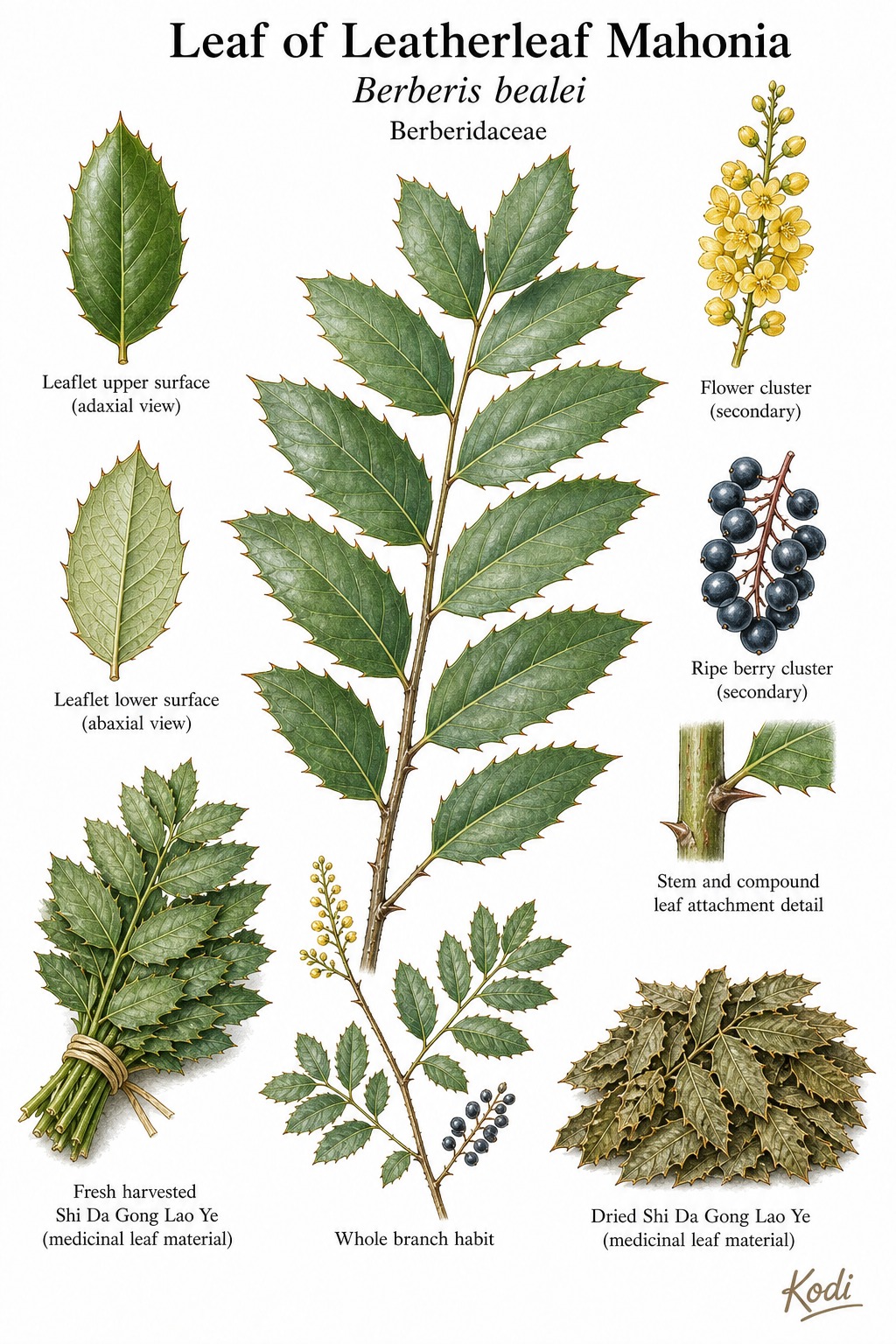
Known in TCM as Shi Da Gong Lao Ye (十大功劳叶), this bitter, cold herb enters the Lung and Kidney. Traditionally, it clears heat and resolves toxicity - Shi Da Gong Lao Ye is used for red eyes, sores, boils, and hot inflammatory conditions, most often applied for cough, hemoptysis, and sore throat. Modern research has identified Berberine among its active constituents.
Part used: Leaf
Also Known As
Latin: Folium Mahoniae | Pinyin: Shi Da Gong Lao Ye | Chinese: 十大功劳叶
TCM Properties
- Taste
- bitter
- Temperature
- cold
- Channels
- Lung, Kidney
Traditional Use
Primary Actions
- Clears heat and resolves toxicity - Shi Da Gong Lao Ye is used for red eyes, sores, boils, and hot inflammatory conditions.
- Stops cough and resolves phlegm - traditional use includes chronic cough, phthisis-style coughing, and hemoptysis when heat and deficiency overlap.
- Supports chronic weakness in regional use - some traditions extend it to sore low back and knees, tinnitus, and dizziness in lingering depleted states.
Secondary Actions
- This record must stay separate from Gou Gu Ye: older sources blurred Chinese holly leaf and Mahonia leaf, but modern pharmacognosy distinguishes the cooler berberine-rich Mahonia medicine from Ilex cornuta leaf.
- Mahonia leaf sits at an unusual overlap of toxin-clearing bitterness and deficiency-cough use, which is why the indications can look broader than a single-channel heat herb.
Classic Formulas
- Shi Da Gong Lao Ye with Chuan Bei Mu or Mai Men Dong - a chronic cough and heat-phlegm pairing style.
- Shi Da Gong Lao Ye with Jin Yin Hua or Lian Qiao - toxin-clearing logic when sores, red eyes, or upper-body heat signs are prominent.
- Shi Da Gong Lao Ye with Du Zhong or Xu Duan - regional pattern logic when cough and weakness coexist.
Classical References
- Traditional references describe Shi Da Gong Lao Ye as bitter and cold, used to clear heat, stop cough, and resolve phlegm.
- Its modern identity as Mahonia leaf is especially important because nearby leaf records in this library include Chinese holly leaf, which older naming traditions sometimes confused with Gong Lao Ye.
- This page follows the Mahonia medicinal-leaf identity rather than the Ilex cornuta leaf tradition.
Modern Research
Active Compounds
- Berberine - the best known Mahonia alkaloid and a major anti-inflammatory marker
- Palmatine, jatrorrhizine, and berbamine - additional isoquinoline alkaloids relevant to antimicrobial and anti-inflammatory activity
- Leaf polyphenols and minor alkaloids - supportive antioxidant and signaling-active fractions
Studied Effects
- A 2016 study found that the dichloromethane fraction from Mahonia bealei leaves inhibited NF-kB-related inflammatory mediators in macrophages and attenuated LPS-induced lung inflammation in mice, providing a strong modern leaf-specific anti-inflammatory signal (PMID 27167461).
- A 2025 paper reported that Mahonia bealei leaf extract inhibited PGN-induced inflammation through the TLR2/MyD88/NF-kB pathway in RAW264.7 cells, reinforcing current mechanistic support for Mahonia leaf in inflammation-related disease models (PMID 39971016).
- A 2018 review of berberine summarized its wide occurrence in berberine-containing botanicals and its anti-inflammatory, metabolic, hepatic, and antimicrobial relevance, which helps contextualize the pharmacology of berberine-rich Mahonia leaf records (PMID 30186157).
PubMed References
- The dichloromethane fraction from Mahonia bealei (Fort.) Carr. leaves exerts an anti-inflammatory effect both in vitro and in vivo. (2016)
- Mahonia bealei (Fort.) Carr. Leaf extract modulates the TLR2/MyD88/NF-kB signaling pathway to inhibit PGN-induced inflammation in RAW264.7 cells. (2025)
- Berberine: Botanical Occurrence, Traditional Uses, Extraction Methods, and Relevance in Cardiovascular, Metabolic, Hepatic, and Renal Disorders. (2018)
Safety & Interactions
Contraindications
- Deficiency-cold of the Spleen and Stomach with loose stool and weak digestion
Cautions
- Historical confusion between Mahonia leaf and Chinese holly leaf means source identity should be checked before applying either monograph's safety or indication logic.
- Because the herb is cold and bitter, it may aggravate weak digestion in fragile patients.
- Modern evidence is still mainly preclinical and centered on inflammation signaling rather than direct clinical trials for phthisis or chronic cough.
Conditions
- Cough Traditional ★★★☆☆ JSON
- Hemoptysis Traditional ★★★☆☆ JSON
- Sore Throat Traditional ★★☆☆☆ JSON
- Tuberculosis Traditional ★★☆☆☆ JSON
Frequently Asked Questions
What is Leaf of Leatherleaf Mahonia used for?
Leaf of Leatherleaf Mahonia is traditionally used to Clears heat and resolves toxicity - Shi Da Gong Lao Ye is used for red eyes, sores, boils, and hot inflammatory conditions., Stops cough and resolves phlegm - traditional use includes chronic cough, phthisis-style coughing, and hemoptysis when heat and deficiency overlap., Supports chronic weakness in regional use - some traditions extend it to sore low back and knees, tinnitus, and dizziness in lingering depleted states.. Research has investigated its effects on: A 2016 study found that the dichloromethane fraction from Mahonia bealei leaves inhibited NF-kB-related inflammatory mediators in macrophages and attenuated LPS-induced lung inflammation in mice, providing a strong modern leaf-specific anti-inflammatory signal (PMID 27167461).; A 2025 paper reported that Mahonia bealei leaf extract inhibited PGN-induced inflammation through the TLR2/MyD88/NF-kB pathway in RAW264.7 cells, reinforcing current mechanistic support for Mahonia leaf in inflammation-related disease models (PMID 39971016)..
What are other names for Leaf of Leatherleaf Mahonia?
Leaf of Leatherleaf Mahonia is also known as Chinese Mahonia Leaf, Mahonia. In TCM: 十大功劳叶 (Shi Da Gong Lao Ye); Folium Mahoniae.
Is Leaf of Leatherleaf Mahonia safe during pregnancy?
The safety of Leaf of Leatherleaf Mahonia during pregnancy has not been established. Consult a qualified healthcare provider before use.
What are the contraindications for Leaf of Leatherleaf Mahonia?
Leaf of Leatherleaf Mahonia should not be used in: Deficiency-cold of the Spleen and Stomach with loose stool and weak digestion. Consult a qualified practitioner before use.