Leaf of Pine
- Chinese
- 松叶
- Pinyin
- Song Ye
- Latin
- Folium Pini
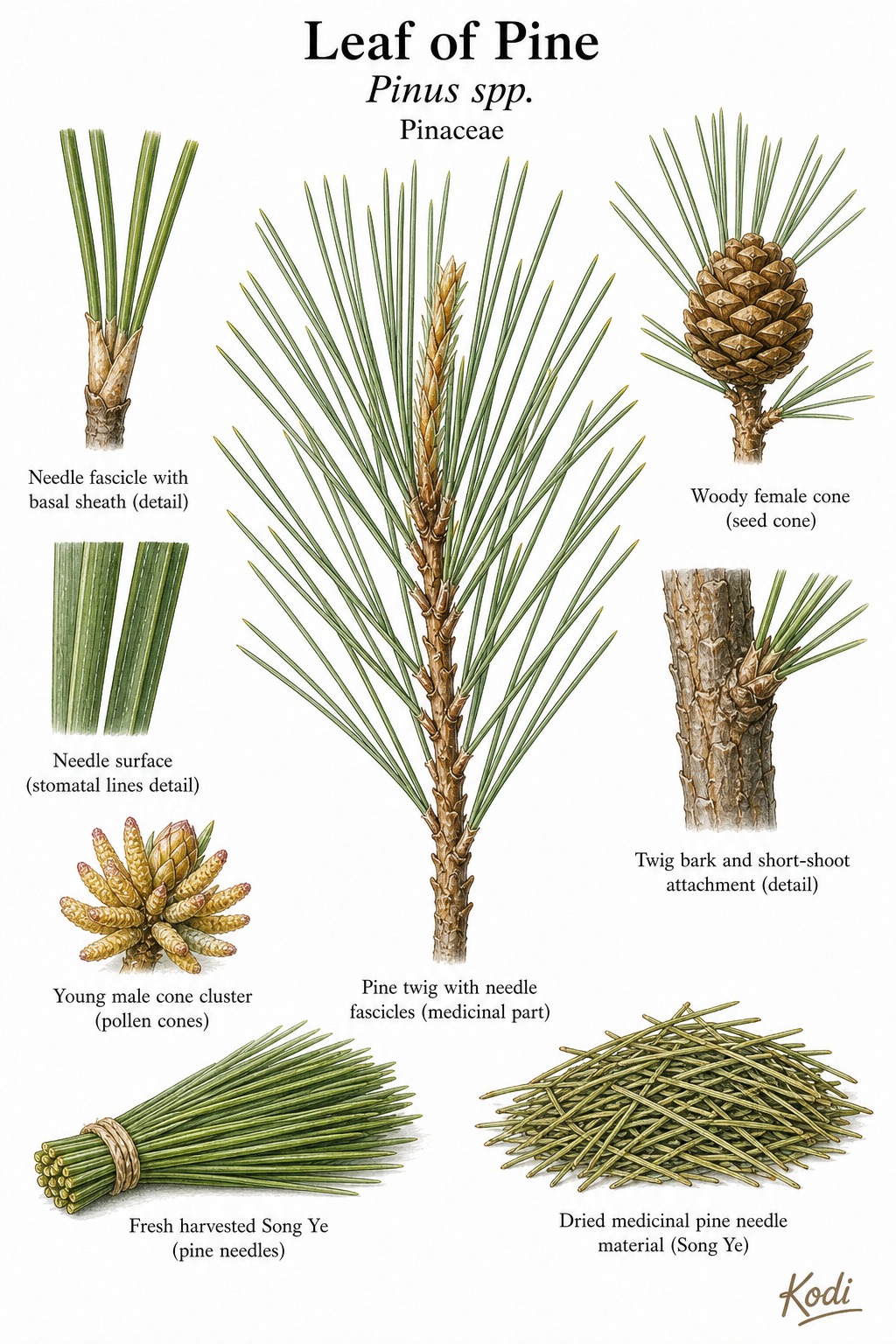
Known in TCM as Song Ye (松叶), this bitter, warm herb enters the Heart and Spleen. Traditionally, it dispels wind and dries dampness - Song Ye is used for rheumatic pain, aching limbs, and damp skin complaints, most often applied for eczema, rheumatism, and traumatic injury. Modern research has identified Flavonoids among its active constituents.
Part used: Leaf
Also Known As
Latin: Folium Pini | Pinyin: Song Ye | Chinese: 松叶
TCM Properties
- Taste
- bitter
- Temperature
- warm
- Channels
- Heart, Spleen
Traditional Use
Primary Actions
- Dispels wind and dries dampness - Song Ye is used for rheumatic pain, aching limbs, and damp skin complaints.
- Kills parasites and relieves itching - traditional use includes eczema, tinea-type skin disease, scabies, and other itchy lesions.
- Activates blood and calms the spirit - older indications extend to traumatic injury, weakness, neurasthenic symptoms, and certain chronic depletion patterns.
Secondary Actions
- The import pinyin `Song Zhen` reflects the pine-needle shape, but standard medicinal naming is more often `Song Ye`, so the canonical pinyin is normalized here while preserving the alternate form.
- Pine leaf should be distinguished from Song Jie, the knotwood record drafted earlier, because pine needle and pine node have different traditional actions and modern chemistry emphases.
Classic Formulas
- Song Ye decoctions or wines - traditional use for rheumatic pain, weakness, and chronic wind-damp obstruction.
- Song Ye external washes - a common approach for eczema, itching, and parasitic or fungal skin complaints.
- Song Ye with blood-moving herbs such as Hong Hua or Ru Xiang - trauma-oriented pairing logic when pain and bruising coexist.
Classical References
- Traditional references describe Song Ye as bitter and warm, entering the Heart and Spleen to dispel wind-damp, relieve itching, move blood, and calm the spirit.
- The herb name is sometimes rendered as pine leaf and sometimes pine needle in English, but both refer to the same medicinal needle-like foliage rather than to wood or resin.
- This page keeps the leaf identity distinct from other pine-derived materials in the library.
Modern Research
Active Compounds
- Flavonoids from pine needles - major anti-inflammatory and antioxidant constituents
- Terpenoids and volatile fractions - aromatic compounds relevant to respiratory and topical use
- Polyphenolic and chlorophyll-associated fractions - broader antioxidant constituents studied in pine-needle extracts
Studied Effects
- A 2021 study isolated anti-inflammatory principles from Pinus taiwanensis needles and showed inhibition of neutrophil inflammatory responses, supporting modern interest in pine needle anti-inflammatory activity (PMID 33924612).
- A 2017 study found that Pinus densiflora needle extract suppressed iNOS, IL-6, IL-1beta, and inflammatory STAT signaling in LPS-challenged macrophages, offering a plausible mechanistic correlate for Song Ye's anti-inflammatory and itching-related use (PMID 28778215).
- A 2018 microscopic and molecular-identification study emphasized the need for species authentication in pine needle materials, which is useful because `Folium Pini` trade can pool multiple Pinus sources (PMID 30226333).
PubMed References
- Anti-Inflammatory Principles from the Needles of Pinus taiwanensis Hayata and In Silico Studies of Their Potential Anti-Aging Effects. (2021)
- Pinus densiflora needle supercritical fluid extract suppresses the expression of pro-inflammatory mediators iNOS, IL-6 and IL-1beta, and activation of inflammatory STAT1 and STAT3 signaling proteins in bacterial lipopolysaccharide-challenged murine macrophages. (2017)
- [Microscopic and molecular identification of pine needles]. (2018)
Safety & Interactions
Contraindications
- Marked yin or blood deficiency with dryness and no damp, parasite, or traumatic component
Cautions
- Pine needle teas, extracts, and essential-oil products are not equivalent in dose or safety profile.
- Correct species identification matters because medicinal pine-needle materials can be pooled from multiple Pinus sources.
- People with conifer sensitivity or contact-reactive skin may need extra caution with topical use.
Conditions
- Eczema Traditional ★★★☆☆ JSON
- Rheumatism Traditional ★★★☆☆ JSON
- Traumatic Injury Traditional ★★☆☆☆ JSON
- Hypertension Traditional ★★☆☆☆ JSON
Frequently Asked Questions
What is Leaf of Pine used for?
Leaf of Pine is traditionally used to Dispels wind and dries dampness - Song Ye is used for rheumatic pain, aching limbs, and damp skin complaints., Kills parasites and relieves itching - traditional use includes eczema, tinea-type skin disease, scabies, and other itchy lesions., Activates blood and calms the spirit - older indications extend to traumatic injury, weakness, neurasthenic symptoms, and certain chronic depletion patterns.. Research has investigated its effects on: A 2021 study isolated anti-inflammatory principles from Pinus taiwanensis needles and showed inhibition of neutrophil inflammatory responses, supporting modern interest in pine needle anti-inflammatory activity (PMID 33924612).; A 2017 study found that Pinus densiflora needle extract suppressed iNOS, IL-6, IL-1beta, and inflammatory STAT signaling in LPS-challenged macrophages, offering a plausible mechanistic correlate for Song Ye's anti-inflammatory and itching-related use (PMID 28778215)..
What are other names for Leaf of Pine?
Leaf of Pine is also known as Pine Leaf, Pine Needle, Song Zhen, Pini. In TCM: 松叶 (Song Ye); Folium Pini.
Is Leaf of Pine safe during pregnancy?
The safety of Leaf of Pine during pregnancy has not been established. Consult a qualified healthcare provider before use.
What are the contraindications for Leaf of Pine?
Leaf of Pine should not be used in: Marked yin or blood deficiency with dryness and no damp, parasite, or traumatic component. Consult a qualified practitioner before use.