Leaf of Wrinkled Giant Hyssop
- Chinese
- 藿香叶
- Pinyin
- Huo Xiang Ye
- Latin
- Folium Agastachis
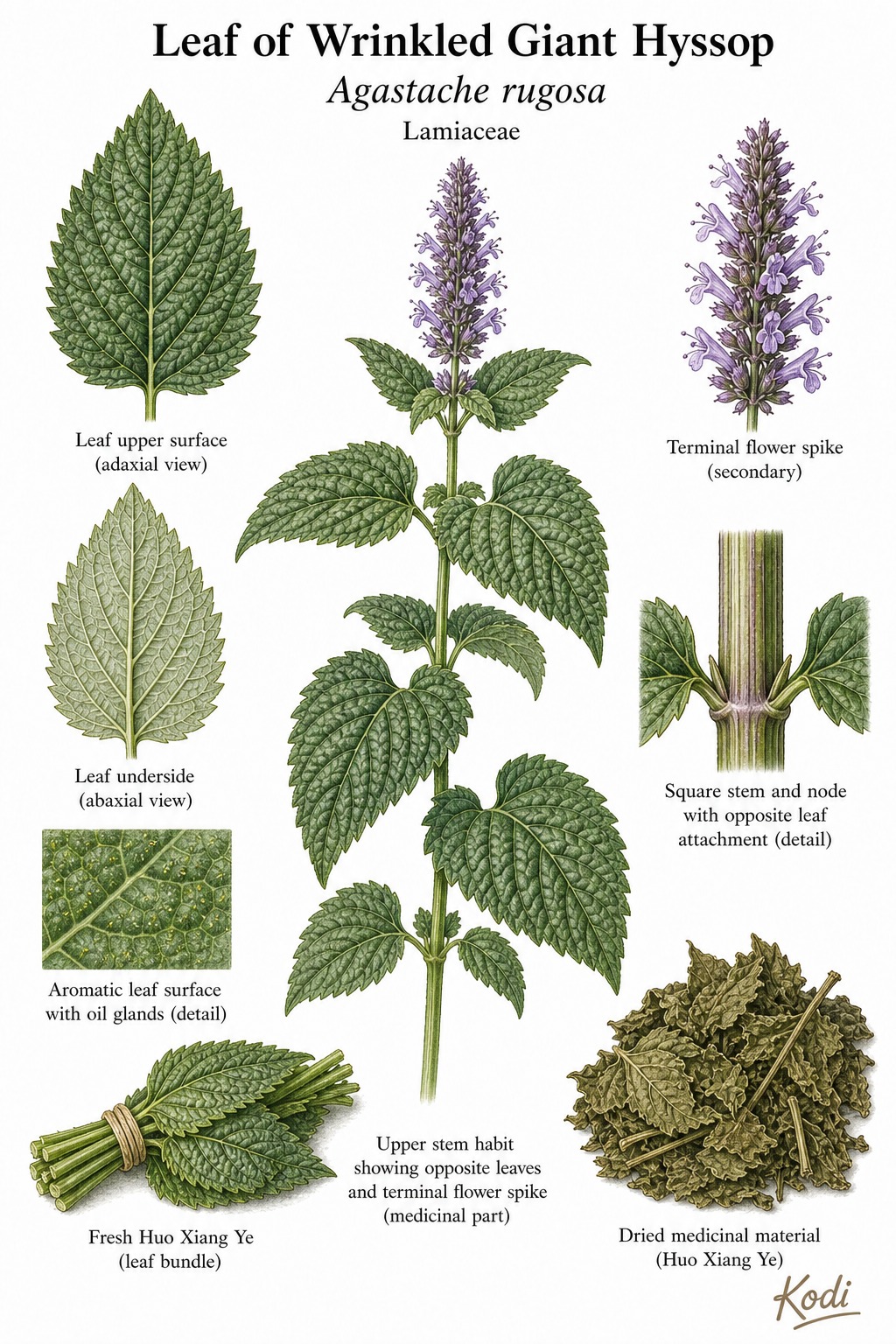
Known in TCM as Huo Xiang Ye (藿香叶), this acrid, slightly warm herb enters the Lung, Spleen, and Stomach. Traditionally, it aromatically transforms dampness and harmonizes the middle - Huo Xiang Ye is used for nausea, poor appetite, abdominal fullness, and damp-turbidity affecting digestion, most often applied for nausea, poor appetite, and diarrhea. Modern research has identified Essential-oil among its active constituents.
Part used: Leaf
Also Known As
Latin: Folium Agastachis | Pinyin: Huo Xiang Ye | Chinese: 藿香叶
TCM Properties
- Taste
- acrid
- Temperature
- slightly warm
- Channels
- Lung, Spleen, Stomach
Traditional Use
Primary Actions
- Aromatically transforms dampness and harmonizes the middle - Huo Xiang Ye is used for nausea, poor appetite, abdominal fullness, and damp-turbidity affecting digestion.
- Releases the exterior and resolves summer-damp - traditional use includes heaviness, mild chills or fever, and digestive upset during humid summer disorders.
- Stops vomiting and freshens turbidity - the leaf is used when foul taste, chest oppression, and rebellious Stomach qi accompany damp obstruction.
Secondary Actions
- This page preserves Agastache rugosa leaf as a separate `Huo Xiang Ye` track rather than flattening it into the already-live `Guang Huo Xiang Ye` page for Pogostemon cablin.
- Agastache leaf is lighter and more explicitly species-sensitive than the broad generic `Huo Xiang` label often seen in commerce.
Classic Formulas
- Huo Xiang Zheng Qi San - classic summer-damp and digestive-turbidity formula family in which aromatic Huo Xiang leads the opening strategy.
- Huo Xiang with Pei Lan and Sha Ren - pairing style for turbid dampness, nausea, and poor appetite.
- Huo Xiang with Ban Xia or Zhu Ru - traditional logic when vomiting and phlegm-turbidity are prominent.
Classical References
- Traditional references describe Huo Xiang Ye as acrid and slightly warm, entering the Lung, Spleen, and Stomach to transform dampness, stop vomiting, and resolve summer-damp.
- Chinese herbology has long acknowledged ambiguity around `Huo Xiang`, which can refer to Agastache rugosa or Pogostemon cablin depending on source tradition.
- This page keeps the Agastache medicinal-leaf identity explicit to avoid future collapse of the two aromatic leaf tracks.
Modern Research
Active Compounds
- Essential-oil constituents such as estragole and methyleugenol chemotype-related compounds - major aromatic markers of Agastache rugosa
- Flavonoid and phenylpropanoid glycosides - supportive anti-inflammatory and antioxidant constituents
- Leaf and aerial-part terpenoid fractions - bioactive compounds relevant to damp-transforming and antimicrobial interpretation
Studied Effects
- A 2023 review summarized phytochemistry and therapeutic properties across Agastache species and noted that A. rugosa is the main East Asian medicinal representative, with anti-inflammatory, antioxidant, antimicrobial, and cardiometabolic activity reported across the literature (PMID 37631149).
- A 2019 study isolated constituents from the aerial parts of Agastache rugosa that inhibited prostaglandin E2 production in LPS-treated macrophages, supporting the herb's modern anti-inflammatory plausibility (PMID 31747281).
- A 2003 analysis showed clear differences in essential-oil composition between Agastache rugosa stems, leaves, and flowers, reinforcing that the leaf record should be treated as a distinct aromatic medicinal part rather than generic whole-herb material (PMID 12575134).
PubMed References
- Agastache Species: A Comprehensive Review on Phytochemical Composition and Therapeutic Properties. (2023)
- Chemical Constituents from the Aerial Parts of Agastache rugosa and Their Inhibitory Activities on Prostaglandin E2 Production in Lipopolysaccharide-Treated RAW 264.7 Macrophages. (2019)
- [Chemical composition of essential oil in stems, leaves and flowers of Agastache rugosa]. (2003)
Safety & Interactions
Contraindications
- Marked yin deficiency dryness without damp turbidity
Cautions
- Species confusion with Pogostemon cablin remains common under the `Huo Xiang` label, so source identity matters for both tradition and chemistry.
- Concentrated essential-oil products are much stronger than ordinary leaf decoctions and should not be treated as equivalent.
- MSK page not found - drug interaction data not available from Memorial Sloan Kettering integrative medicine database
Conditions
- Nausea Traditional ★★★★☆ JSON
- Poor Appetite Traditional ★★★☆☆ JSON
- Diarrhea Traditional ★★★☆☆ JSON
- Common Cold Traditional ★★☆☆☆ JSON
Frequently Asked Questions
What is Leaf of Wrinkled Giant Hyssop used for?
Leaf of Wrinkled Giant Hyssop is traditionally used to Aromatically transforms dampness and harmonizes the middle - Huo Xiang Ye is used for nausea, poor appetite, abdominal fullness, and damp-turbidity affecting digestion., Releases the exterior and resolves summer-damp - traditional use includes heaviness, mild chills or fever, and digestive upset during humid summer disorders., Stops vomiting and freshens turbidity - the leaf is used when foul taste, chest oppression, and rebellious Stomach qi accompany damp obstruction.. Research has investigated its effects on: A 2023 review summarized phytochemistry and therapeutic properties across Agastache species and noted that A. rugosa is the main East Asian medicinal representative, with anti-inflammatory, antioxidant, antimicrobial, and cardiometabolic activity reported across the literature (PMID 37631149).; A 2019 study isolated constituents from the aerial parts of Agastache rugosa that inhibited prostaglandin E2 production in LPS-treated macrophages, supporting the herb's modern anti-inflammatory plausibility (PMID 31747281)..
What are other names for Leaf of Wrinkled Giant Hyssop?
Leaf of Wrinkled Giant Hyssop is also known as Agastache Leaf, Korean Mint Leaf, Agastachis. In TCM: 藿香叶 (Huo Xiang Ye); Folium Agastachis.
Is Leaf of Wrinkled Giant Hyssop safe during pregnancy?
The safety of Leaf of Wrinkled Giant Hyssop during pregnancy has not been established. Consult a qualified healthcare provider before use.
What are the contraindications for Leaf of Wrinkled Giant Hyssop?
Leaf of Wrinkled Giant Hyssop should not be used in: Marked yin deficiency dryness without damp turbidity. Consult a qualified practitioner before use.