Leafy Twigs of Oriental Arborvitae
- Chinese
- 侧柏叶
- Pinyin
- Ce Bai Ye
- Latin
- Cacumen Platycladi
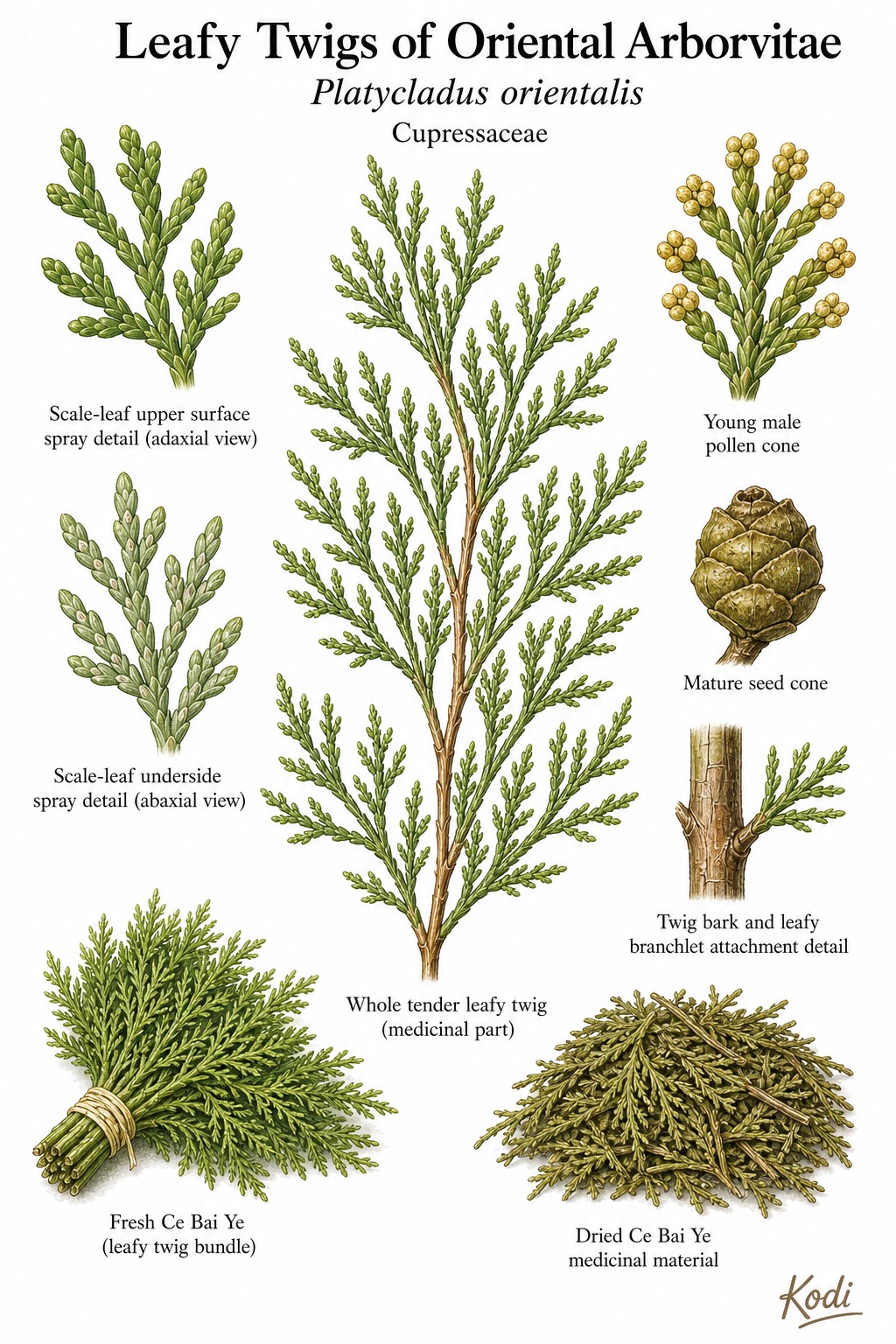
Known in TCM as Ce Bai Ye (侧柏叶), this bitter and astringent, cold herb enters the Lung, Liver, and Spleen. Traditionally, it cools blood and stops bleeding - Ce Bai Ye is used for hemoptysis, nosebleed, uterine bleeding, and other bleeding driven by blood heat, most often applied for hemoptysis, abnormal uterine bleeding, and cough. Modern research has identified Monoterpenes, among its active constituents.
Part used: Leafy tip
Also Known As
Latin: Cacumen Platycladi | Pinyin: Ce Bai Ye | Chinese: 侧柏叶
TCM Properties
- Taste
- bitter, astringent
- Temperature
- cold
- Channels
- Lung, Liver, Spleen
Traditional Use
Primary Actions
- Cools blood and stops bleeding - Ce Bai Ye is used for hemoptysis, nosebleed, uterine bleeding, and other bleeding driven by blood heat.
- Resolves phlegm and stops cough - it is chosen for chronic cough or cough with blood-streaking when Lung heat or dryness are present.
- Supports hair growth in external use - topical wash or oil traditions use it for hair loss and scalp disorders.
Secondary Actions
- The charred form `Ce Bai Ye Tan` is more strongly hemostatic than the raw leafy twig.
- This herb cools and astringes at the same time, which makes it especially useful in bleeding patterns where both heat and leakage matter.
Classic Formulas
- Shi Hui San - classic blood-heat bleeding formula in which Ce Bai Ye appears in charred hemostatic form.
- Ce Bai Ye with Ai Ye or Zong Lv Pi - combination logic for uterine bleeding with different cold-heat and astringent balances.
- Ce Bai Ye topical preparations - traditional external use for hair loss and scalp conditions.
Classical References
- Traditional references describe Ce Bai Ye as bitter, astringent, and cold, entering the Lung, Liver, and Spleen to cool blood, stop bleeding, resolve phlegm, and stop cough.
- The medicinal part includes tender leafy twigs rather than woodier branch material.
- Its dual internal and external use helps explain why it appears in both bleeding formulas and hair/scalp traditions.
Modern Research
Active Compounds
- Monoterpenes, sesquiterpenes, and diterpenes - major volatile and lipophilic constituents of Platycladus orientalis leaves
- Flavonoids such as quercetrin, hyperoside, and afzelin-type compounds - anti-inflammatory biomarkers identified in leaf profiling studies
- Essential-oil fractions rich in cedrol-related components - supportive aromatic constituents
Studied Effects
- A 2025 study isolated terpenes from Platycladus orientalis and identified compounds with NLRP3-inflammasome inhibitory activity, supporting modern anti-inflammatory interest in Ce Bai Ye chemistry (PMID 39798145).
- A 2022 chemical-profiling and network-pharmacology study identified anti-inflammatory biomarkers in oriental arborvitae leaves, again pointing to a coherent leaf-based pharmacology (PMID 34866494).
- A 2010 study found that a methylene chloride fraction of Thuja orientalis leaves inhibited inflammatory biomarkers through NF-kB and p38 MAPK signaling and protected mice from lethal endotoxemia, offering an earlier mechanistic signal for the medicinal leaf record (PMID 21040769).
PubMed References
- Terpenes from Platycladus orientalis and the evaluation of their potential anti-inflammatory activity. (2025)
- Chemical profiling and identification of anti-inflammatory biomarkers of oriental Thuja (Platycladus orientalis) using UPLC/MS/MS and network pharmacology-based analyses. (2022)
- Methylene chloride fraction of the leaves of Thuja orientalis inhibits in vitro inflammatory biomarkers by blocking NF-kB and p38 MAPK signaling and protects mice from lethal endotoxemia. (2010)
Safety & Interactions
Contraindications
- Deficiency-cold bleeding without heat or leakage signs
Cautions
- Because Ce Bai Ye is cold and astringent, it may be less appropriate for patients whose bleeding reflects cold deficiency rather than blood heat.
- Topical hair-use traditions are supportive and slow, not emergency answers for sudden hair loss or inflammatory scalp disease.
- MSK page not found - drug interaction data not available from Memorial Sloan Kettering integrative medicine database
Conditions
- Hemoptysis Traditional ★★★☆☆ JSON
- Abnormal Uterine Bleeding Traditional ★★★☆☆ JSON
- Cough Traditional ★★☆☆☆ JSON
- Hair Loss Traditional ★★☆☆☆ JSON
Frequently Asked Questions
What is Leafy Twigs of Oriental Arborvitae used for?
Leafy Twigs of Oriental Arborvitae is traditionally used to Cools blood and stops bleeding - Ce Bai Ye is used for hemoptysis, nosebleed, uterine bleeding, and other bleeding driven by blood heat., Resolves phlegm and stops cough - it is chosen for chronic cough or cough with blood-streaking when Lung heat or dryness are present., Supports hair growth in external use - topical wash or oil traditions use it for hair loss and scalp disorders.. Research has investigated its effects on: A 2025 study isolated terpenes from Platycladus orientalis and identified compounds with NLRP3-inflammasome inhibitory activity, supporting modern anti-inflammatory interest in Ce Bai Ye chemistry (PMID 39798145).; A 2022 chemical-profiling and network-pharmacology study identified anti-inflammatory biomarkers in oriental arborvitae leaves, again pointing to a coherent leaf-based pharmacology (PMID 34866494)..
What are other names for Leafy Twigs of Oriental Arborvitae?
Leafy Twigs of Oriental Arborvitae is also known as Arborvitae Leaf and Twig, Platycladi. In TCM: 侧柏叶 (Ce Bai Ye); Cacumen Platycladi.
Is Leafy Twigs of Oriental Arborvitae safe during pregnancy?
The safety of Leafy Twigs of Oriental Arborvitae during pregnancy has not been established. Consult a qualified healthcare provider before use.
What are the contraindications for Leafy Twigs of Oriental Arborvitae?
Leafy Twigs of Oriental Arborvitae should not be used in: Deficiency-cold bleeding without heat or leakage signs. Consult a qualified practitioner before use.