Lesser Galangal Rhizome
- Chinese
- 高良姜
- Pinyin
- Gao Liang Jiang
- Latin
- Rhizoma Alpiniae Officinarum
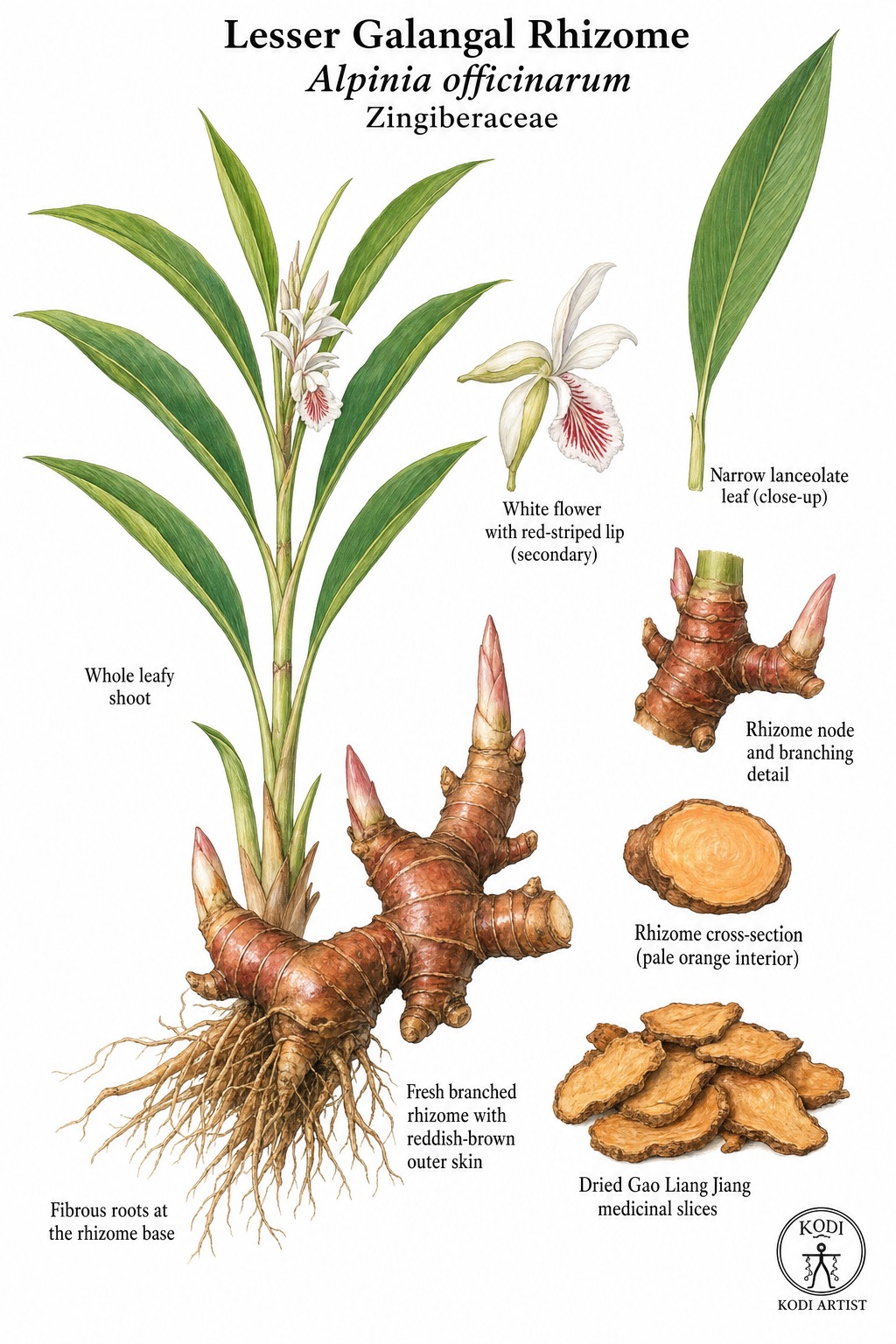
Known in TCM as Gao Liang Jiang (高良姜), this acrid, hot herb enters the Spleen and Stomach. Traditionally, it warms the middle and alleviates pain - Gao Liang Jiang is used for stomach cold, epigastric or abdominal pain, and cramping that clearly improve with heat, most often applied for abdominal pain, nausea, and diarrhea. Modern research has identified Diarylheptanoids among its active constituents.
Part used: Rhizome
Also Known As
Latin: Rhizoma Alpiniae Officinarum | Pinyin: Gao Liang Jiang | Chinese: 高良姜
TCM Properties
- Taste
- acrid
- Temperature
- hot
- Channels
- Spleen, Stomach
Traditional Use
Primary Actions
- Warms the middle and alleviates pain - Gao Liang Jiang is used for stomach cold, epigastric or abdominal pain, and cramping that clearly improve with heat.
- Stops vomiting - it is selected when cold in the middle burner causes nausea, retching, or vomiting.
- Helps stop diarrhea from middle-burner cold - traditional use extends to loose stool and digestive weakness when cold predominates over damp-heat.
Secondary Actions
- Compared with fresh ginger, Gao Liang Jiang is drier, hotter, and more focused on deep interior stomach-cold pain rather than on exterior cold release.
- It frequently appears in small focused formulas because a little can strongly redirect a cold middle burner.
Classic Formulas
- Liang Fu Wan - classic formula pairing Gao Liang Jiang with Xiang Fu for stomach-cold pain with qi stagnation.
- Gao Liang Jiang with Ban Xia - common pattern logic when cold causes both pain and vomiting.
- Gao Liang Jiang with Wu Zhu Yu or Xiao Hui Xiang - warming combinations for deep abdominal cold and pain.
Classical References
- Traditional references describe Gao Liang Jiang as acrid and hot, entering the Spleen and Stomach to warm the middle, stop pain, and arrest vomiting.
- Its classic use is for clear cold patterns, not for acid reflux or abdominal pain driven by heat.
- The rhizome is also part of the food-medicine interface in southern Chinese traditions, though the medicinal record stays clearly stronger than ordinary culinary use.
Modern Research
Active Compounds
- Diarylheptanoids such as galangin-related and heptanone-linked constituents - major bioactive fractions in Alpinia officinarum
- Volatile oils and pungent aromatic compounds - supportive digestive and antimicrobial constituents
- Flavonoids and related phenolics - antioxidant and anti-inflammatory components
Studied Effects
- A 2006 study found that diarylheptanoids from Alpinia officinarum suppressed inducible nitric oxide synthase expression and nitric oxide production in activated macrophages, supporting a real anti-inflammatory mechanism in the rhizome (PMID 16450300).
- A 2023 animal study reported hepatoprotective effects of Alpinia officinarum rhizome extract against cisplatin-induced liver injury, showing that modern pharmacology interest extends beyond simple digestive warming (PMID 37757646).
- A 2020 chemistry study isolated dimeric diarylheptanoids with neuroprotective activity from Alpinia officinarum rhizomes, reinforcing the rhizome's rich and distinctive chemical profile (PMID 32391504).
PubMed References
- Suppression of inducible nitric oxide synthase expression by diarylheptanoids from Alpinia officinarum. (2006)
- Hepatoprotective effects of Alpinia officinarum rhizome extract on cisplatin-induced hepatotoxicity in rats: A biochemical, histopathological and immunohistochemical study. (2023)
- Dimeric Diarylheptanoids with Neuroprotective Activities from Rhizomes of Alpinia officinarum. (2020)
Safety & Interactions
Contraindications
- Stomach heat, vomiting from heat, or yin-deficiency dryness with burning pain
Cautions
- Because Gao Liang Jiang is strongly warming, it should be used more cautiously in patients with reflux, ulcer irritation, or bleeding clearly worsened by heat.
- Culinary galangal and concentrated extracts are not always dose-equivalent to decoction use in TCM formulas.
- MSK page not found - drug interaction data not available from Memorial Sloan Kettering integrative medicine database
Conditions
- Abdominal Pain Traditional ★★★★☆ JSON
- Nausea Traditional ★★★☆☆ JSON
- Diarrhea Traditional ★★★☆☆ JSON
- Dysmenorrhea Traditional ★★☆☆☆ JSON
Frequently Asked Questions
What is Lesser Galangal Rhizome used for?
Lesser Galangal Rhizome is traditionally used to Warms the middle and alleviates pain - Gao Liang Jiang is used for stomach cold, epigastric or abdominal pain, and cramping that clearly improve with heat., Stops vomiting - it is selected when cold in the middle burner causes nausea, retching, or vomiting., Helps stop diarrhea from middle-burner cold - traditional use extends to loose stool and digestive weakness when cold predominates over damp-heat.. Research has investigated its effects on: A 2006 study found that diarylheptanoids from Alpinia officinarum suppressed inducible nitric oxide synthase expression and nitric oxide production in activated macrophages, supporting a real anti-inflammatory mechanism in the rhizome (PMID 16450300).; A 2023 animal study reported hepatoprotective effects of Alpinia officinarum rhizome extract against cisplatin-induced liver injury, showing that modern pharmacology interest extends beyond simple digestive warming (PMID 37757646)..
What are other names for Lesser Galangal Rhizome?
Lesser Galangal Rhizome is also known as Lesser Galangal, Alpinia. In TCM: 高良姜 (Gao Liang Jiang); Rhizoma Alpiniae Officinarum.
Is Lesser Galangal Rhizome safe during pregnancy?
The safety of Lesser Galangal Rhizome during pregnancy has not been established. Consult a qualified healthcare provider before use.
What are the contraindications for Lesser Galangal Rhizome?
Lesser Galangal Rhizome should not be used in: Stomach heat, vomiting from heat, or yin-deficiency dryness with burning pain. Consult a qualified practitioner before use.