Floating Wheat
- Chinese
- 浮小麦
- Pinyin
- Fu Xiao Mai
- Latin
- Fructus Tritici Levis
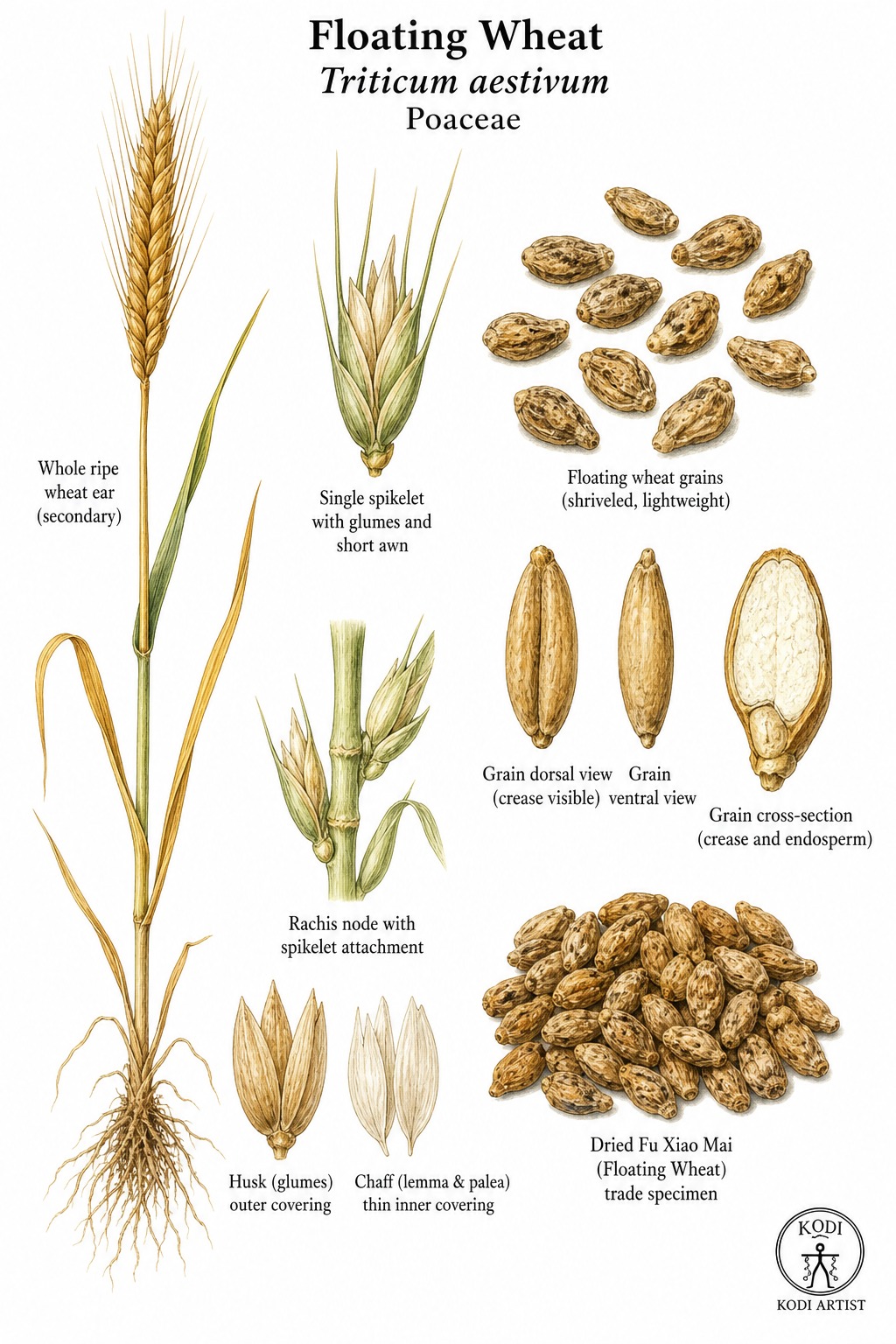
Known in TCM as Fu Xiao Mai (浮小麦), this sweet, cool herb enters the Heart. Traditionally, it stops spontaneous sweating and stabilizes the exterior - Fu Xiao Mai is the classic floating wheat medicinal used when deficiency allows fluids to leak outward as daytime sweating, most often applied for spontaneous sweating, night sweats, and insomnia. Modern research has identified Linoleic among its active constituents.
Part used: Fruit
Also Known As
Latin: Fructus Tritici Levis | Pinyin: Fu Xiao Mai | Chinese: 浮小麦
TCM Properties
- Taste
- sweet
- Temperature
- cool
- Channels
- Heart
Traditional Use
Primary Actions
- Stops spontaneous sweating and stabilizes the exterior - Fu Xiao Mai is the classic floating wheat medicinal used when deficiency allows fluids to leak outward as daytime sweating.
- Checks night sweating and clears deficiency heat - it is also used when chronic depletion or yin deficiency leads to steaming heat, irritability, and sleep-related sweating.
- Nourishes the Heart and calms restlessness - older use includes vexation, poor sleep, and post-febrile irritability when the patient is weak, warm, and unsettled rather than externally invaded.
Secondary Actions
- Fu Xiao Mai is not the same thing as ordinary Xiao Mai or later wheat-seed records. The medicinal identity is the light, shriveled grain that floats when washed.
- Because it is mild and food-adjacent, it is often chosen for children, frail adults, or convalescent patients who need gentle containment rather than harsh astringing.
Classic Formulas
- Mu Li San - the classic deficiency-sweating formula pairing Fu Xiao Mai with Mu Li, Huang Qi, and Ma Huang Gen to secure the exterior and stop spontaneous sweating.
- Fu Xiao Mai with Mu Li and Nuo Dao Gen - traditional pairing logic for mixed spontaneous and night sweating during convalescence or deficiency heat.
- Fu Xiao Mai with Bie Jia or Di Gu Pi - a classical strategy when night sweating and low-grade deficiency heat are more prominent than simple daytime leakage.
Classical References
- Traditional materia medica describe Fu Xiao Mai as sweet and cool, entering the Heart channel to stop sweating, clear deficiency heat, and settle irritability.
- The medicinal distinction from ordinary wheat matters: the page tracks the floating, light grain used in deficiency-sweating formulas, not a general cereal food.
- Older herbology repeatedly places Fu Xiao Mai among gentle stabilizing medicinals rather than among the stronger binders or tonic seeds.
Modern Research
Active Compounds
- Linoleic acid and alpha-linolenic acid - key fatty-acid markers highlighted in recent Fu Xiao Mai-focused profiling work
- Kaempferol and secoisolariciresinol-related differential constituents - part of the modern metabolomic signature separating floating wheat from ordinary wheat
- Ferulic-acid and broader wheat phenolic fractions - supportive antioxidant constituents present across Triticum grain chemistry
Studied Effects
- A 2024 metabolomic and network-pharmacology study compared floating wheat with common wheat and identified differential components and potential hyperhidrosis-related targets, offering a modern rationale for the traditional antiperspirant reputation of Fu Xiao Mai (PMID 38338298).
- A 2025 experimental study identified linoleic acid and alpha-linolenic acid from Fu Xiao Mai and reported cardioprotective effects in a heart-failure model through aquaporin-1 and gut-microbiota pathways, but this remains preclinical and does not justify self-treatment of heart disease (PMID 41154077).
- A 2022 study of Korean wheat cultivars documented meaningful antioxidant and cytoprotective capacities in Triticum aestivum, giving broad biochemical plausibility for grain-based restorative use even though it was not a direct Fu Xiao Mai clinical trial (PMID 35954104).
PubMed References
- Revealing the Antiperspirant Components of Floating Wheat and Their Mechanisms of Action through Metabolomics and Network Pharmacology (2024)
- Linoleic Acid and Linolenic Acid May Alleviate Heart Failure Through Aquaporin (AQP1) and Gut Microbiota (2025)
- Antioxidant and Cytoprotective Capacities of Various Wheat (Triticum aestivum L.) Cultivars in Korea (2022)
Safety & Interactions
Contraindications
- Celiac disease, non-celiac gluten sensitivity requiring strict avoidance, or IgE-mediated wheat allergy
- Exterior disorders that still need venting rather than astringing
- Profuse sweating from replete heat rather than deficiency leakage
Cautions
- Fu Xiao Mai contains wheat constituents and should not be treated as automatically safe for people who must avoid gluten-containing medicinals.
- This is a mild deficiency-sweating herb, not a stand-alone answer for persistent night sweats, fever, weight loss, or cardiovascular symptoms.
- MSK page not found - drug interaction data not available from Memorial Sloan Kettering integrative medicine database
Conditions
- Spontaneous Sweating Traditional ★★★★☆ JSON
- Night Sweats Traditional ★★★★☆ JSON
- Insomnia Traditional ★★☆☆☆ JSON
- Palpitations Traditional ★★☆☆☆ JSON
Frequently Asked Questions
What is Floating Wheat used for?
Floating Wheat is traditionally used to Stops spontaneous sweating and stabilizes the exterior - Fu Xiao Mai is the classic floating wheat medicinal used when deficiency allows fluids to leak outward as daytime sweating., Checks night sweating and clears deficiency heat - it is also used when chronic depletion or yin deficiency leads to steaming heat, irritability, and sleep-related sweating., Nourishes the Heart and calms restlessness - older use includes vexation, poor sleep, and post-febrile irritability when the patient is weak, warm, and unsettled rather than externally invaded.. Research has investigated its effects on: A 2024 metabolomic and network-pharmacology study compared floating wheat with common wheat and identified differential components and potential hyperhidrosis-related targets, offering a modern rationale for the traditional antiperspirant reputation of Fu Xiao Mai (PMID 38338298).; A 2025 experimental study identified linoleic acid and alpha-linolenic acid from Fu Xiao Mai and reported cardioprotective effects in a heart-failure model through aquaporin-1 and gut-microbiota pathways, but this remains preclinical and does not justify self-treatment of heart disease (PMID 41154077)..
What are other names for Floating Wheat?
Floating Wheat is also known as Light Wheat, Blighted Wheat, Floating Wheat Grain, Tritici. In TCM: 浮小麦 (Fu Xiao Mai); Fructus Tritici Levis.
Is Floating Wheat safe during pregnancy?
The safety of Floating Wheat during pregnancy has not been established. Consult a qualified healthcare provider before use.
What are the contraindications for Floating Wheat?
Floating Wheat should not be used in: Celiac disease, non-celiac gluten sensitivity requiring strict avoidance, or IgE-mediated wheat allergy; Exterior disorders that still need venting rather than astringing; Profuse sweating from replete heat rather than deficiency leakage. Consult a qualified practitioner before use.