Hupeh Liriope Root Tuber
- Chinese
- 山麦冬
- Pinyin
- Shan Mai Dong
- Latin
- Liriopes Radix
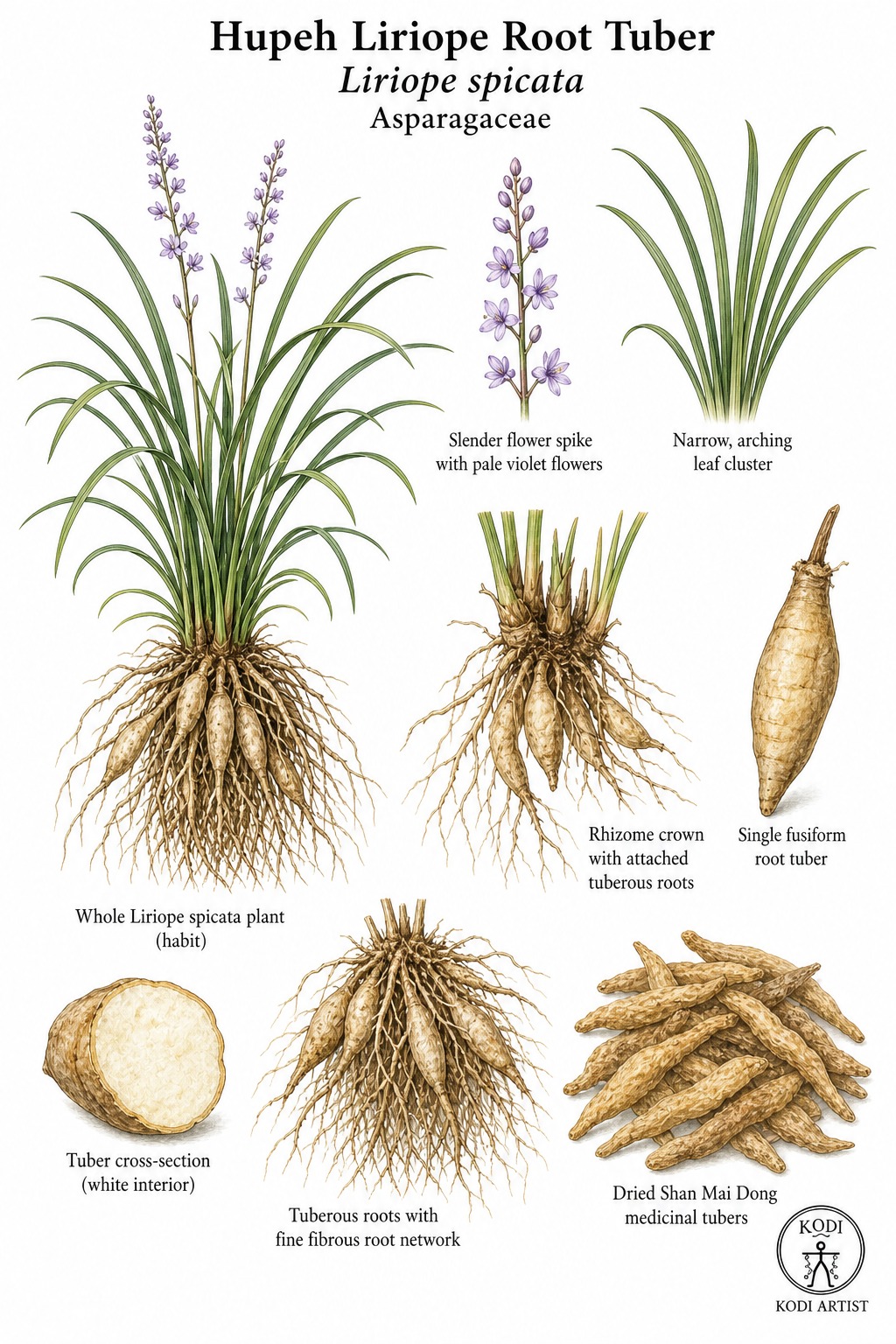
Known in TCM as Shan Mai Dong (山麦冬), this sweet and slightly bitter, slightly cold herb enters the Lung, Stomach, and Heart. Traditionally, it nourishes yin and generates fluids - Shan Mai Dong is used for thirst, dry mouth, and fluid injury after febrile disease or chronic depletion, most often applied for dry cough, yin deficiency, and insomnia. Modern research has identified Steroidal among its active constituents.
Part used: Root
Also Known As
Latin: Liriopes Radix | Pinyin: Shan Mai Dong | Chinese: 山麦冬
TCM Properties
- Taste
- sweet, slightly bitter
- Temperature
- slightly cold
- Channels
- Lung, Stomach, Heart
Traditional Use
Primary Actions
- Nourishes yin and generates fluids - Shan Mai Dong is used for thirst, dry mouth, and fluid injury after febrile disease or chronic depletion.
- Moistens the Lung and stops dry cough - traditional indications include cough from Lung dryness, chronic dry throat, and scant sputum from yin damage.
- Clears Heart irritability - it is also used for vexation, restlessness, and poor sleep when dryness-heat or yin deficiency disturbs the Heart.
Secondary Actions
- This page preserves Shan Mai Dong as the Liriope sourcing layer of the broader `maidong` complex rather than collapsing it into already separate Ophiopogon / Mai Men Dong records.
- In practice it is often treated as a substitute or regional sibling to Ophiopogonis Radix, but the plant source and modern chemistry are not identical.
Classic Formulas
- Shan Mai Dong with Sha Shen and Yu Zhu - a traditional pairing style for Lung-Stomach dryness with thirst and dry cough.
- Shan Mai Dong in Sheng Mai San-style substitution logic - used when practitioners replace Mai Men Dong with a Liriope source while still aiming to restore qi, yin, and fluids.
- Shan Mai Dong with Tian Men Dong - an Er Dong-like approach for pronounced dryness, irritability, and wasting-thirst patterns.
Classical References
- Pharmacopoeial teaching describes Shan Mai Dong as sweet, slightly bitter, and slightly cold, nourishing yin, engendering fluid, moistening the Lung, and clearing the Heart.
- Modern materia medica recognizes Shan Mai Dong as part of the broader maidong medicinal complex, but source-plant precision still matters for editorial accuracy.
- This record therefore keeps the Liriope identity explicit so later Ophiopogon-derived Mai Dong pages still have room to function separately.
Modern Research
Active Compounds
- Steroidal saponins such as spicatoside A and related glycosides - key markers across medicinal Liriope species
- Polysaccharides from the tuberous root - major fractions studied in metabolic and immunologic models
- Lirioproliosides and related steroidal glycosides - characteristic constituents reported from Liriope spicata var. prolifera
Studied Effects
- A 2013 study found that total polysaccharides and purified polysaccharides from the tuberous root of Liriope spicata var. prolifera improved glucose handling, insulin resistance, and hepatic lipid accumulation in diabetic KKAy mice (PMID 23762123).
- A 2009 mouse study reported that water extract and crude polysaccharides from Liriope spicata var. prolifera affected the InsR/IRS-1/PI3K pathway and improved glucose metabolism, supporting modern interest in the herb's fluid-yin and wasting-thirst indications (PMID 19607904).
- Research on Liriope platyphylla water extract has shown immunomodulatory effects in activated macrophages, illustrating why the broader Liriope tuber complex continues to attract anti-inflammatory and respiratory-support research even though species are not fully interchangeable (PMID 23201926).
PubMed References
- Antidiabetic Activity of Polysaccharides from Tuberous Root of Liriope spicata var. prolifera in KKAy Mice (2013)
- Effects of water extract and crude polysaccharides from Liriope spicata var. prolifera on InsR/IRS-1/PI3K pathway and glucose metabolism in mice (2009)
- Immunomodulatory effects of Liriope platyphylla water extract on lipopolysaccharide-activated mouse macrophage (2012)
Safety & Interactions
Contraindications
- Loose stools or middle-burner weakness with dampness that worsens under rich moistening herbs
- Phlegm-damp obstruction without significant yin or fluid depletion
Cautions
- Modern studies often use Liriope spicata var. prolifera or Liriope platyphylla extracts, so research findings should not be treated as perfectly interchangeable with all maidong products.
- Species substitution with Ophiopogon-derived Mai Dong is common in trade and requires source awareness.
- Persistent chronic cough, thirst, or wasting symptoms still require medical assessment rather than herb-only self-treatment.
- MSK page not found - drug interaction data not available from Memorial Sloan Kettering integrative medicine database
Conditions
- Dry Cough Traditional ★★★★☆ JSON
- Yin Deficiency Traditional ★★★★☆ JSON
- Insomnia Traditional ★★☆☆☆ JSON
- Type 2 Diabetes Research ★★☆☆☆ JSON
Frequently Asked Questions
What is Hupeh Liriope Root Tuber used for?
Hupeh Liriope Root Tuber is traditionally used to Nourishes yin and generates fluids - Shan Mai Dong is used for thirst, dry mouth, and fluid injury after febrile disease or chronic depletion., Moistens the Lung and stops dry cough - traditional indications include cough from Lung dryness, chronic dry throat, and scant sputum from yin damage., Clears Heart irritability - it is also used for vexation, restlessness, and poor sleep when dryness-heat or yin deficiency disturbs the Heart.. Research has investigated its effects on: A 2013 study found that total polysaccharides and purified polysaccharides from the tuberous root of Liriope spicata var. prolifera improved glucose handling, insulin resistance, and hepatic lipid accumulation in diabetic KKAy mice (PMID 23762123).; A 2009 mouse study reported that water extract and crude polysaccharides from Liriope spicata var. prolifera affected the InsR/IRS-1/PI3K pathway and improved glucose metabolism, supporting modern interest in the herb's fluid-yin and wasting-thirst indications (PMID 19607904)..
What are other names for Hupeh Liriope Root Tuber?
Hupeh Liriope Root Tuber is also known as Liriope Root Tuber, Shanmaidong, Liriopes, Liriope Tuber. In TCM: 山麦冬 (Shan Mai Dong); Liriopes Radix.
Is Hupeh Liriope Root Tuber safe during pregnancy?
The safety of Hupeh Liriope Root Tuber during pregnancy has not been established. Consult a qualified healthcare provider before use.
What are the contraindications for Hupeh Liriope Root Tuber?
Hupeh Liriope Root Tuber should not be used in: Loose stools or middle-burner weakness with dampness that worsens under rich moistening herbs; Phlegm-damp obstruction without significant yin or fluid depletion. Consult a qualified practitioner before use.