Litchi Seed
- Chinese
- 荔枝核
- Pinyin
- Li Zhi He
- Latin
- Semen Litchi
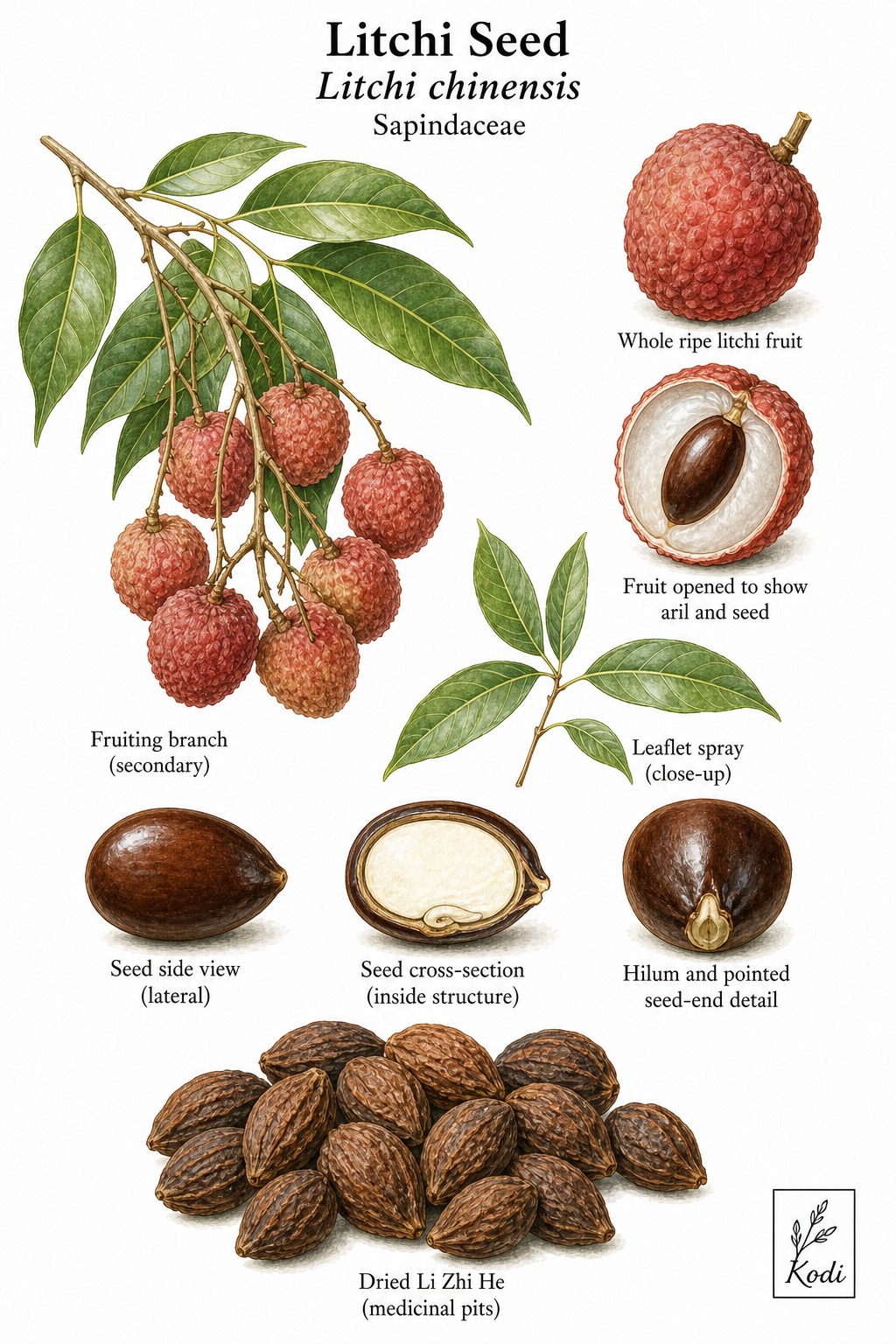
Known in TCM as Li Zhi He (荔枝核), this sweet and slightly bitter, warm herb enters the Liver and Stomach. Traditionally, it regulates qi and stops pain - Li Zhi He is classically used for lower-abdominal, epigastric, and groin pain when qi stagnation and cold congeal in the middle or lower burner, most often applied for abdominal pain, liver qi stagnation, and dysmenorrhea. Modern research has identified Catechin among its active constituents.
Part used: Seed
Also Known As
Latin: Semen Litchi | Pinyin: Li Zhi He | Chinese: 荔枝核
TCM Properties
- Taste
- sweet, slightly bitter
- Temperature
- warm
- Channels
- Liver, Stomach
Traditional Use
Primary Actions
- Regulates qi and stops pain - Li Zhi He is classically used for lower-abdominal, epigastric, and groin pain when qi stagnation and cold congeal in the middle or lower burner.
- Disperses cold and treats hernia-type pain - older indications especially emphasize testicular swelling, inguinal pain, and cold-contraction patterns in the Liver channel.
- Reduces nodules and swelling - historical use includes stubborn cold-stagnation masses or distended painful lumps in the lower abdomen or genital region.
Secondary Actions
- Li Zhi He is a narrow pain-relieving seed rather than a general food-fruit record. The medicinal part is the dried pit, not the sweet fleshy litchi fruit.
- It is often paired with Ju He, Xiao Hui Xiang, or Wu Yao when cold-liver-channel pain radiates to the groin or testes.
Classic Formulas
- Li Zhi He with Ju He and Xiao Hui Xiang - classical pairing logic for hernia-type pain, testicular distention, and cold-contraction in the groin.
- Li Zhi He with Wu Yao or Mu Xiang - traditional strategy for qi-stagnation abdominal pain with a clear cold component.
- Li Zhi He with Shan Zha He - older pairing style for lower-abdominal or testicular pain discussed in traditional hernia-type pattern language.
Classical References
- Traditional herbology describes Li Zhi He as warm, sweet to slightly bitter, and entering the Liver and Stomach channels to regulate qi and stop pain.
- Its classical focus is cold-stagnation pain, especially in the lower abdomen, groin, or testes, rather than broad gastrointestinal tonic use.
- This record therefore stays separate from any future litchi fruit or food-facing page.
Modern Research
Active Compounds
- Catechin and procyanidin A2 - seed polyphenols highlighted in neuroinflammation research
- Protocatechuic aldehyde and protocatechuic acid - phenolic constituents isolated from Litchi chinensis seed
- Flavonoid glycosides and other seed polyphenols - broad antioxidant and signaling-active fractions
- Jasmonates and terpenes - additional anti-neuroinflammatory constituents identified from lychee seed
Studied Effects
- A 2009 phytochemical study isolated protocatechuic aldehyde, protocatechuic acid, daucosterol, and epicatechin from Litchi chinensis seed, helping define the chemical basis of Li Zhi He (PMID 19645237).
- A 2018 study identified catechin and procyanidin A2 from lychee seed as active anti-neuroinflammatory components that suppressed Aβ-induced inflammatory signaling through the NF-kB pathway in BV-2 cells (PMID 30036972).
- A 2017 experimental study found litchi seed extracts suppressed prostate-cancer progression in models through apoptosis induction and attenuation of epithelial-mesenchymal transition, illustrating how far modern pharmacology extends beyond the narrow classical pain-herb profile (PMID 28134352).
PubMed References
- [Isolation and characterization of polyphenols in seed of Litchi chinensis] (2009)
- Polyphenols Derived from Lychee Seed Suppress Aβ (1-42)-Induced Neuroinflammation (2018)
- Litchi seed extracts diminish prostate cancer progression via induction of apoptosis and attenuation of EMT through Akt/GSK-3β signaling (2017)
Safety & Interactions
Contraindications
- Heat patterns or yin-deficiency dryness without cold stagnation
- Patterns without qi stagnation, distending pain, or cold-contraction features
Cautions
- Li Zhi He is used for specific cold-stagnation pain patterns and should not be taken simply because groin, pelvic, or abdominal pain is present.
- Persistent testicular pain, hernia symptoms, or enlarging groin masses require standard medical evaluation.
- The dried seed is medicinal material, not an edible nut substitute.
- MSK page not found - drug interaction data not available from Memorial Sloan Kettering integrative medicine database
Conditions
- Abdominal Pain Traditional ★★★★☆ JSON
- Liver Qi Stagnation Traditional ★★★☆☆ JSON
- Dysmenorrhea Traditional ★★☆☆☆ JSON
- Abdominal Distension Traditional ★★☆☆☆ JSON
Frequently Asked Questions
What is Litchi Seed used for?
Litchi Seed is traditionally used to Regulates qi and stops pain - Li Zhi He is classically used for lower-abdominal, epigastric, and groin pain when qi stagnation and cold congeal in the middle or lower burner., Disperses cold and treats hernia-type pain - older indications especially emphasize testicular swelling, inguinal pain, and cold-contraction patterns in the Liver channel., Reduces nodules and swelling - historical use includes stubborn cold-stagnation masses or distended painful lumps in the lower abdomen or genital region.. Research has investigated its effects on: A 2009 phytochemical study isolated protocatechuic aldehyde, protocatechuic acid, daucosterol, and epicatechin from Litchi chinensis seed, helping define the chemical basis of Li Zhi He (PMID 19645237).; A 2018 study identified catechin and procyanidin A2 from lychee seed as active anti-neuroinflammatory components that suppressed Aβ-induced inflammatory signaling through the NF-kB pathway in BV-2 cells (PMID 30036972)..
What are other names for Litchi Seed?
Litchi Seed is also known as Lychee Seed, Lychee Pit, Litchi, Litchi Kernel. In TCM: 荔枝核 (Li Zhi He); Semen Litchi.
Is Litchi Seed safe during pregnancy?
The safety of Litchi Seed during pregnancy has not been established. Consult a qualified healthcare provider before use.
What are the contraindications for Litchi Seed?
Litchi Seed should not be used in: Heat patterns or yin-deficiency dryness without cold stagnation; Patterns without qi stagnation, distending pain, or cold-contraction features. Consult a qualified practitioner before use.